What smells do you associate with holiness?
If not “holiness,” then let’s call it “sanctity.” “Austerity” could also work, I think. Whatever word you want to use, it’s the idea of being in a very large place where a lot of people do a lot of generally serious things in the name of something arguably intangible, and it has a unique smell. The government buildings I have been in don’t have that kind of smell (“why” is something others can argue), but synagogues, the right kind of churches, and museums definitely do.
Somewhere a while back, I read that the reason people love the smell of “old books” is because lignen- the fibrous matter in plants and trees that paper is made of- has compounds that decompose over time into a yellowish color and is related to vanillin, the compound that (you may have guessed) gives vanilla its smell and flavor. Synagogues and churches inevitably have a LOT of old books in them unless they are brand new. Hymnals, prayer books, and holy texts to service a whole congregation don’t come cheap, and there aren’t “new editions” of ancient vows and praise that require refreshing the stock. The same prayer books (ideally) serve generations. The next time you walk into a place of worship, it might be interesting to wonder who held your hymnal before you. What were they going through? What were they thinking, if anything? What did they pray for if they could? Were they praying for you?

I had dragged myself into the chapel at synagogue just in time to find a seat, and that smell dragged me away from the reek of the kitchen’s bubbling stocks, grease, and onions into the past. My old synagogue had that smell to it as well- it was the idea that it was Quiet Time. Serious Time. Holy Time. I connected that smell with something I was supposed to respect, but truthfully it always meant stuffy, judgy people, kids my own age I hated, and slipping off my uncomfortable chair and hiding in the memorial hall or library.
The shul I go to now doesn’t have a library or memorial hall nearly so accessible, and it still has that smell of old books and austerity. The key difference, though, is that I chose to be there this time. I wasn’t ordered into a suit and packed into a car with my sisters. I was here in my own clothes- still reeking of cooked fat, flour, and hot metal- and it wasn’t even a holiday. It was just Friday night Shabbat services. Now the smell says “You’re a Jew, among other Jews, about to do some Jewish shit. You’re about to get Jewwy Wit It.” It smells like old books and stubborn existence and challah and sugary kosher wine, with middle notes of candle wax and cologne.
There’s a familiar cast of characters at my synagogue, some of whom I’ve gotten to know better than others. There’s the young curvy woman with her husband who I met once at High Holidays but spoke to rarely since. Occasionally, there’s the old matriarch who caught it when I pronounced the final “t” sound of some Hebrew words as an “s” and asked how long I spent with the Chabad movement- an honest-to-God shibboleth I was never really aware of. The old man I chatted with about the Jewish symbolism and themes in comic books hasn’t been through in a few weeks… I don’t remember his name, but I hope he’s okay. I want to loan him a book and talk about it a bit.
Eventually, we greet each other, and the prayers start. It’s a familiar formula and rhythm (how many people before me flipped these pages in the same order? How many really read the Hebrew?), and I fall in quickly. It’s meditative, soothing even- unless they change up the melodies we sing to. It’s a Reform shul, so that’s as likely to happen as not based on who is doing the music and who the cantor is. The senior cantor is very expressive and operatic, while the junior cantor’s style is more influenced by Broadway and Disney.
During the Shema, I swear the scent of that old shul gets stronger. Some practitioners cover their eyes; others don’t. Sometimes the melody changes from the traditional cantation (especially for the kids choir), and sometimes it doesn’t. Regardless, it’s old. A prayer written in the Torah itself, handed down by Moses as part of his last address before he died. A confession of faith, an affirmation of responsibility and the last words a Jew speaks before death.
“Hear, O Israel- The Lord is our God. The Lord is One.”
I continue with the V’Ahavta- the admonition following the confession that we all memorized by rote, syllable by syllable, from childhood, and finally wonder how many people said those words as they died. How many passed out of existence over those words? How many people let those words stand as the sum total of their existence?
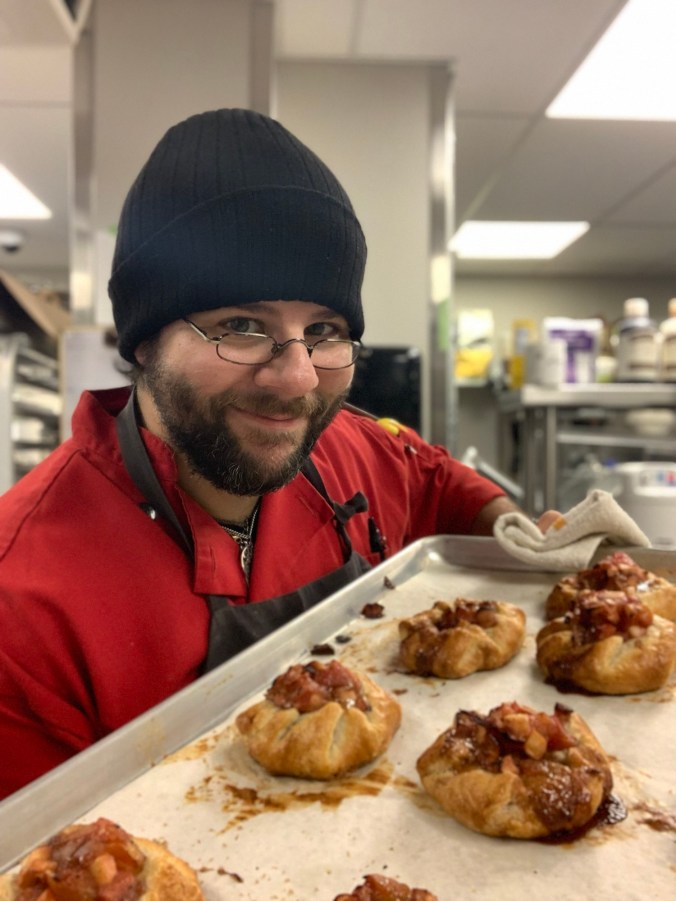
Baking and feeding others is, without a doubt, my calling. I’ve long since decided that no matter where I go and what I do in my future, I want it to have something to do with feeding others. I’ve even described it as a ministry of a sort, my chosen way to care for the world and put some kindness and beauty back into it.
It’s Saturday the morning after- the actual day of rest, when good observant Jews aren’t meant to do a list of things considered “work”- and I’m back in the kitchen breaking all of those rules. I turn on the ovens, I turn the lights on, cut parchment paper, shlep bags of flour around. It’s what I do- what I choose to do. Actions as natural to me as breathing and the recipes as rote as any prayer in the siddur. I don’t even need to look at half of them anymore. I’m here because my assistant needed the day off to handle some family problems, and I will always support my team.
Before long, the rest of the team will be in chopping onions, frying off bacon bits for jam, and straining the bones and roasted vegetables from the giant pot of chicken stock that’s been simmering all night. The smell of roasted poultry and hot chicken fat smashed me as soon as I came in the door- on winter mornings, you can smell it in the parking lot over the icy evergreen air. The bouquet of Sweat, Energy, and Hospitality clings to my clothes after I leave. Taken out of context, it reeks of onions and grease, but I’m already adding some context of my own.
The smell of yeast and warm milk wafts from my station while I put together the morning’s bread- a rich dough not unlike brioche. I need to make caramel sauce today and the Corn Cranberry Florentines we use for deco- that will add the smell of carefully burning sugar and hot butter to the mix. There are some cookies to bake for a lunch event too- that’s a scent that frying onions can’t cover up. The baking sugar and chocolate will pass through the kitchen like a wave and get all the cooks wondering if I baked extras. Of course I did. I always do. I have to look after my people.
Day of rest or not, this is my holy work. It’s a spiritual that I couldn’t see in the context I was introduced to first. I was too young yet, the synagogue too stodgy, judgy, and dead-feeling to ever be somewhere I wanted to live. It took a lifetime of exploration and my own calling to make sense of it again and choose it for myself. This is work I want to give my life to and spend my life teaching and advocating for.
How many generations of humans knew what the smell of baking bread meant? How long has the smell of caramelizing sugars made mouths water and smile? How many iterations of recipes on pages of yellowing pages of books were written so that new generations of people could eat and enjoy?
I am a Jew, and I am a Chef, and I get to be part of those chains into the future for a kinder and tastier world.
Stay Classy,

 The Black Hat Baker