Good morning, friends and neighbors!
Given last weeks tell-all about pie, I thought it would appropriate to give savory pies their chance!

Good morning, friends and neighbors!
Given last weeks tell-all about pie, I thought it would appropriate to give savory pies their chance!
Bakers and chefs chimed in, and I scrolled through their responses before finally saying,
“Yeah, everything here is about right to my experience. Here’s a couple other things I do that you might find helpful..”
My friend from last time popped up. “Oh thank God, I was wondering this too. Have you written about this?”
I went back and found my previous pie-related entries, only to realize I NEVER COVERED FILLINGS.
“Dude, GET ON IT, and then send me the link! Maybe a video how-to?”
Well, I like to correct my mistakes, and I’m here to please, so strap in all. I’m going to take you through baking pies and my personal Top 5 Fruit Pie recipes! Video how-to will come soon!
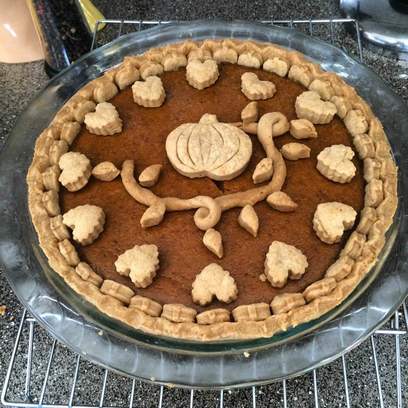 Pumpkin Pie
My Favorite Recipe
(from The Joy of Baking. Good for 2 single-crust pies or one double-crust pie)2 1/2 cups (350 grams) all-purpose flour
1 teaspoon salt
2 tablespoon (30 grams) granulated white sugar (leave out if you want it savory)
1 cup (226 grams) unsalted butter, chilled, and cut into 1 inch (2.5 cm) pieces
1/4 to 1/2 cup (60 – 120 ml) ice water or other chilled liquid (experiment with different liquids to get interesting flavors!)
Herbs or Spices as you see fitIf you are using an electric mixer, freeze the butter. If not, chilled is fine.
Mix all the dry together, and then the butter until the mix resembles coarse meal (if making by hand, use your fingers or a pastry blender to cut in the butter. You DON’T want any large lumps. By keeping the butter chilled/frozen, you break up the butter before it can melt.
Add the liquid all at once. If it’s too dry, add a bit more. Your dough should be cold, but not wet or very sticky. Pulling apart a lump, you should be able to see layers inside. Split into two equal size discs, wrap in plastic and chill.Basic pie dough is 3 parts flour, 2 parts fat, 1 part liquid- hence, 3-2-1 Dough
Keep everything as cold as possible, and use as little flour as possible when rolling. Otherwise the dough will absorb it and dry out.
If your dough is shrinking back after you roll it, it means it’s been overworked. Let it sit for a few minutes before rolling again.
Pie Assembly

 No judgments- You do you!
Again, it’s up to you! For me, I personally like to pre-cook. It means I can spread out the time necessary to make a pie (having dough and filling made a day before means that I can just assemble and bake when I’m ready!)
It also leads to a thicker filling, since you are really just heating the pre-cooked filling and baking the crust.
How Do I Know When It’s Cooked?
Got all that? Good!
Here’s some of my favorite pie fillings!
4 lbs chopped fresh peaches
1 lb. sugar
About 1 oz. cornstarch
Any spices you like (for a smoky hit, add a little ground chipotle pepper!)
A few jalapeno peppers, diced and seeded.
Cook as for the blueberry pie, whisking the dry ingredients into the cooking fruit, and adding the jalapenos at the end. Just like with the herbs, adding the peppers toward the end preserves their heat! If you cook them with the filling, they wind up just tasting like green pepper.Cherry Almond Cardamom
Good evening, friends and neighbors!
After last week… I suppose I should give the opposition equal time.
Realistically speaking, I’ve spent more years of my life (so far) NOT drinking alcohol, so you’d think I’d have more experience and opinions regarding sober solutions as opposed to potent potables.
Yes, “sober solutions” was a stretch. Sorry about that.
Anyway, here’s my list in no particular order, and reasons why.

Good evening, friends and neighbors!
There was a time I really detested the taste of alcohol.
I call these “The Wandering Years.”

Good evening, friends and neighbors!
Back in culinary school, I quickly learned that the single most useful tools a student can have on them at any given time is a pen and a notebook.
Especially in my Soups, Stocks, and Sauces class, a.k.a. Hot Foods 101.
My chef for that class was a fun and pleasant guy, but tended to have something of a short temper and a dry sense of humor. When we got into the kitchen for the practical half of the day’s class, he would have EVERYONE’S production scrawled up on a chalkboard.
He would then rattle through it, top to bottom, along with recipe specifics that group must know. Then he would erase the board- and he wouldn’t answer ANY questions for the rest of the day that amounted to “What else was I supposed to do again?”
I learned VERY quickly how to jot down notes, written in my own flavor of shorthand, and to create mnemonics for myself each day to make sure that- once the board was erased- the only thing I had to say was “Yes, Chef.”
The little flip notebooks I filled didn’t just help me that day- I often used them to scrawl down recipes and procedures my chefs described, or later on to sketch quick plating ideas. Those saved ideas and recipes got compiled in a little bound notebook with a magnet closure- and never got too far from my knife roll or chef uniform.




 The Black Hat Baker