If you’ve been reading this blog for any amount of time, you can guess what my state of mind has been like this last week and why I wound up skipping a blog post.
I’m not going to go over the recent election here except to say that while I’m frustrated and disappointed, I’m not wholly surprised. That can also be said for the anti-Jewish pogroms that seem to be all the rage in Europe again. Clearly going “vintage” doesn’t just mean aesthetics anymore- it also covers racial violence, and several groups appear to be giving 1939.
The Outrage and Angst Machines are running full tilt and their product remains what it always has been- Fear and Exhaustion, getting dumped into our lives faster than ever.
The idea is not to drown us, but to make it so we drown ourselves. To make us isolate ourselves in fear of everyone and everything and burn out all our energy over The Next Big Bummer so we’ll throw up our hands, sit down, shut up, and get on with dying quietly.
“Engage with the world around you at your own risk,” it all yells at us from the TV, from our phones, from stickers and posters and placards and screaming strangers. “Better and safer to Trust Us, give us your money and voices, and let us tell you who to hate today while we swaddle you in little luxuries. You can even choose which ones.”
No one likes wasting their time, or feeling like their time is being wasted. If you can’t explain the impact of a task, why does the task need to be done by anyone?
I’ve been silent on here for the last few weeks. Between a very compressed event schedule at the winery, Yom Kippur, and the anniversary of October 7th, I haven’t had the energy or the will to do much at all. With the arrival of a slow period, though, I finally have time to rest, think clearly, and put something on this blog worth reading.
I also have time to take on some of the more… “long-form” projects that come through the kitchen. One of these was a process I’ve come to call “Quinceageddon.” It began last year when my chef bought about 40 lbs of locally-grown quince, dropped it in our walk-in fridge, and told me to do something with it.
For those who don’t know, a quince is thetsundere version of a pear. Historically called the “fragrant pear,” a quince looks like a giant lumpy pear that has a positively wonderful fragrance- floral, sweet, and sharp all at the same time- but is utterly inedible by itself. The fruit is so rich in pectin and tannin that it’s like biting into a rock-hard raw potato, but painfully bitter in addition to being actually painful.
The single most popular- and arguably the best- thing to do with quince is to make quince paste, or membrillo. The striking red color and tart/sweet flavor makes it a staple pastry filling in Latin America and Spain, as well as a classy addition to cheese boards. Membrillo can be bought from specialty stores, but it tends to be expensive because making it takes hours of work. First comes peeling, coring, and chopping the rock hard fruit. Then braising the fruit with water and citrus to soften it. Then milling, blending, mixing and cooking it slowly for hours until the puree turns crimson red, and finally blending and cooling… but if you (or the pastry chef you hired) have a bit of a blank day to spend, it’s easy enough to make it yourself.
*Frenchy SpongeBob Voice* “8 Hours Later…”
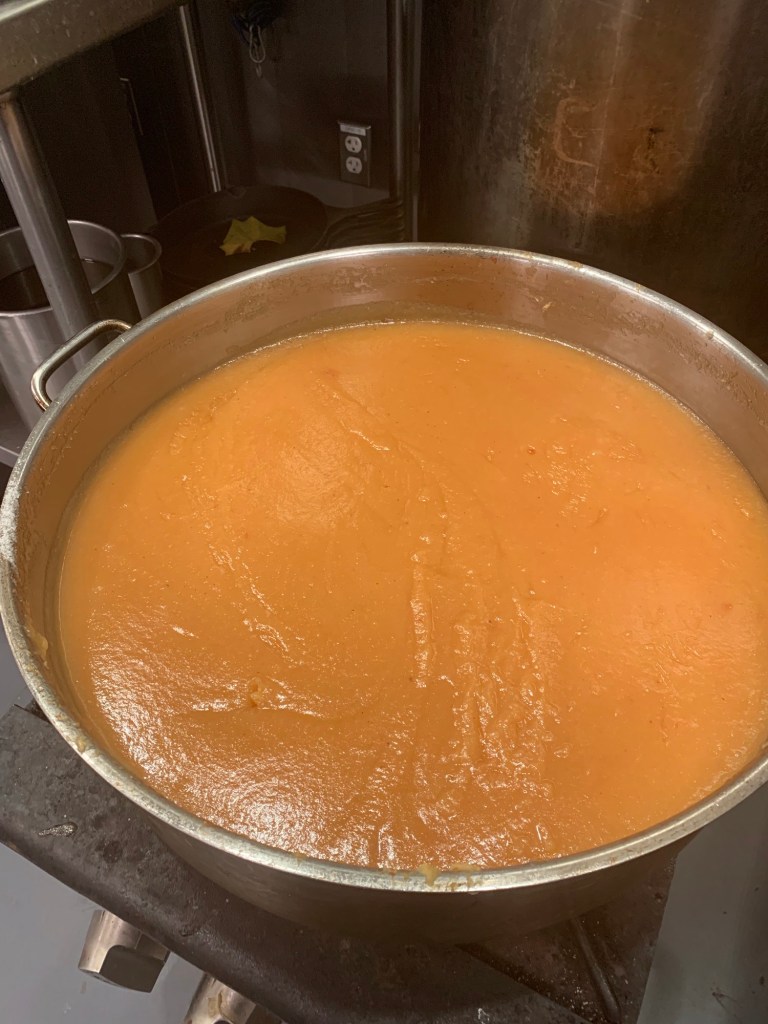
The other project I found myself working on this week was seeing to the end of our tomato supply. All summer, we had an excellent supply of local tomatoes that we worked into sauces, salads, jams, platters, platings, and the like. With autumn in full swing and tomatoes leaving the markets, it was time to similarly see them off our menu.
That meant we had about 20 pounds of beautiful (if somewhat wrinkly) multicolored cherry tomatoes that would soon be attracting more fruit flies than customers if we didn’t deal with them soon, turning them into jam that could be reliably frozen for a future time… which meant they were handed over to me and my team.
Slowly, individually plucking the green stems and leaves off the tomatoes as I dropped them into a bucket on a scale, I realized, would probably make a cook fresh out of school (or a younger me, for that matter) go mad and question their life choices… if I just told them to do it.
While I was plucking through these tomatoes, my assistant Marisah was taking another crack at piping the gouger cheese puffs we use for events. As I plucked stems, I called back advice over my shoulder as she mixed the sticky pate au choux batter until I realized what I was doing and said “Augh, sorry… you’ve literally made this before, I’m preaching to the choir here.” To which Marisah graciously laughed and said “It’s alright, I enjoy the teaching.”
That’s when I looked back down at my tomatoes and realized a mistake that too many chef make and that I do my very best not to make- they don’t give the context for a task.
For too many “old school” chefs and cooks, when you are given an instruction, the correct answer is “Yes, chef” and then you do it. Maybe the almighty Chef will give you a reason or some instruction, but the key in that task is obedience. When the boss says “jump,” you ask “how high” on the way down. That was what made a good cook. “Kids these days with their questions and their ideas and their entitlement…”
Karen fixed that for me relatively quickly in my career over a batch of pastry cream.
“Your custard always gels too hard, Matt. What are you… wait, are you done mixing it already?” “Um, yeah Karen- that’s what I was taught, mix it until the butter melts…” “Matt, if you just put the butter in there, it’ll melt and then you’ll have brick. You move it until the butter melts and it’s cool. If you want a custard pie filling, that’s fine, but if you want it smooth and pipeable, you need to mix it longer.” “Always ask questions, Matt.”
If I told Marisah or anyone else “peel and chop 40 pounds of quince” or “individually pull the green bits off 16 pounds of cherry tomatoes” without any other information, or if I answered questions with “because I said so,”why wouldn’t I expect shitty results? That’s stupid, capricious, annoying, and a massive waste of goddamned time.
If, on the other hand, I was honest and said “Peel, core and chop these quince. We’re making a shit-ton of quince paste for the year, and peels and seeds will make the milling more difficult” and “We’re throwing all these into jam and we don’t want the green bits,” suddenly there’s a reason to do a good job of it beyond “I have authority and you don’t.”
What’s more, being open to questions can help, change, or eliminate the task altogether. I think of it as “keeping me honest’ in the face of culinary orthodoxy, because if someone else says “why can’t we just food mill or process the tomatoes as they are” suddenly I, as a teacher and leader, have to think the task through.
In the case of the tomatoes, I need to be able to say “The food processor will chop up the green bits, and we don’t want them at all. The food mill will strain out the seeds which we do want.” The same logic applies for why we don’t process the parsley.
Occasionally, however, it gives me pause to say “Hey, why DON’T we do the task that way?” If I can’t find a reason, we experiment. If it works, voila- a useless task as been eliminated because I was able to say “Huh… let’s try it!” Instead of getting butt-hurt over my orders being questioned, an apprentice feels validated, labor has been reduced, and efficiency increased.
Put your ego aside, get your head out of your ass, and invest the tiny amount of time it takes to feed your employees curiosity. Create enjoyable teaching moments, and reap the benefits of ideas beyond your own.
“The History of every major Galactic Civilization tends to pass through three distinct and recognizable stages, those of Survival, Inquiry, and Sophistication, otherwise known as the How, Why, and Where stages. For instance, the first stage is characterized by the questions “How can we eat?” the second by the question, “Why do we eat?” and the third by the question “Where shall we have lunch?”
-Douglas Adams, The Restaurant at the End of the Universe (The Hitchhikers Guide to the Galaxy #2)
If you are biological, you need to eat. You need to consume the energy you need to live somehow, no way around it. Plants photosynthesize, animals graze or hunt, and humans go to Wawa. It’s part of the whole “being alive” thing.
For most of our history as a species, what we ate was of greater concern than how we ate it. Douglas Adams hilariously but accurately described it in The Hitchhiker’s Guide quote I gave above. What Adams left to food historians, sociologists, barstool philosophers, and other nerds like myself to debate was how we felt about the act of cooking. Even within the lifetime of the last couple of generations here in the USA, the change in how we as a culture approach cooking and food in general has been massive.
If one is curious enough, one can twist out the wild story from the influences of changing cultural norms, gender roles and expectations, technological developments, and world events like twisting yarn out of cobwebs.
Several books and personalities have investigated this question in depth before- I’ve dipped a couple toes in that ocean myself. I’ll link some of those books throughout this post, but I want to focus on one interesting aspect of it- when and how did cooking for yourself become something to brag about?
“Experience is the hardest teacher there is- it gives the test first and teaches the lesson after.”
I’m still plugging away at my book at mentorship and training. It’s slow going, partially because of lack of metaphorical spoons on a given day and partially because going back over some parts involves frankly unpleasant memories. What I tell myself about why this particular book has taken so damn long compared to my last two is because I’ve been in a position of Actual Documented and Titled Leadership- first as the kitchen manager of the pie shop and now as the pastry lead of a winery.
I’ve told myself that these experiences were effectively ongoing research material and proof of concept for the book and that that’s why I effectively put the book on ice for a bit. “This is good advice? Ok, how’d it work when YOU tried it?”
On an interpersonal level, not badly. Plenty of folks left their jobs, a few stayed, those who stayed were happy. Not everything is for everyone, and that’s just how life goes.
On a professional level, though, and especially as a middle manager, there is a lot that went wrong no matter what I said or did. There is only ever so much one person can control, and the role of a leader, in my mind, is to lead, communicate, serve, and protect their team. Eventually people have to look after themselves- as a leader, I can only ever advocate and look out of them as much as I can.
“The creation of the world did not occur at the beginning of time, it occurs every day.” –Marcel Proust
All you can do some days is keep going.
I come into the kitchen and assess the production list for the day, keenly aware of my struggles to lose weight again.
Next comes reviewing the banquets for the day and make sure I block out time to individually decorate and tray the desserts people paid for, knowing that people I called friends are agitating for my death (intentionally or not) because I’m a Jew.
I build out the list, grab ingredients, and start mixing the day’s breads, fully conscious that my government is a joke and that folks like me are continually convinced to focus their ire on each other than the higher-ups with every reason to keeps us all angry and hateful all the time.
I make my silly little pastries, bake my silly little breads, and carry on like none of it is disappointing and hurtful and frustrating and sad. I do it because I know someone out there IS disappointed, hurt, frustrated, and sad, and what I make can be the One Good Thing that they get to enjoy today.
I can grieve. I can rage and piss and moan and cry… but not when I’m baking. There’s someone else’s day at stake then, and it’s not mine to ruin.






 The Black Hat Baker