Good afternoon, friends and neighbors.
I am annoyingly active on Facebook. “Annoying” certainly for myself, since I’d like to believe I have better things to do than scroll through an increasingly bleak news feed and let fear/ anxiety/ envy consume what remains of my energy. (Fun fact: I do, I just kinda suck at reminding myself to do them.)
One thing that Facebook HAS done for me, however, is connected me with a community of fellow professional cooks and chefs from around the world. I tend to haunt these conversations more than I talk- you wouldn’t believe just how much of being a good storyteller is listening, rather than talking.
The other day, though, I felt the need to pipe up.
One chef in the community was working in the kitchen of a hospital and had recently been put in charge of their pastry department as well as their hot kitchen. He was okay enough with the baking aspects- he knew how to follow a recipe, do the math, and so on. There was only one thing he was concerned about with his new duties- chocolate work.
The hospital had an EXCELLENT food program. They make chocolates and truffles in-house for their OB-Gyn unit- new mothers get a little box of specialty chocolates. The chef had chocolate on hand, tools, materials, equipment… but he knew NOTHING about working with chocolate.
Myself and another chef leapt in with a host of advice- tempering, flavoring, handling, sourcing, the works. The majority of my knowledge came from culinary school, and occasional experimenting in the casino under my friend Karen, but apparently it was more than my friend had ever gotten to hear.
Afterward, I got to thinking “You know, this is probably something a lot of folks would like to know. I should write something about it.”
Here we go, then. Strap in.

What is Chocolate?
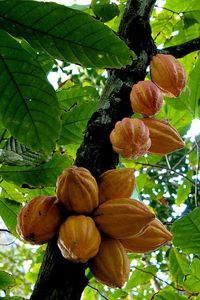 from Wikipedia
That’s a good start. Chocolate begins its life as the seeds of the cacao plant, which are then fermented, washed, dried, and ground, and then combined with any number of additional ingredients to make the chocolate you find at your favorite candy store. Commonly, this is chocolate liquor (not alcoholic- this is the name given to the raw results of processing cacao), cocoa butter, sugar, and occasionally dairy product in order to make milk chocolate.
Often, people will describe a chocolate bar or a kind of chocolate with a percentage- 35%, 65%, 70%, and so on. This percentage indicates how much of that chocolate is the liquor in relation to everything else. While it absolutely has flavor and chemical ramifications for the professional to think about, for the average chocolate lover, you can think of this as “how chocolatey/bitter this will be.” 35% is where milk chocolate usually lands. 55% is semi-sweet, 65%-80% is “dark” or “bittersweet” chocolate, and 100% is baking chocolate- USUALLY inedibly bitter on its own. My former roommate Andrew can attest to this, as the previous gerbil for my culinary experiments.
Sorry, Andrew- I’m sure you’ll be able to taste things again one day.
Chocolate has a long and varied history as well, dating back to it’s first recorded usage as a drink by the pre-Olmec civilizations of Mexico as far as 1900 BC. Of course, its history is tragically colored by the impacts of colonialism, European exploitation, and slavery- even to today.
Buy small and local, folks… it doesn’t just stimulate your local economy, but also MUCH more likely to be ethically sourced.
While there are only three varietals of cacao harvested right now, the permutations of their growth, location, season, and harvesting process invite limitless flavor profiles and terroir not unlike fine wines or other crops.
No, not ALL chocolate tastes alike.
Keeping You In Suspense: Tempering, Blooming, And Using Chocolate
Now you KNOW, however, that it’s a mixture of chocolate solids, cocoa butter, and probably a mess of other ingredients- sugar, dairy, emulsifiers, flavorings, childhood dreams, etc. All the same, it seems like one, unified solid. You’ve probably seen a case where that wasn’t quite true though- and I don’t mean melting.
If you eat chocolate (especially as a little kid,) you’ve probably poked around your house and found old Halloween candy, or a forgotten chocolate bar in the bottom of your bag that you got as a snack. You’ve picked it up, it felt solid, and went “Woo! Bonus chocolate!” You go to unwrap it and… wait, that doesn’t look right.
It’s all weird and mottled-looking. There’s white stuff on on outside, and it feels spongy. You break off a little bit, and it… just kinda bends and pulls? No satisfying snap. It’s dull-looking, not the shiny chocolate you remember.
“Dang it… it’s gone bad” you think, and go to chuck it out.
Well, I’ve got good and bad news for you- the bad news is that, no, you wouldn’t want to eat that chocolate. It probably wouldn’t hurt you or make you sick, but it just won’t be enjoyable.
The good news is that, if you want, you can probably bring it back.
The chocolate you buy, in order to make sure it can sit on a shelf at room temperature for a good long while, goes through a process called “tempering-” where the chocolate is melted down, then cooled and reheated very carefully to make sure it can tolerate reasonable temperatures and stay one uniform mass. When chocolate is warmed up and DOESN’T cool down properly (such as being stuck in a wrapper at the bottom of your bag for 8 months), it loses its temper and “blooms.” The cocoa butter and sugar separate and rise to the surface on their own, creating that mottled look and gross taste
As melted chocolate cools, the cocoa butter in it starts to reform and crystallize. It may sound weird to think of fat “crystallizing”, but if you’ve ever fried bacon, poured off the fat into a container, and noticed that the surface of the fat looks sparkley, it makes more sense.
Cocoa butter crystals can take up to seven different forms, each more temperature-stable than the last, with the 6th and 7th ones being the hardiest and most resistant to temperature abuse. Tempering chocolate is a process where you do two things at once:
- Raise and lower the temperature of the chocolate so that only those toughest, firmest crystals survive.
- Through physical manipulation (i.e. stirring and moving the chocolate), those crystals are constantly broken down to be as small as possible- so small that your tongue can’t detect their texture, and you wind up with smooth, tasty chocolate!
Bakeries and confectioners have large tempering machines- essentially a big spinning bowl with a thermometer and scraper that they can control the temperature of very slowly and keep it moving throughout. These machines can cost hundreds or thousands of dollars- but the process itself can be done very easily on a small scale with equipment you have at home!
You need:
1. Chocolate (duh.)
2. A double boiler– two pots of similar size, one of which rests securely inside the other.
Direct heat from a stove (even on low) is WAY too hot for handling chocolate and will burn it quickly. Using a double boiler, the lower pot is filled with water, which steams up and makes sure the upper pot (holding the chocolate) doesn’t get above 212*F (100*C.) If you don’t have two pots, you can use a heatproof bowl that fits instead. Just be careful grabbing it!
3. A heatproof spatula or wooden spoon (my personal favorite)
4. A good thermometer.
They make special glass “chocolate” thermometers, but you can absolutely use any instant-read probe thermometer- the kind you use to make sure your roast chicken is done.
Some folks, including me, have used infrared laser thermometers. They are cool and all, but they only tell you the SURFACE temperature of the chocolate, rather than of whole thing, so use your own discretion. Those can be bought at home improvement stores (they’re USUALLY used to detect drafts near windows.)
It’s kinda crazy how many great kitchen tools you can get at a hardware store.
Bending the Arc
- Tabling– The melted chocolate is poured onto a heat-absorbing surface (like a slab of marble) and pushed back and forth across the surface. Quality of the temper is determined by the appearance and thickness of the chocolate as it cools. This is very much an “old world” method, and while it’s still used today, you need to have a LOT of experience with chocolate to do it reliably.
- Inoculation/Vaccination/ Seeding Method- This is the method I use and the one I was taught in school. After being melted, chunks of already-tempered chocolate are pitched in as the batch cools. Their presence A. helps the chocolate cool (like dropping ice cubes in a hot drink), and B. inspires Stage 6 crystals to form by introducing some into the batch. This is the best way for a beginner, though it will require a little math and calculation if you are trying to only melt a certain amount of chocolate. It also, of course, requires having already-tempered chocolate on hand.
- Resting– This “method” isn’t really a method, and I don’t think I’ve ever heard of it being used outside of my old textbooks. The melted chocolate is put in a bowl, at room temperature, gets stirred occasionally, and otherwise just sits there. Results are variable to say the least- I’ve never worked anywhere where this method was used- or even taken seriously. If you’ve had success with it, let me know.
For most purposes, however, temperature ranges are pretty consistent across brands for different types of chocolate- dark, milk, and white. This chart from the good folks at ChocolateAlchemy.com is the best I’ve found on the net:

Not all “chocolate” is CHOCOLATE. There are bunch of different types- from real chocolates formulated for specific purposes, to “chocolate-flavoured” candy melts. This is the kind that you find at craft stores more often than not. They’re not actually chocolate- just artificially flavored candy with a high amount of fat to make them easier to handle for the hobbyist or for simple decorative work. They do not need to be tempered, but if you decide to use them, follow THEIR heating instructions. Believe me, you don’t want to waste your time tempering crap, OR have a foul-smelling gritty mess on your hands.
Using whichever method you choose, once you’ve taken your chocolate (slowly) through those temperature ranges, you will notice the characteristics of properly-tempered chocolate!
- It’ll be shiny.
- It will harden up quickly at room temperature. You can drop a little bit on a sheet of paper and, within 5 minutes, see it harden, darken, and shine.
- When cooled, at room temperature, it’ll break with a satisfying “SNAP!”
How To Use Chocolate (and generally not f*** it up)
Now… what do you do with it?
WHATEVER YOU WANT!
What follows is just a couple tips and ideas for what to do with chocolate:
Tips For Chocolate Working!
1. WATER IS THE DEVIL.
Water will cause your melted chocolate to cool way too quickly and “seize.” It’ll become gritty and gross, and there will be NO rescuing it. When tempering or using chocolate, keep water away as much as humanly possible. That includes the humidity of a refrigerator!
2. Oil-based Colors and Flavors
If you want to flavor your chocolate somehow, or color white chocolate, your colors and flavors will need to be oil-based, because WATER IS THE DEVIL. The most readily-available brand of oil colors I know is “Chef Rubber,” and you can use whatever flavored oil you’d like. Just be aware that flavored oils are expensive, and you will NEVER be able to make chocolate taste like anything BUT chocolate, with the addition of whatever flavor you are going for. Colors might need to be mixed with melted cocoa butter first, THEN added to white chocolate in order to make an even tone. You can buy cocoa butter bars separately from most suppliers (they look a lot like white chocolate, but lack sugar or dairy.)
3. Mise En Place!!
Once ready, chocolate needs to be held at it’s appropriate, “working” temperature. Unless you are REALLY sure of your ability to maintain that temperature, chocolate isn’t going to wait for you to get your tools, molds, bags, etc in order. Have all of your tools and materials ready and nearby! Once that chocolate is ready, it is GO TIME, and you don’t wanna be running around with chocolate on your hands trying to find the right tip for your piping bag.
4. Ganaches
Ganache is a beautiful thing. A mixture of hot dairy and chocolate that, depending on the ratios you make it with, can be a filling, a decoration, an icing, or whatever you need! It is pretty forgiving of flavoring (especially with liquor! A whiskey or rum ganache can be amazing), and can be piped, spread, or warmed up and used to enrobe!
Generally, ratios for a soft-solid at room temperature ganache are as follows:
Dark: 1:1 chocolate to dairy by weight.
Milk: 2:1
White: 4:1
You can tweak these ratios for the consistency you need. If you need the final product to be a bit more firm, use a little more chocolate, etc.
As for your dairy, you’ll likely find it easiest to start with heavy cream. Heat up your cream till it scalds, and pour it over the chopped chocolate in a heat-proof bowl. Cover in plastic and let it sit for a bit, then whisk till uniform.
Ganache is NOT shelf-stable, and DOES need to be refrigerated! It’s also VERY sensitive to temperature.
That’s about all I’ve got for you for right now! I’ll probably come back at a later date with some more pictures of this stuff when I have a chance.
In the meantime, there are TONS of blogs and chocolatiers out there who you can get more information from, and chocolate companies almost ALWAYS have information on their products available on their websites and in catalogs!
Best of luck, and
Stay Classy,




 The Black Hat Baker