“L’Dor v’Dor”- Heirlooms of Pride and Pain

Yesterday I was hurting for something to write about this week. It had been an exhausting week and there are always stand-by topics when it comes to food writing- exhaustion, mental health, how to not be a jerk when dining- the usual list. I’d covered most of these pretty well, though, so I wasn’t ready to cover old ground quite that churned up. I was about to head out for a walk when the following quote came across my social media: “You inherited more than generational trauma. Your ancestors also left you their wisdom and their strength.”

Given that I’m feeling very very Jewish at a moment when two entire cultures people have very recently had their generational traumas triggered at the same time by bad actors and pointed at each other (with a whole Western world primed to lay their own politics on the conflict no less,) the word “generational” leaves a strange feeling in the mouth. Whether regarding trauma or strength and wisdom, it comes packed with a lot of emotions that are best understood, managed, and then utilized- or dispensed with.

L’dor v’Dor-” in Hebrew, “From generation to generation.” We keep living, we keep passing on what we are and what we learned, for good or ill.
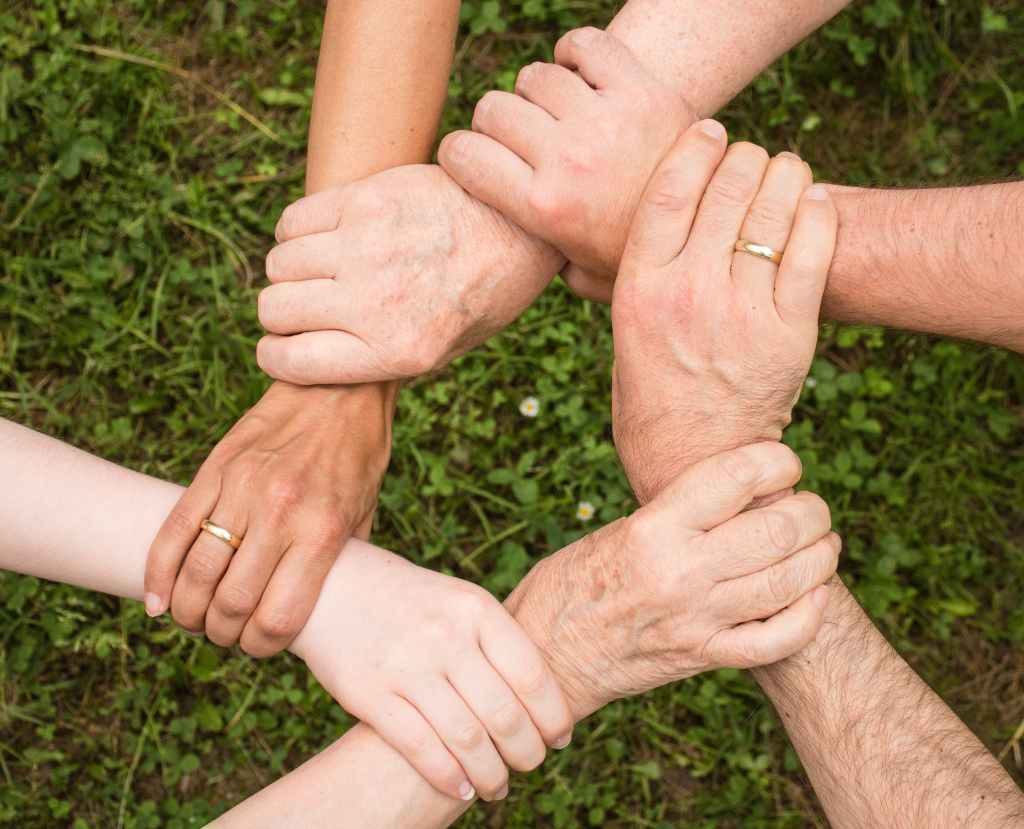
Six hands of multiple genders and generations grasping each others wrists over a grassy background.
Photo by Pixabay

“There are terrible ways to be strong.”

I’ve written something about the specific nature of my Jewish upbringing in a few blog posts. I don’t know that I always went into particulars, but “generational trauma” is something that Jews know a lot about and the lessons from it are some of the hardest, most spiteful lessons that we’ve had handed down. The kind that we describe to our Gentile friends with jokes like “Every Jewish holiday is based somehow on ‘They tried to kill us, we survived, let’s eat!” or “Why are Jews neurotic? It’s because we owe our survival to some of our ancestors waking up one morning and going, “the vibes are off- let’s get on a boat elsewhere right the fuck now.”

That’s dark humor right there. Combine that with some of the wisdom my grand-family handed down to me:

  • Learn everything you can, Matt. Knowledge is something that can’t be taken away from you.”
  • Youll always find bookstores in Jewish communities. Booksellers love Jews because we always have to remember the past.”
  • Learn to be able to do a little of everything- you never know when it’ll come in handy.
  • “You know your grandfather almost couldn’t practice medicine in this town because they wanted the town ‘Jew-Free,’ but they let him in because he was also a Freemason.”

Good advice for anyone, right? Then you read it again and you see the unspoken lesson- “Everything that we have can be taken away from us. We must never forget who we are and be ready to live wherever we go next.”

This all got ramped up to 11 after World War II when maintaining and rebuilding the community and Jewish identity became not just a necessity but (albeit understandably) a spite-driven burden to be explicitly handed down. I had female friends who were directly told that failing to find a Jewish husband and having lots of Jewish children would be “giving the Nazis a posthumous victory.” My previous blog post looked at this from a religious standpoint as spite is nothing to build a spiritual practice on, but from a cultural perspective this specific version of “never forget” became an obsession.

In my Jewish secondary schooling (which we called “Hebrew High,”) every year we’d be taught aspects of the culture and religion that were only touched on in the Jewish version of “Sunday school.” It almost became a joke that, every year, there’d be a class called “___ and the Holocaust.” “Art and the Holocaust.” “Music and the Holocaust.” “Film and the Holocaust.” “Holocaust Literature.”

A highly polished version of Israeli and Zionist history was included, of course. The timeline of those courses largely went “Dreyfus Affair, Herzl had a big brain idea, Britain was cool with it then wasn’t, America was okay about it, all the Arabs and Muslims hate us, but we fought them and won, still there now, so send money so we can plant more trees.” The division of the Middle East by the Entant after World War I was barely mentioned, nor was even the word “nakba.” The fact that Herzl was a bit of a classist with internalized antisemitism of his own, that Zionist philosophy has fractured 15 different ways since then, and that The Balfour Declaration was a (largely unsuccessful) ploy to get American Jews to pressure their government into joing the war were never mentioned at all.

As an aside, I’ve seriously had to unlearn more about Israel and Zionism than “activists” have picked up in hashtags and slogans since 10/7. If you don’t have skin in the game, your job is to listen- not lecture.

What does education like this create? What is being passed down “from generation to generation? The answer is a community held together by the holes poked in it. A religious and cultural community that keeps itself “strong,” but hypervigilant, spiteful, and scared. To quote Rabbi Zalman Schachter-Shalomi, when challenged by another rabbi in their discussions with the Dalai Lama that our insularity has made us strong- “There are terrible ways to be strong.”

“May Their Memory Be A Blessing”

When you are on the run, you learn to survive and pack light. You teach your children how to do the same. You teach them to do what you can with what you have, value knowledge and stories, and never forgetting who you are (because no matter what they say, the rest of the world will always remember.)

Persecution creates paranoia, and it creates ingenuity and resolve. Besides prizing knowledge and history, my parents and grandparents had more to say– about remembering that we had little, so when we have more we should give to those who don’t. Ashkenazic Jewish cooking itself is a story of Jews moving from place to place, making themselves a part of communities and learning how to enjoy the food as best they could.

We also learned that while the rest of the world marks Holocaust Rememberance Day from when the Allies liberated Aushwicz, in Judaism we mark it from the start of the Warsaw Uprising– when the Allies left us to our own devices and we as Jews fought back ourselves.

In Judaism, when we speak of someone who died, we don’t say “may they rest in peace.” We say “may their memory be for a blessing”- meaning that we should remember them when blessing the living. “You should be as strong as your Grandpa Larry.” “You should be the kind of woman your Bubba Mitzi was.” It’s one small way we pass more than pain l’dor v’dor- from generation to generation. We pass on gifts as well.

When and if I have children, though, I hope I live to have the presence of mind to pass the lessons on without the pain and spite, so they can enjoy the blessings more.

Stay Classy,

The BHB's Top Hat Signature Logo

Two Stories About Skill and the Plight of the Self-Taught

One of the best compliments I have ever received in my life is that I am a good teacher. Between that and being told I have a comforting presence and an “old soul,” I hope I’m well on my way to transforming into Uncle Iroh (Combination teahouse/pie shop/stout-heavy Shire-inspired taproom, anyone? Get at me investors.)

In all seriousness, I do take those kinds of compliments seriously and earnestly. Teaching is not easy- I’ve had both great and terrible teachers in my life, and I know how stressful it can be to make sure you are doing the job well (I’m married to one, after all.)

This applies even more to crafts and professions like cooking and baking, where mentorship is the lifeblood of passing on knowledge. Translating the skills, finesse, mentality, and spirituality of a craft is more than can be contained in a mess of cookbooks and videos. At some point, everyone will need someone to stand beside them, hold their hands and say “This is what it needs to feel like. This is how you tell it’s ready. This is what ‘done’ looks like.”

You can get pretty far teaching yourself if you have the will, love, and knack for it- but not nearly as far as you can by learning from those who went before you.

Quote picture of a statue of the Buddha with the Zen Proverb "To follow the path, look to the master. Follow the master. Walk with the master. See through the master. Become the master."

There’s No Getting Out of Experience

Let me tell you a story about two bakery owners who want to have profitable, flourishing businesses but see the same obstacle in the way- the people doing the baking.

Both are recognizing that it’s a job seekers market right now. In the wake of the pandemic, restaurant workers are feeling their power and demanding more from their management than ever in history. Better pay, benefits, better hours, better working conditions- the things whose very absence made the restaurant world even remotely profitable for generations. Cooks, servers, and chefs are sick of loving an industry that historically has survived by wringing the blood from them, and they are in a position to demand change.

Both bakery owners have decided that this is untenable for them. They either cannot or will not pay what the market now demands for experienced labor and do not feel that investing in people is the best way forward. They both come to the same conclusion- “If I can’t afford to get experienced and capable people, I will get inexperienced people and remove the need for experience.

Animated GIF from Saturday Night Live of a man in a suit saying "What could possibly go wrong?"

Rise(?) of the Machines

One bakery owner decides to get rid of the need for skills with automation. They throw a bunch of money into getting machines to do as many production tasks as possible and giant freezers to store everything. That way big batches can be made all at once and kept instead of making fresh pastries each morning. Yes, they know the quality goes down a bit, but the customers won’t.

The machines are expensive though. They also need to be assembled, programmed, and tested. The existing recipes (the ones the bakery had been making by hand for years) don’t come out right from the machines. Test after test, trial after trial, ingredients and time going in the trash until- finally- the machine makes something that will “work.”

The quality is paltry compared to the originals. The curd is gummy and filled with gelatin and the pastry is tasteless- but the customers probably won’t notice, and now they don’t have to pay someone who knows how to make those things well.

Even simple tasks like filling pastries with almond cream! Who knows how much money they were losing when employees might overfill by a couple grams? Now they have an extruder and hopper so that, instead of having someone who can handle a piping bag, all they need is someone who can pull a trigger on a gun to release the exact amount they want. That is, it will– once they get it to work. They’ve had to remodel their restaurant and get rid of half their dining room to make space for all the new tech they’ve bought. It’s not all working yet, but eventually…

Animated Gif from the Tv Show "The Prisoner" with white text reading "I am not a number. I am a person."

RTFM

The other owner has a different idea. They think people are still necessary, but that the work itself isn’t so hard that the right person can’t teach themselves to do it well with the right systems.

The owner had a capable pastry chef in the kitchen, and that chef had a team of people they had personally trained to do their jobs well. Together they understood the flow of the kitchen- the chef taught anyone on the team anything they needed to know and went over it patiently until they got it right. The chef invested in the team- time, effort, faith- and was generally rewarded for it by a team with the knowledge and confidence to operate without them.

One by one, though, the team left. They loved the job, the work, and everything they were learning on the way… but they needed better pay and benefits. It was getting to the point that even the chef’s assistant had to quit because they simply couldn’t afford to keep working at the bakery anymore. Finally, the chef went to the owner and said the same thing.

For the owner, the answer was simple- have the chef make videos and document everything. Write down all of the changes they’d made and the processes they’d created, and make instructional videos so that future staff could watch and learn. The owner believed in systems and data- they didn’t like that the chef was taking time to teach the staff personally and wanted to make videos so that the chef could do other things instead and let new staff learn on their own. “Ideally,” the owner said, “anyone off the street should be able to come in, watch these videos, and be able to do your job capably if not proficiently.”

The chef shrugged and agreed. They liked teaching others and didn’t want to burn bridges with their soon-to-be-former boss. It was fun making the videos too. They thought it was a little galling that the owner seemed to think years of experience in a craft could be handed down in a manual and a couple video clips, but that wasn’t going to be their problem much longer. They’d do their best regardless, but quietly hoped that the owner would find a replacement for them quickly. This is a craft after all, and some things don’t translate well to video.

A quote meme of Red Adiar saying "If you think it's expensive to hire a professional to do the job, wait until you hire an amateur."
To quote a friend of mine, “A professionals job is to make something difficult look easy.”

No One Does It All By Themselves

There is something to be said about being an autodidact (self-taught person.) In a lot of ways, autodidacts are the very best kind of amateur you could hope to find. They (hopefully) have the love, attention, motivation, and self-direction to dive into a craft of their own will and (hopefully again) have the capacity to seek resources when they don’t know something and learn from their mistakes.

At the same time, there is no substitute for actual experience. I have taken several cracks at teaching through this blog, writing down recipes, and making videos, but I know there is no substitute for the training and insight that comes from directed practice and mentorship. I may be thrilled that a new baker loves baking at home, baked with their mom growing up, has a library of cookbooks, and binged every cooking video on YouTube and TikTok- that kind of passion is laudable. If they come in and say that that makes them ready to be a pastry chef though, I would have to disappoint them.

I’m glad all those videos and resources and services exist. I honestly am. It’s getting people excited about cooking at home again. It’s exposing them to new worlds and cuisines they might not have tried otherwise, and even the videos of people reacting to god-awful recipes can be hilarious and act as a horrible warning. Hell, I’ve even picked up a couple new techniques and ideas from those videos.

It’s not experience, though. It’s not training. It’s not mentorship– and it will only take you so far.

Stay Classy,

The BHB's Top Hat Signature Logo

Drinker With A Writing Problem

I’ve been walking a good chunk of the afternoon. I walked down from my home on Mount Tabor a nearly-straight shot on a blessedly warm March afternoon because I was a man on a mission. Only part of it was to get a good walk in on a sunny day and absorb as much vitamin D as possible. Another solid chunk was to go out among the populace on St. Patricks Day and find some friendly souls to get blitzed with.

Truth be told though, I walked over fifty blocks downhill in the sun through suburbs, commercial districts, industrial zones, and homeless camps alike because I wanted to try some friggin whiskey.

I did, it was delicious, and I have some thoughts about alcohol.

A pint of porter on St. Patricks Day at Loyal Legion, Portland OR
Continue reading

Who’s In Your Corner?

Some people pick new projects to work on with care. They weigh their existing time and energy, the effectiveness of their efforts at any given moment, and choose their next task efficiently.

I, on the other hand, seem to pick my projects by going “Fuck it,” buying a new 1-subject notebook and a green pen, and burying myself in the internet.

Just because I start researching projects like that though doesn’t mean I jump in haphazardly. I’ve already learned the consequences of that. I know to try and cover all my bases, get the best insight and information I can, and of course get the guidance of pros.

The best thing about being in the food business is that when you decide you’re gonna try something out, there’s tons of people who’ve done it before you and not all of them sucked at it.

Less “magic sword,” more “how to not crash another business.”

Guides and Teachers, NOT Cheerleaders

No mistake, everyone needs a cheer squad- folks who love you, support you, and will remind you of everything you have going for you that will help you succeed- but it’s even better when you have people that you know support you but will grab you by the collar to smack some sense into you.

The ones that will call you out on cutting corners, letting things slide, and acting outside your values. They’ll point out how you are messing up, not mince words, and help you find new ways forward.

You know, mentors.

As an interesting fact, did you know that the Japanese word for teacher- 先生 (sensei) literally translates as “one who as gone before?” In other words, someone who’s done this before and knows the way.

It’s easy to imagine the best mentors as being like the favorite Wise Old Teachers of our stories and media- Gandalf, Uncle Iroh, Obi Wan Kenobi. Folks like that might exist, but most of us aren’t lucky (or plot-armored) enough for them to find us. We need to seek them out.

That alone is a challenge because there are plenty of people who might have gone before you, but not all of them were successful, or successful the same way you want to be. Part of being a student is being able to learn from everyone, but not FOLLOW everyone.

Everyone Has Something To Teach

My bakery is currently hiring for bakers and servers. After a friend of one of our employees (who left restaurants because of mistreatment, shitty conditions, and general abuse) hemmed and hawed about sending in her application, the employee asked me “Hey, do you mind if I just grab her and bring her over here to meet you? She’s stressing about her resume, her experience… everything!”

I told her she could- that it wasn’t even a real interview, she didn’t have to bring anything, and that she could tour the space, see our work and meet me. Then she could make a better decision.

The friend came by and she seemed nervous at first, but after seeing the chef just standing next to an oven quietly peeling potatoes for Shepards pie and getting a tour of the space, she sent in her application. My assistant later said “Finally! I mean, yeah, we ALL came from shit restaurant jobs- but you’re really cool to work with, I’m okay I think, and her friend is here and having a good time! This is a good place- she doesn’t need to worry so much.”

Regardless of how long I stay with my current kitchen, that fact and statement are what I’m proudest of. More than recipes, more than sales and figures, more than prestige- the fact that I ran a kitchen where my staff felt appreciated, respected, safe, and happy will stay on my resume until the day I die.

I learned to make it that way by paying attention to what I needed in their position, learning from the people who provided it- and learning from the people who didn’t. After all, “if you can’t be a glowing example, be a terrible warning.”

I’ve had bosses and been in business that made me miserable. I wanted to quit the industry all together. At one point, I wanted to end my life. I learned as much from them as I did from the better ones. Instead of “classically” learning to bring up cooks “the way I did,” I learned to do it different.

To teach, not scream.
Support, not belittle.
Offer dignity and grace, not derision.
Express my love of the craft more than my exhaustion.

As a result, my cooks WANT to push themselves. They WANT to learn more, and feel encouraged to do so rather than threatened into perfection. I wouldn’t have realized quite how to communicate and offer that if I hadn’t learned from people who didn’t, or couldn’t.

We can learn from others without choosing to emulate them. For some of our teachers, their best lessons can be “don’t be like me.”

I will forever love and miss Tony, but one of the best lessons he taught me is to not wind up in his shoes.

We can learn from everyone, but remember to be picky about who’s in your corner.

Stay Classy,

The BHB's Top Hat Logo Signature

What Makes Baking So Scary?

There are two common responses I get from career cooks when I start talking about baking. It’s either “Bakers are fucking useless and can’t do shit without a recipe book in front of them” or “Bakers are mad scientists and just the idea of baking terrifies me. It’s so precise that anything could fuck anything up.”

They are both right and both wrong because cooking and baking require different mindsets. Being able to do both is not just a matter of skill, it’s a matter of being able to switch between two different sets of priorities and relationships with time. As for “always needing a recipe book…” I humbly suggest that baking recipes can be done on the fly if you know which rules to follow and which to break. Once you know the right ratios, you can whip up a dough, bread, or filling from memory, but I’ll thank you not to disrespect our sacred grimoires, thank you.

Talk of wizardry and alchemy aside, though, what makes baking so scary?

Actual footage of a baker attempting to multitask.
Continue reading