How’s It Work?- Meringue

     Good evening, friends and neighbors!
I figure it’s been a while since I’ve talked a bit about kitchen science. One of the things that seems to really discourage people from baking at home is the precise nature of it- the chemistry and math involved in particular.
    So every now and again, I’m going to do an entry on the scientific and practical aspects of some part of baking. Perhaps it’ll be a process, perhaps it’ll be a product… whatever you all would like!
    Along the way, I’ll also include some tips and tricks I’ve picked up along the way to help you along with your own baking ideas- because knowledge is fun, but it’s better if you can use it to make something that’ll go in your face.
Picture

Homf homf homf Science is tasty!

Picture

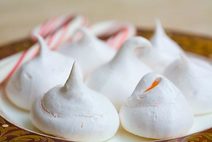
Peppermint Meringue Cookies from SimplyRecipes.com

    Let’s kick things off with one of the lightest, fluffiest, most enticing elements of baking- something that conjures up soft, marshmallowy clouds floating on pies. 

Meringue.

“Oooooh…. what is it?”
    In brief, meringue is egg whites that have had sugar and air whipped into them, turning them into a light fluffy substance with a number of uses. Meringues are used in making mousse, some buttercream frostings, and some cakes. It can also be baked in dollops in a very low oven to make tasty sweets, blended with gelatin or other stabilzers to make marshmallows and divinity candy, or piped out to make macarons or dacquois layers.

“How does it work?”
   
Everyone knows that eggs are a great source of protein. Most of that protein exists in the white of the egg. The yolk has SOME protein, but mostly it contains the fats and cholesterol of the egg. Yolks have their own splendid uses and features, but that’s for another entry.
    When you whip egg whites, the violent tearing caused by the beater (a.k.a. “mechanical shear”) makes the proteins in the egg whites denature, or stretch out and change shape. As they do so, air gets trapped in the bubbles of the stretched whites, creating a foam. Allowed to do so for a length of time, more air will be trapped, and the foam will grow lighter and finer. If you remember blowing bubbles in your milk as a kid, you’ve seen this in action.

     Milk, however, is mostly water and also contains milk fat, so the bubbles would eventually pop. Egg whites, however, have far more protein and very little fat, so the bubbles stay and become foam.

     Sugar is always added in one form or another to meringue. The sugar has two jobs- 1. Bond with water molecules and keep them in the meringue, letting it stay moist enough to keep form, and 2. To sweeten.
Since sugar substitutes don’t behave chemically QUITE like sugar, it’s not wise to use them in trying to make meringue.

    There are a number of ways for adding the sugar to your egg whites and creating a meringue- each method creating noticeably different results, and ideal for different purposes.

French meringue is the most common one in home kitchens. As the whites are whipped, granulated sugar is slowly added into the cold whites and is allowed to dissolve in. This is also the most fragile type of meringue, and if it is not to be included in a recipe before baking, it must be served raw. By folding ultra-fine almond flour and confectioners sugar into the meringue, you get the batter for the recently-insanely-popular French Macarons

Picture

You know, these dainty and delicious little buggers?

Italian meringue has its sugar added in the form of a boiling sugar syrup while the whites are whipping. This is a more difficult process, but not very. The result is a thick, shiny, smooth meringue that is sometimes used for mousse, Italian buttercream, and some cookies. Since boiling hot sugar is being added and the whites are essentially being cooked, Italian meringue can be left uncooked. This is also the favorite meringue for topping pies. This is also the meringue preferred for spreading into sheets and making thin, crispy dacquois layers.
Picture

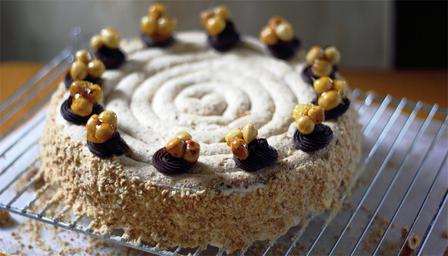
Hazelnut Dacquoise, pic from bbc.co.uk

Lastly, the Swiss meringue. To make a Swiss meringue, the whites are VERY carefully warmed over a double boiler, and the sugar is dissolved into it by whisking, and then is whipped till cool. The result is a very stable, shiny, marshmallow material that is ideal for making Swiss buttercream.

That’s about all for meringue right now- any questions? Comments? Want me to cover something in the next post? Let me know in the comments, or shoot me a message at the BHB Facebook page or Twitter! You ARE following me, aren’t you?

Stay Classy,
P.S.

Hey- what’s the point of learning about meringue if you don’t get to practice?? I’ve got the perfect recipe in mind….

French Macarons
Yield: about 64 half-dollar sized wafers, enough to make 32 sandwiches.

Ingredients
3 egg whites (large eggs)
1/4 c sugar
1 2/3 c confectioners (10x) sugar
1 c almond flour (as finely ground as possible. Seriously, run it through a food processor if you need to.)
Flavoring (preferably water/alcohol based. No flavoring oils!)

Equipment
Stand mixer with whip attachment (or a whisk and a couple strong arms)
Mixing bowl
Rubber scraper
Fine sifter
Cookie sheet
SILPAT baking sheet (you can TRY using parchment, but Silpat works best.)
Piping bag with a #8 round tip

1. Sift the confectioners sugar and almond flour together. If there are any stubborn particles, discard them or rub them through.

2. In the CLEAN mixing bowl (wiped out with a little lemon juice), and using the equally clean whip, whip the white until JUST foamy. Slowly add the 1/4 c sugar, and then whip to soft peaks.

3. Add the almond sugar mix to the meringue, and fold it in, quickly but lightly. Folding is exactly what it sounds like. Using your rubber scraper, bring whats on bottom of the bowl to the top, and keep going. You don’t want to pummel TOO much air out of your merengue- just enough to make it smooth. Here is where you would fold in your flavoring too. You’re going to fold about 30-40 times.

4. Fit your tip into your piping bag, and fill with the batter. You’ll know your batter is the right texture if you pipe a little bit out and it makes a peak that soon spreads and flattens. Lay out your Silpat on your cookie sheet, and pipe out half-dollar sized dollops.  Let these sit at room temperature for an hour. Meanwhile, preheat your oven to 285 F (140 C). 


5. Once the macarons have sat, bake them for 10 minutes or so, till they have raised slightly and lost their shine, but are NOT browned. Remove from the oven, and wait for them to cool COMPLETELY before peeling off the Silpat. Sandwich them with a bit of your favorite buttercream and enjoy! Keep them in an airtight container at room temperature for 3 days or so.


Enjoy!


-BHB

Discipline- In The Pursuit of Perfection

     Good evening, friends and neighbors!

The other day, my girlfriend and I were talking about our work over dinner. She’s a piano teacher, specializing in teaching very young children, ages 3 to 9. At this age, the children don’t learn to read music so much as listen and learn by ear, memorizing pieces and which keys make what notes to play them.
As we were talking, she mentioned that one of the hardest things to teach students of any age isn’t so much the material, as the characteristics of a pianist- attention to detail, feeling the music, investment and passion in playing, and most of all the diligence and discipline for practicing.


    I couldn’t help but smirk and agree. “Discipline” sounds like a dirty word these days, recalling images of ranting, groundings, spankings, and generally other forms of punishment that parents are warned they shouldn’t use on their kids because it will turn them into cold-hearted, dead-eyed shamblers of the twilight world that is their fate.
Picture

“Calm down, Damien…”

But I’m not talking about that- at least, not directly.


Continue reading

Paying Your Dues

     Good evening, friends and neighbors!


In recent years, there has been much debate about the idea of internships, particularly the unpaid variety. The concept has always been that a young person (usually a student) would work for free in order to build knowledge and experience. Various other intangible benefits tend to be mentioned as well- “looks good on a resume,” “foot in the door for a paying job,” “building connections/ networking opportunities,” and so on.

In cooking, an unpaid internship is sometimes called “doing a stage” (pronouced ‘staj.’) For a young culinarian, staging can be rewarding, or even life-changing, offering opportunities to learn from experienced chefs, travel, and get a feeling for the kitchen life from another point of view.

     Although staging still happens in parts of America and Europe, today’s economic realties sadly make it impractical for most students, or even chefs who would host them. In some cases, a staging student might be paid in room and board, or even stay for a while under the chef’s roof. Unfortunately, everyone has bills to pay, the need to support themselves, and places that will offer room and board for labor are very much the exception, not the rule.


No matter what you do, you’ve gotta feed the monkey.

Picture

“Did that ever occur to you, dude?…Sir?…”

Continue reading

Nothing Lucky About It

Good evening, friends and neighbors.

This last week has been exciting and stressful for me on a number of different levels- personal and professional, across both my day job and the BHB. It gets so easy sometimes to get “lost in the noise-” become so overwhelmed that you feel like your are doing everything, when you are really doing nothing. Nothing, at least, toward what you really want to do.

Especially during times like this, it’s tempting to want to compare yourself to others. It’s easier to give in to envy and anger and self-doubt than to confront your challenges sometimes.

Picture

Or smash your head into a hard surface. That too.

Recently, I’ve been able to pull out of a bit of a slump.

First though, we’re going to talk about my friend Carrie.

Carrie is a friend of mine and another baker who graduated culinary school about the same time I did. She is an extremely gifted baker and cake decorator. One of the teachers at the school put in a recommendation for her to work at a well-known local cake studio. She did extremely well, and through another teacher, she is now spending her second spring and summer working in a restaurant in the French Alps, and is currently vacationing in Spain.

Carrie is a good friend of mine. She leaves my decorating skills in the dust.

She works in a fascinating place that I have never been to, surrounded by natural splendor, loves the people she works with, and the work she does.
I envy the HELL out of her.

For someone like Carrie, it’s easy to look at her accomplishments, grumble, kick the dirt and mutter that she got a bunch of lucky breaks. She knew her teachers, her teachers knew the right people, they got her an in, etcetera.

This kind of thinking does Carrie, and talented people like her, a MASSIVE disservice. What’s more, it demonstrates an incredible consequence of comparing yourself to others- defeatism.

The old saying goes that “Luck is when preparation meets opportunity.” It’s not so much how the coin lands for you, it’s being ready to do what’s needed to make EITHER way the coin lands work out best for you- and that takes skill, planning, dedication, and hard work. 

Yes, Carrie DID get in her current position through a string of connections. Untold, however, is that Carrie:

– worked several years in a restaurant.
– worked very hard at culinary school, demonstrating impressive skill and knowledge that earned the admiration of her teachers and fellow students.
– showed enough character and determination that her teachers felt that a recommendation for her would not reflect badly on them.
– worked/works long and hard at these jobs to demonstrate that their faith is not unfounded, and making her an asset to her employers.
– made numerous sacrifices and hard decisions in all aspects of her life.


To write all of that off and just say she was “lucky” is insulting and, frankly, bullshit. Carrie was prepared, so when the opportunities came, she could reach out and seize them. She earned what she got.

In comparing ourselves against others, we rarely take into account everything a person has done that we HAVEN’T seen, or isn’t obvious. You can’t know the stories and motives behind every persons life.

Which is why it’s vital, if you are going to succeed in anything, DON’T COMPARE YOURSELF.
You have to follow your own plan and your own motives.
You have to make your own luck.

As I said before, I’ve been having a tough week. Thoughts and worries about how to move my career forward, how to build and improve on the BHB, what my next steps should be, and so on whizzed around my head like angry hornets.
Plenty of friends, family, and other well-meaning folks offered advice, suggestions, resources, connections, and more, but all of it seemed to be help for Step 3, 4, 5,7, and 12 when I wasn’t even sure what Step 1 should be.

I was lost in the noise and burying myself in daily minutiae, stagnating.

I compared myself to other apparently successful people, grumbling and envious.

Then, one night, after a talk with my girlfriend, I realized what my problem was-

Mise en place.

I may or may not have covered this before, but “mise en place” is French for “everything in place.” In the kitchen, it is having all of your ingredients right in front of you, in the forms you need them, in the ORDER you need them, before you even think of mixing anything together.
Mise en place is the motto, the creed, and religion of the kitchen.

The mise en place for my life was utter crap.
I didn’t know what Step 1 should be because I HAD no steps. Everything seemed so monumental and difficult, because I was looking at it as ONE BIG HONKING THING.

I looked up, saw the whizzing thoughts and worries around my head, and made them line them. I put them in priority order, and just looked at one thing at a time.

You know- some of the decisions I’ll be making still look really damn worrying and scary, but they are a scary I can manage now.

Once you organize yourself and break things down, things rarely look quite so confused and nerve-wracking as they do at first.

As another old saying goes, “When the ‘why’ is clear, the ‘how’ is easy.”

Stay clear, and 

Stay Classy,

Let All Who Are Hungry…

Good evening, friends and neighbors! I apologize for the week of silence- the reason why will become clear momentarily.
First, a couple of my favorite food quotes:

“What does cookery mean? It means the knowledge of Medea and of Circe, and of Calypso, and Sheba. It means knowledge of all herbs, and fruits, and balms and spices… It means the economy of your great-grandmother and the science of modern chemistry, and French art, and Arabian hospitality. It means, in fine, that you are to see imperatively that everyone has something nice to eat.” – John Ruskin

“The fact is, I love to feed other people. I love their pleasure, their comfort, their delight in being cared for. Cooking gives me the means to make other people feel better, which in a very simple equation makes me feel better. I believe that food can be a profound means of communication, allowing me to express myself in a way that seems much deeper and more sincere than words. My Gruyere cheese puffs straight from the oven say ‘I’m glad you’re here. Sit down, relax. I’ll look after everything.’ 
– Ann Patchett, “Dinner For One, Please, James”

In a previous entry, I discussed (likely at annoying length) my feelings about what hospitality means- the welcoming of guests in one’s house, and kindness to the stranger at your door. In a way, I feel that charity is another form of hospitality- perhaps a different definition of the same word: giving of oneself to make others comfortable.

A while back, a friend of my family asked if I would donate some baked goods to a meeting of the Red Door Society, the donors group for Gilda’s Club. For those who don’t know, Gilda’s Club is a support group for people with cancer and their families. This includes meetings and workshops for those with cancer, cancer survivors, caretakers, and even an arts-and-crafts activity group for children. The organization was started by famous Saturday Night Live comedienne Gilda Radner and her husband, Gene Wilder. Gilda was diagnosed with (and eventually succumbed to) cancer, and the couple established the organization on the belief that no one should have to face cancer alone.

Obviously, I said yes. You may have seen the pictures of my creations for that event on the BHB Facebook page (because you’ve liked the BHB on Facebook, right?)
If not, here they are- Red Velvet Doors, and Mocha Brownie Bites!

     After I finished setting up, my friend invited me to hang around and meet some of the donors. All in all, it was a fine little party, and I’m glad they enjoyed the pastries.

     That’s not what this blog is about though.

     Towards the end of the night, a few members of the group were invited up to share their stories. A woman told about how scary it was for her and her young family when she was diagnosed with breast cancer. Gilda’s Club doesn’t ask a penny of any of it’s members, and the woman talked about how she no longer felt alone in the fight, her husband learned what to expect in caring for her, and her children could talk about everything and have fun at “Noogieland” (the children’s programming.) Every evening, all the programs would break for about 15 minutes, and everyone would convene in the kitchen area to snack, talk, and chat for a bit.

     Even in the terrifying face of cancer, the Irish proverb is true: “Laughter is brightest where the food is.”

     That night, I met the CEO of the local chapter and asked about donations. They are a non-profit organization, and start off each year with a budget of $0. Everything-  EVERYTHING- they provide to their members FREE OF CHARGE, is donated or paid for with donated capital.

     “…It means, in fine, that you are to see imperatively that everyone has something nice to eat.”

     “‘I’m glad you’re here. Sit down, relax. I’ll take care of everything.'”

     Not being an especially wealthy man, I asked if they accepted donations of baked goods. The answer was an emphatic “YES.” Those 15 minute breaks the young woman had mentioned always involve food- usually donated, occasionally cooked in-house.

     I asked her if she’d be terribly opposed to a few dozen cookies or a cake appearing on the table every week or so, courtesy of the Black Hat Bakery.

     I guess I’ll be a little more busy now.


     I get to bake and try out new recipes.
     The food gets eaten and enjoyed, by people who wouldn’t mind having something else to smile about.


     That’s about as big a win-win as I can think of.


     Whatever you can do for something you care about, do it.
     Give money.
    Offer your time.
     Bake cakes and cookies and give them away.

      Hospitality doesn’t just happen at home.


Stay Classy,