Carpe Prodigialis

The Horse Brass Pub is busy tonight. The cold and wind outside feels miles away when you are sitting at a small table over a hot meal and a pint of cold, dark, heavy beer. That is very much what I’m in the mood for.

My usual “writing table” is occupied, so I’ve found a similar two-top just to the right of the door and around the corner to better avoid drafts. Looking out the window at the darkening sky and swaying leaves, I know I’ve only go so long before I need to head home and eat dinner. I sit myself down, leaning my walking stick against the wall and out of the way, tuck my cloak under myself, and start to write.

Continue reading

“Whose Idea Was This?”- Looking At Vintage Recipes and Food History

Like most of the internet, I’ve gotten a real kick out of the Tik Tok videos of Dylan Hollis. The vintage style aficionado and self-described amateur food historian has carved a space for himself on the internet with his bombastic personality and humor while testing out recipes spanning the 1800s to early 2000s.

The recipes he tries vary wildly in quality, and the recurrence of typically timely ingredients (especially lard and gelatin) regularly turn into comedic gold. More than once, Dylan strikes oil in his search for tasty recipes (“magic” peanut butter cookies and an eggnog recipe from the 1800s spring quickly to mind) and I sometimes use his videos as inspiration for things I can make at the pie shop.

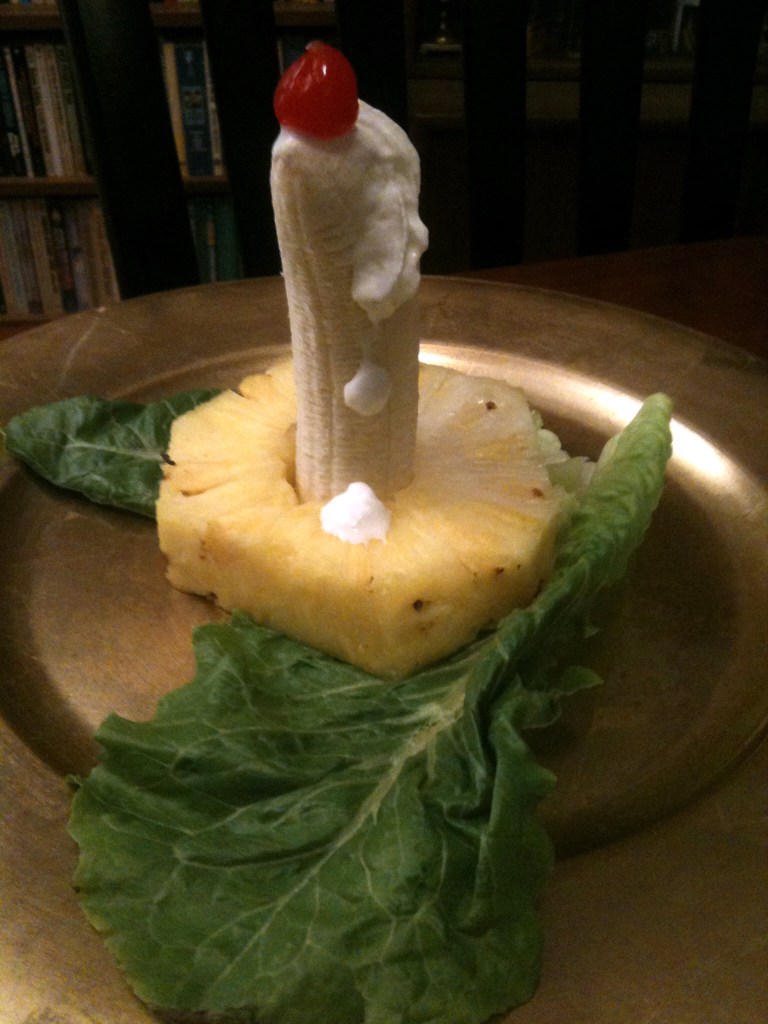
Most often, I find myself intrigued by the recipes he picks and the trends they exhibit. WHY so much lard in everything made before the 60s? Why so much gelatin in mid-century America? Just HOW freaking high, lonely, horny, or all three must someone have been to create the “Candlelight Salad?”

The answer is, simply, that these recipes- like the books, movies, and music that were enjoyed then- are products of their time. Foodways are a part of culture and one can track the history and trends of a period of time as easily in a cookbook as you could a textbook.

Someone back in the 1920s decided that this was a salad. James Beard described it as “culinary eroticism.”
Picture from Wikipedia.
Continue reading

Where Does the Wanderlust Come From?

Portland is enjoying a smoky Indian Summer, and it’s a situation in which I truly wouldn’t mind being caught in the rain on my way home.

I’ve ducked out of the heat in the Side Street Bar- not-quite-dive off of Belmont. I’d intended to drop copies of my books off with a local secondhand bookstore. Apparently my knack for salesmanship doesn’t extended farther than pastry, so I figured by handing a few autographed copies over bookstores I could at least get a little marketing done for the cost of the books. This is Portland, after all- we love “local” everything, including authors.

Hiding from the sun isn’t my thing, even on a sweaty Sunday. As busy as the bake shop has been, I find myself “working for the weekend” and trying to get as much low-pressure living into 48 hours as possible. Sometimes that means going afield and exploring a new part of the city- sometimes it means going down the street to a pub where no one knows me, having a couple beers, and putting down a couple words.

Sometimes peace of mind looks like mountain-top retreats and hammocks on beaches, and sometimes it a couple cold pints in a bar playing classic blues on a hot day. It’s a matter of personality and perspective really.

I used to say that I got truly restless when I lost weight and suddenly had a lot more energy. I couldn’t just crash out on the couch all day- I HAD to go out. I had to see, to do, to walk, move and find. I also used to blame it on being a fan of Anthony Bourdain, but the time line doesn’t quite jive. Tony made me want to try, talk, travel, and tell stories- but I can’t blame him for my inability to just sit at home on a dull day anymore.

Where does the urge to go out and wander around come from? From the need to feel free, and the knowledge you can.

“Master, I go hunting.” – Ursula K. LeGuin, A Wizard of Earthsea
Continue reading

“The World Has Enough of Us”- Why Not Everything You Love Needs To Be Monetized

I started making mead 9 years ago with a single jug, a beer fridge, and a jar of honey. It looked like a simple, fun, low-effort way to do science and get “free” booze out of it. It was a single gallon batch that I got ratio for from The Art of Fermentation. After about two weeks, I took a sip of my first mead- wildflower honey infused with some cinnamon sticks and a single split vanilla bean. It was cloyingly sweet but obviously had fermented slightly, so it was a win in my book.

The success of making a fizzy, slightly-alcoholic-but-drinkable beverage led to a years-long hobby. I’ve shared with friends, experimented, collected more books and (slightly) better equipment, and even won an award at the Oregon State Fair.

(To be clear, that award was a silver medal in a single subcategory. I came in second out of two entries in the “experimental” mead subgroup.)

A few weeks ago, I bottled my latest mead.

It was a version of one of my first metheglins (a.k.a. Mead with spices), but this time I wanted to Do It Properly. It wasn’t a “shake and pray” wild ferment. I’d made a 4 gallon batch using locally sourced honeys. I wrote down my sources, my water temperatures, the sources and amounts of the spices I used, and I used campden tablets and real cultured mead yeast to Make It Right. I didn’t know what “gravity” was for that first jug way back when. For this one, I factored time and temperature into recording the changes in gravity over five months.

The result was a spicy, warming mead that drank like a dry white wine. By any measure, it is my best mead yet- and I will never sell it to anyone. That’s because unlike baking and now writing, home brewing is something I want to keep mine.

“The Besamim Box”- A 12.7% ABV spice mead that drinks like a dry white wine. Made by me over five months, and absolutely NOT for sale.

The drive to Capitalize and Monetize everything we enjoy or may do well is thee double-edged sword of Damocles hanging over everyone’s head today. As soon as we realize we enjoy or have a knack for something, one of the first questions we are asked (or ask ourselves) is “how can I make money off of this?”

Why? Why is simply enjoying ourselves from the start not reason enough?

I remember the first time I realized I enjoyed making origami paper figures and that they made others happy. Within a day, I had set up a little table and chair on my nearly-empty sidewalk with a stack of square paper, trying to sell origami figures.

It wasn’t enough to just make me happy. Something told me I had to make it worthwhile- and that meant it had to make money. I dare anyone to tell me that my goofy 10 year old ass could have made a career out of selling origami figures on the sidewalk in Margate. At least the hobos selling wire-wrapped stones and pendants in Portland buy their own materials.

Baking and writing also make me happy, but I long ago decided I was willing to try making careers out of them. It’s either the best or worst thing you can do with a hobby you love. Often it’s both. I still love baking and creating in the kitchen, but when shit hits the fan and I need to stare down the barrel of a 60 hour week because all these pies need to be made, baking stops being a fun activity really damned quick.

It’s the same thing with writing. As much as I love writing, telling stories, and introducing people to worlds and ideas they may never have considered otherwise, when I’m not feeling it it is 1000% work.

For sources, look at roughly a third of this blog.

Meadmaking, though, is one hobby I insist on keeping a hobby. I may barter a bottle or two, but I will never sell it. I will never start a meadery (except as a joke. I’m on Untappd as “Le Chapeau Noir Meadery”) or go into the brewing business. No matter how good I might be or awards I might get.

Why? Because it’s mine.

We all need things at only have meaning to us that no one else cares about. The little things, activities, and moments that make us happy. We are absolutely inextricably connected and intertwined with each other, but we also need opportunities to explore and be ourselves. To understand ourselves a s a community of one.

For me, that means connecting with local beekeepers and honey vendors, finding new varieties, and bringing them mead made from their honey. It means giving bottles to friends as a gift, or just chilling down a bottle for my wife and I to enjoy on a summer night.

Mead is a thing I make that’s just for me to enjoy with those I love. No one and nothing else need interfere. There is no sin or failing in this- no “loss of potential” or waste simply because I’m not attaching a price tag to the result. The world has enough of us for so much of our waking lives- we can have some of ourselves TO ourselves.

What’s something you do that you refuse to monetize or share beyond yourself and choice others? Tell us about it in the comments!

Stay Classy,

The BHB's Top Hat Logo Signature

“I Do Not Dream of Labor”- The Difference Between Labor and Industry, and What It (Should) Mean to Work

I spend way too much time on social media. If it wasn’t the best engine for reaching out to my readers and sharing what I do with a global audience, I would have wiped my accounts ages ago for the sheer amount of half-assed “hot takes” people are encouraged to belch out about everything from Sudanese economics to Dr. Seuss. It really is the dark side of the democratization of knowledge that anyone with a keyboard thinks “I have an opinion and a way to express it, therefore it is just as valid and important as any expert.”

Yes, so says the pastry chef and food writer with a blog who is about to expound on the psychology and philosophy of labor, but stick with me for a minute.

As a guy who works for a living, is trying to create a work environment that his employees can thrive in, and is having difficulty finding qualified help, I think I have some insight into the whole “no one wants to work anymore,” “quiet-quitting/working to contract” kerfuffle fiasco mass whining discussionthat has been making the rounds lately.

This quote is actually tacked up over my desk at the bakery- just in case I ever forget why I do what I do.
Continue reading