It’s good to be writing for you all again. I only wrote a little bit on my vacation, but it feels better to actually have a deadline again- even a self-applied weekly one.
It’s the people that can make or break a job for someone.
We’re social creatures, and if we must spend a third of our days and half our waking hours in the same place, doing the same (or similar) activities with the same people- especially if that place is cramped, hot, and busy- we prefereither to be around people we like, or left alone.
Working with and around people you like and respect can help you hang on, even in a miserable job- and a great job won’t be enough to keep you around if there’s people making it a living hell.
If you’re lucky enough to have a team of people you like and admire personally as well as professionally, there’s no reason you shouldn’t want to go out and have fun with them! If you do though, it’s best to remember to leave work at work.
In retrospect, my therapist wasn’t telling me anything I didn’t already know. That’s really the role of a therapist or psychologist- unpacking and untangling what’s in you, and organizing it so you can figure your own mind out.
About two years ago, I had a mental breakdown after leaving a job I had loved, but no longer felt happy working. At the time, I thought it was just me reacting to doing something out of character– leaving a job without having another right away was, to my mind, colossally irresponsible.
As I spoke, though, my therapist cast it in a new light:
“Yeah, that WOULD be really irresponsible, but you did that before- when you moved out to Oregon. You got a new job way sooner this time too… why the drastic reaction?”
”I think it’s because you enjoyed this job so much. You loved the kitchen and felt at home. The kitchen has always been your safe space, and losing it regressed you- to the scared, overweight kid bullied on the schoolyard. All your work and self-improvement felt like nothing.”
It’s been a while, but I feel like I’m finally reclaiming the kitchen in my life. Here’s how.
Missing What Was Lost
As far back as I can remember, the kitchen was where I was always happiest.
As a kid, my parents cooked, and family dinners were mandatory. Holidays meant gathering around my grandmother’s big knobbly-legged dinner table, and a regular visit involved sitting in the kitchen over matzah ball soup.
Living on my own, visiting friends meant puttering around the kitchen fixing drinks and food. I always loved the idea of the kitchen being visible to the dining/sitting area simply because- while I wouldn’t always want help- company and conversation while I worked was always welcome. That’s the way my apartment is set up now.
When visiting friends, I always gravitate toward the kitchen. It’s where the beer is coldest, where I can feel useful, and where the best conversation is- normally because it involves food.
And as a professional baker, my kitchen- draining, exhausting, and work though it is- is where I feel in control. Everything makes sense. I know where I need to be and what I need to do, and I have an answer to everything. Whatever’s going on beyond the door can get bent- there has always been a feeling of “this is my domain.”
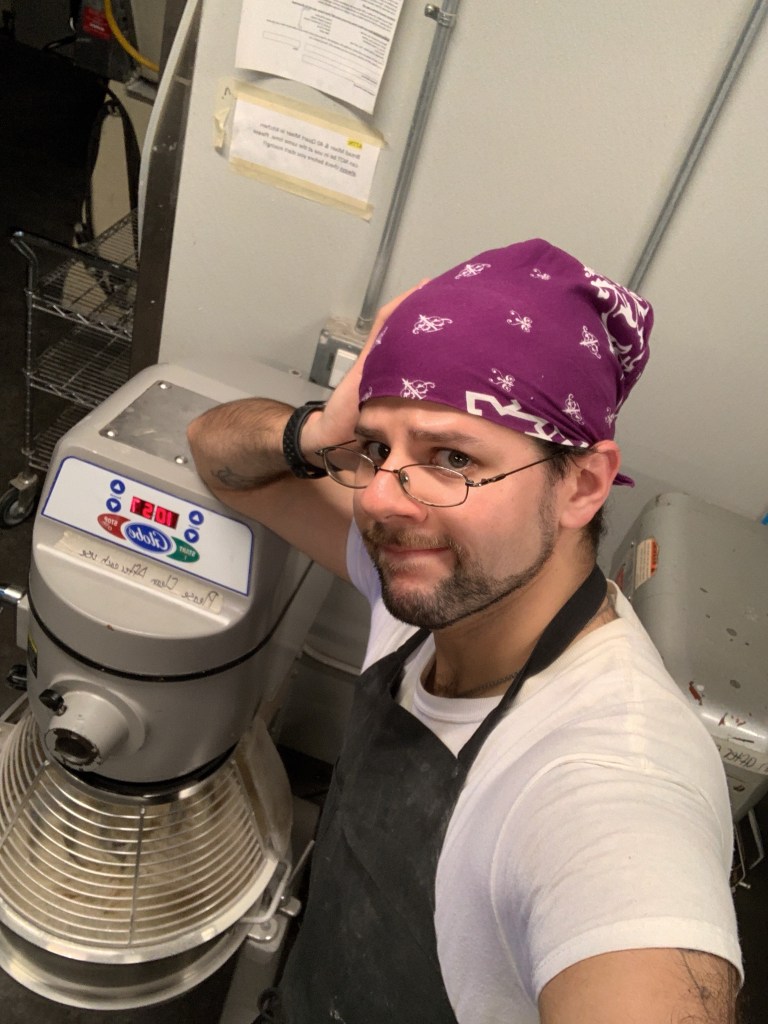
Even when something takes forever to mix.
That’s really it, I suppose. That feeling of control. Cooking is “the art of control” after all, and I love knowing where everyone and everything is in my kitchen, where I can make things work to my will.
The job I left had robbed me of that- turning a place and activity I loved, already under stress due to being how I make a living, into a place I dreaded, and activity that exhausted me with no reward.
So I left. I left the environment I called “home”, with no prospects, because the potential pain of leaving was welcome compared to the pain of staying.
Rebuilding and Refocusing
After another misadventure in another kitchen, I landed at my current spot. After a year and change, I’ve earned a promotion and a small team to lead.
Even though I’m writing a book on mentoring and leadership in the kitchen, it’s hard to put into words (convincingly, anyway) how I train and motivate even a small team and get them excited about their (admittedly boring and repetitive) work.
I encourage my team. I give them guidance, critique, and advice. Best by far, though, I try to give them interest and love. I try to help them make the kitchen their sanctuary too. Most of the time, it’s already there. They wouldn’t have tried making a job out of this work if they didn’t love it on some level- or at least been the kind to cook at Super Bowl parties and poke their head out of the kitchen door for commercials.
Love of the craft will carry a team when practicalities will not- but only so far. I’ll teach them to tell when a tart crust is ready. I’ll demonstrate the fastest way to fill an almond croissant. I’ll show them how, when a quiche is finished, it jiggles like my old chef Victoria would say “a nicely toned ass.” It’s up to them to find the rest of that love in themselves.
Much like I’ve had to do these last few weeks.
“Chop Wood, Carry Water.”
Very recently, in my quest to read more, I finished an excellent adventure novel titled “Cinnamon and Gunpowder.”
I won’t go into deep detail (I’d rather you read the book and got what YOU needed out of it), but the book can be summarized thus. In the early 1800s, a British chef is kidnapped by pirates after they murder his boss, and he is forced to prepare an elegant meal for the captain of the ship once a week, or else he gets killed/thrown overboard. The book is told through his journal entries, and he documents the crew, their voyages and adventures across the globe, and his numerous attempts to escape.
What he ALSO documents, however, is what (and HOW) he manages to cook for the captain in the barely-equipped ships galley and using the unusual provisions (notoriously lacking in things like fresh vegetables and meat, butter, eggs, etc.) It includes:
Bribing a sailor to provide him with fresh fish.
Using coconut water and a dried fig to make a yeast starter (kept warm by his body heat)
Sealing lard and shortening in a waterproof jar and towing it behind the ship on a long rope to chill it in the depths of the sea… so he can make tart crust, rolled out with a cannonball.
Along the way, the chef is forced to “return to basics,” learn about new ingredients he finds, get creative with methods, and- most importantly- find comfort in (and refine his philosophy of) the work he had done his entire life.
I am not kidnapped, or on board a ship skittering across the globe. No one is threatening to cut my throat if those quiche aren’t PERFECT, but I do still suffer from the same problem that strikes almost every other creative that tries to make a living out of what they love- staying in love with it.
Yeah, this again.
More often than not, the answer comes from forcing myself to bake on my off-days.
“Forcing myself” is an odd way to put it. You don’t really think of “forcing” yourself to do something you supposedly love. At the same time, work is work. It’s tiring. “I bake every day. I don’t want to spend my few days off each week in the kitchen too!”
I need to remind myself though that when I bake at home, it’s for me. It’s my opportunity to “chop wood and carry water-“ get back to the roots of this craft, and remind myself just why I love it so much. It’s my opportunity to, much like the protagonist in Cinnamon and Gunpowder, focus less on the “job” aspect and more on the craft.
“Food and cheer and song…”
I don’t entertain at my apartment nearly as much as I’d like to. My wife and I are both busy people, and the apartment is usually in some state of disarray.
So when I met a friend who was apartment hunting and invited them in to relax before heading home, it felt good on a number of levels. Not just because I knew they wouldn’t care so much if my apartment was a wreck, but because I got to look after someone for a bit. I got to offer them snacks and tea. They sat under my roof, played with my cat, and enjoyed my company.
That is why I do what I do. I love looking after others.
As I speak, there is rugelach dough warming on my counter, waiting for me to roll and fill it to bake tomorrow morning. It’s a cookie I used to make at my old job- the one I left. My boss was of two minds about me making rugelach every week. It did pull sales away from simpler, more profitable fare… but there was also a group of people who showed up every week looking for it.
I’m gonna make it for my friends this week. Just because I can, and because even though it’s literally my job to bake every day, this is still how I show my friends I love them.
No job, no string of jobs, no career can take that from me. They can only make me forget for a while- but I always remember eventually.
The idea of “faking it till you make it” is that, by somehow pretending and acting that a situation is different, you can make it become different and thereby make your fantasy real.
As you can guess, I don’t exactly buy into that. The reason? I’m a shitty liar, and I know when I’m trying to lie.
I’m finally attending to my side work, and not a moment too soon. It’s starting to get a bit too real out here.
For reference, “side work” in this case doesn’t mean I just decided to start cleaning down my tables, scrubbing floors, and organizing the walk-in in the bakery. That’s an expectation of kitchen life. I use the idea of “side work” as a metaphor for self-care. The stuff that isn’t necessarily anyone’s job, but it needs to get done or things get pretty gross pretty fast.
In everyday life, “side work” is things like making dentist appointments, cleaning your house, balancing your check book… and in my case, getting myself back in front of a psychologist.
Lately, my stress levels have been a bit higher than usual. A large contract is coming the way of my bakery, and my team is central to completing it. Over the time we’ve had to prepare, there’s been delays, meetings, and higher priorities left and right. Then, in the final week we have to prepare- we don’t have enough ingredients, and won’t till the end of the week.
I’m frustrated, I’m stressed, I tried to avoid this situation happening. In the end, it’s going to be me working extra hours trying to make the deadline- and I’m more pissed about not making the deadline than I am the extra work.









 The Black Hat Baker