Why is No One Cooking?

     Good evening, friends and neighbors!

     The other day, one of my chefs posted this article from Esquire, titled “Nobody is Cooking Anymore.”

     The quick and dirty summary of the article is: the state of American cuisine is such that plates at restaurants feel “composed” or “assembled” rather than “cooked.” What I got from the article is that the author feels that dishes are presented as edible works of art: each piece wondrous and perfect on it’s own, but then simply arranged on the plate in a pleasing manner, and he wants to see a return to things being cooked as a union of flavors- mentioning specifically stews, dirty rice, bagna-cauda, and cassoulet.

     While I disagree with some points of his article, there is one point there that I wish he had discussed more. It’s something I have brought up on this blog before, and I daresay I will again, but here it is:

     You don’t need to go out to eat well, and the best food doesn’t necessarily go for $80 a plate.

     If you grew up in a cooking household, this is likely a “duh!” moment for you. The very best, most timeless recipes we have today are old recipes from the poorest and most desperate times in our culture- or else deviations of them. The formula went simply thus: 

What You Have or What’s Cheap and Plentiful + Preparation Permitted in your Situation = Tasty Something That Fills You Up

     Simple, huh? 
     From this formula though, we get matzah ball soup, sausages, Vietnamese pho, Scottish haggis, shrimp and grits, tarts, tripe soup, ratatouille, beef and Guinness stew, corned beef and cabbage, cassoulet, and many others. The best food in the world doesn’t need to come with a four figure bill- many travelers (including myself) have found the best meal of their trips standing on sidewalks, coming out of a cart, or slapped into their hands for pocket change. 

     Cooking and baking have many facets. Some of the best wisdom I’ve ever heard is that cooking is about “taking the very best ingredients, and not screwing them up.” The addendum to that is “and let them work together.” It takes phenomenal art, skill, and education to make one of the plates you’ll find in a three Michelin Star joint in Manhattan. It will likely be wonderful. Wonderfulness, however, can also be found in a simple bowl of something hot, made right.

     In testament to this fact (and since I haven’t included a recipe on here in a while), below you’ll find my recipe for Beef and Guinness Stew. The most expensive thing you might find in this recipe is either the meat or the beer, but if you make it right (and enjoy it on a cold winter night, with a bottle of dark, heavy, malty porter or stout), it won’t matter at all- because sometimes a bowl of something good and hot, and bottle of something good and cold, puts you right where you belong.

     Stay classy,

Beef and Guinness Stew
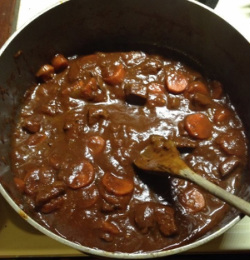
Picture

Ingredients

—————

1lb. boneless chuck beef (some places label it for stew)

1 large onion, roughly chopped

3 large carrots, sliced into thick coins (about 1/3″-1/2″)

2 tbsp flour, seasoned how you like (I used a pinch of cocoa, chili, coriander, parsley, thyme, and paprika)

12 oz. Guinness (I used Extra Stout, but you can use any porter or stout you want)

3 oz.  tomato paste (plain, no spices – this is half of one of the tiny cans)

1 tbs. minced garlic (about 3 cloves or so)

Rosemary, salt, pepper to taste.

Method

———

1. Toss the beef in the season flour to coat and brown in pan with a bit of hot fat (Pam, veg oil, whatever.) When browned, remove the beef to a bowl and use the same pan to fry the onions until translucent. If they burn slightly, perfect. I used the same large pot for this step as I did for cooking the stew- any burned bits get deglazed by the beer and go into the stew.

2. When onions are ready, add beef back in, along with the carrots and Guinness. Bring JUST to a boil, and then add the paste, garlic, and rosemary. Bring JUST to boil again, and immediately cover tightly and reduce heat down to a gentle simmer (medium low to low).

3. Let it simmer for 1 1/2- 2 hours. Check regularly (every 30 min. or so) to make sure it doesn’t dry out. If needed, after 45 minutes, add 6 oz.water and stir.

After 2 hours, if the carrots and beef are tender, serve with boiled potatoes on the side, or a dollop of mashed potatoes right on top with each bowl.

NOTES: Spices were used without measurement and were to my taste. If it tastes good on beef, it’ll work here

Also, 2 hours is a ballpark figure. As with most stews, this is low and slow cooking- if you can get this going 4 or more hours ahead of time and keep an eye on it, it will only get better, and everything more tender.



Magic On A Plate

Good evening, friends and neighbors!

     I was straining pretty hard trying to find something to talk about tonight. I like to think that I throw interesting idea up here, and I certainly wanted something thought-provoking.

   Nothing came up immediately, so I flicked over to YouTube and said, “Eh, I’ll think of something.”

    As I was rolling through YouTube, I noticed that one of my favorite channels, Extra Credits, had put up a new video. For those of you who don’t know, the Extra Credits puts out weekly videos based around various aspects of video games- design, writing, storytelling, mechanics, marketing, the industry, etc. As a bit of a gamer and literature/history nerd, their videos frequently get me rather intrigued in aspects of art I hadn’t truly devoted much time (or thought) to. For example, they have done videos on Horror characters and monsters, character development using the Myers- Briggs Type Indicator, a crash course in symbolism, and even a quick and dirty (but interesting and informative) overview of the “hero’s journey” narrative. I highly recommend looking them up if any of that appealed to you- or indeed, if you like games, writing, or business at all.

     Their most recent video discussed something that, as a writer and wanna-be storyteller, I never realized had a name- the magic circle. The magic circle, in brief, is an atmosphere created that “draws people in”- that lets the audience divorce themselves from the real world and enter the world of the story. This can be generated by a number of things- the presence of music, stirring and startling visuals, the hint of the mysterious, even the physical location and conditions the audience is in. It’s whatever qualities in a story or it’s performance that let the audience lose themselves in the world and invest in the story.

     As I was watching the video and listened to the Extra Credits crew discuss examples of how it works and where it can be found, I got to thinking about something else I had read recently that made mention of very similar notions- a book I had picked up on Judaism.

    Rabbi Niles Goldstein’s excellent book Gonzo Judaism was suggested to me by my older sister. Having grown up in a pretty secular Jewish family, and part of a religious congregation we had roughly ZERO interest in, we had both spent quite a lot of time in recent years debating and evaluating our identities as Jews- if that’s what we would even call ourselves, what it would mean if we did, what it would mean if we DIDN’T, and so on, back and forth. In the book, Rabbi Goldstein calls for a change in what seems to be the dominant atmosphere of American Judaism and calls for younger, questing, vibrant souls to confront Judaism in the same spirit that Hunter S. Thompson confronted journalism (creating what he called “gonzo journalism”- hence the book title.) One chapter in the book discussed how a “new” Judaism didn’t need to (and, in fact, couldn’t) completely divorce itself from the old, and how some congregations have been looking backward- digging up old, forgotten, esoteric prayers and rituals from Judaisms past and breathing new life into them. 

   Regardless of which religion you come from, or even no religion, the impact and effect of ritual cannot be denied. Rituals, performed properly, and with full faith and knowledge of their meaning, are not just superstitions and chores, but SYMBOLS. Even if you are not religious, you have certain habits in your life that MEAN something. When you come home from work and take off your tie or put on comfy clothes, that is a ritual- one of making the transition from your work self to your home self. Inversely, when I was working at a hospital, it didn’t matter if I had arrived early for my shift and was in the building for 30 minutes already, clipping on my ID badge felt like I was “officially” on the clock, and at work. Even the simplest images and actions can have power if we give it to them- then they become rituals.

When several rituals are used together, they create an atmosphere- something that draws us out of ordinary life and into the holy moment we are experiencing. Lighting candles, lighting incense, singing certain songs, wearing particular clothes- all work in concert to draw us into something different.

In other words, they create a magic circle.

Anyone I haven’t lost by now is probably nodding and going, “Ok, great- rituals are important. I thought this was a food and dining blog.”

     Well… what else is food? What else is sitting together at a dinner table? The smell of dinner coming in from the kitchen… the taste of THAT roast chicken your family ONLY makes on Friday night. How are these anything BUT rituals? How is that anything BUT a magic circle, dividing Friday night dinner from all the other dinners you had that week? 
Restaurants spend an incredible amount of money on creating ambience- decor, music, lighting, furniture, uniforms for the staff- all of it based around a certain theme and meant to convey a feeling- creating a magic circle in which you are physically and emotionally enveloped in a single story- the story of you having dinner. As Warner LeRoy said, “A restaurant is a fantasy — a kind of living fantasy in which diners are the most important members of the cast.”

     In Gonzo Judaism, Rabbi Goldstein gives suggestions on how to approach rituals- creating ones for yourself that will create a separation for you: a division between the sacred space and moment in time you want, and the rest of the mundane world. Lighting incense, putting on certain music, fixing particular foods- all serve to bring you mentally and emotionally to somewhere far, far away from where you are. 

    Meals do not need to be, and perhaps were not meant to be, just necessary pauses in the day to shove nutritious material into your body.

     Nothing NEEDS to be “ordinary”. Every day doesn’t NEED to be “same shit, different day.” All it takes is the desire to make it different, the awareness of how, the attentiveness to make it happen- and just a bit of the magic we place into anything that matters.

Stay classy,

Bake What You Know

    Hello, my friends! I hope 2014 has been going well for you all, and that everything is moving along deliciously.

I am currently sitting in my girlfriend’s living room while she plays piano.

Me: “Hun, I’m three days late on a blog entry. What should I write about?”

Em: “Weren’t you talking earlier about eating and dining culture? Write something about that?”

Me: “That’s ALL I write about though- I need something else!”

Em: “How about you? Write about your roots and whatever.”

I knew I was dating her for a reason, ladies and gents.

     There is wisdom and warning in the classic saying, “Write what you know.” It reminds the writer that there are always ideas, and that one should always be able to write about their chosen topic knowledgeably and responsibly. The caveat, however, is that only writing about what you know discourages you from researching and learning more.

How does this connect to food?
Simply, and I will illustrate with a thought exercise.

Sit back and think a moment about some of your favorite memories. Moments that made you feel warm and loved- or maybe ones that made you feel invigorated and alive.
Recall every detail of those moments that you can. Every single sensation- touch, taste, smell, sound, vision.
The two that will come to you most readily and rapidly will be taste and smell. 

    When I do this, I can almost immediately recall the taste of my grandmother’s matzah ball soup and her corn pudding. I can quickly recall the smell of the whiskey and beer my friends and I had on a wild pub crawl through Manchester, New Hampshire late one night. (I also recall the aftermath, less fondly.)
     These moments stay with us, and we carry them our entire lives. Writers carry the inspirations and lessons of every book they ever read. Painters and photographers carry the same from every picture and all their favorite painters. In a way, we all have a sort of gallery in our minds, where the exhibits are memories and the library is full of ideas and inspirations.

 A chef’s gallery is full of food. Every table they ever sat at, every dish they were ever served, every restaurant, cafe, diner, and bar they’ve sat in- they can pull from that gallery quickly and vividly. They can pull from it and create.

The food writer Molly Witzenberg put it very well when she wrote:

  “When I walk into my kitchen today, I am not alone. Whether we know it or not, none of us is. We bring fathers and mothers and kitchen tables, and every meal we have ever eaten. Food is never just food. It’s also a way of getting at something else: who we are, who we have been, and who we want to be.”

In my personal gallery, I have my mother’s kitchen, and the smells of family dinners with my grandmother. I have every fine dining experience that was ever afforded to me. Whenever I am called upon to make a new dessert, I immediately fall back on those memories, so I might modify the saying to be “Bake what you know, and bake what you love.”

Just like the original saying though, there is a caveat.

If you want to cook well, you must first learn to eat well. Seek out and sample strange new things whenever you can- a culinarian has no place being a picky eater. If anything, get picky about quality. Life is too short to eat at McDonalds and the local diner every day. 

If you want to make amazing new things, do your homework, and expand your gallery.

Stay curious all and, of course,

Stay Classy,

Why I Don’t Do Resolutions

Good evening, friends and neighbors! Happy New Year!


I’m currently typing this from The Avenue Cafe, a small bar/gastro pub place where I’m grabbing a little beer and fine food before I return home to wait out the winter storm that promises to render me a homebody for the weekend. Yes, I imagine I am being a little reckless, as I watch the sleet and snow start to fall outside- but sometimes, fine beer and food is quiet worth it, and Avenue has both.


2013 is in the can, and a hell of a year it was- for the bakery, for me personally and professionally. I really don’t have anything in the way of resolutions (as you may have gathered from the title of this post), but I promise I have non-snarky reasons for it.


A lot of people, oozing with bitterness, cynicism, and disappointment, tend to have the same reason for not making resolutions- they always break them, so why bother? The opposite end of the spectrum are the people that make four thousand glorious and aspirational resolutions (“I’m going to lose 50 lbs! and write that novel! and quit my job and start my new business selling bacon art to the rich and famous!), only to forget and give up on them around February.


My feeling is that resolutions aren’t, and shouldn’t, be reserved for one day a year, and they certainly shouldn’t be mandated by tradition. Grand, life-altering decisions shouldn’t be relegated to a holiday tradition. Resolutions- real resolutions that change your life- happen when they happen. They happen in crisis moments, in moments of revelation, in moments of anguish, and moments of indescribable beauty and glory. They happen in moments of blood-boiling rage, exquisite joy, and seemingly insurmountable sorrow.


I made the resolution to start my own business when I realized I could never be truly happy working for someone else.


I made the resolution to lose weight when my uncle (now passed) was in the hospital for the third time because he refused to do anything about his weight or his diabetes.


Don’t let the fact that it’s a New Year encourage you to make half-hearted, half-assed resolutions. You’ll make them when you’re good and ready. When you are sick to death of being less than you know you are capable of, furious with the direction your life has taken, or struck with a moment of revelation that describes everything you want from this world and need only reach forth your hand and take, you’ll make your resolutions- and keep them.


Happy 2014, my friends. I wish you happiness, peace, and that just enough of your wishes should come true that you have something to strive for.


Stay you.

Stay strong.

And as always


Stay classy,

Christmas in the Kitchen

     Good afternoon, friends! Merry Christmas Eve, and a happy whatever-holiday-you-celebrate-this-time-of-year!
     I’m writing this from my girlfriends kitchen in Haddon Heights. Her mother is sitting and listening to NPR while knitting, while my girlfriend has just recently un-banished me from the living room where she is wrapping presents.
     I’m also typing this while I wait for my focaccia dough to proof, and debate what dessert I can make for us all to have this Christmas Eve (perhaps something to go with the boozy eggnog we currently have sitting in the fridge?)

    It’s been a while since I really had an experience like this around the holidays. I’ve spent the last few months in a frantic haze- finishing school, baking cakes, arranging my schedule and so on- so this quiet, meditative moment comes as a welcome relief. The fact that I am feeling this meditative lull while baking bread is not lost on me, and reminds me of one of my favorite baking quotes-

“[Breadbaking is] one of those almost hypnotic businesses, like a dance from some ancient ceremony.  It leaves you filled with one of the world’s sweetest smells… there is no chiropractic treatment, no Yoga exercise, no hour of meditation in a music-throbbing chapel, that will leave you emptier of bad thoughts than this homely ceremony of making bread.”  ~M.F.K. Fisher


     In my previous post, I expressed my feelings about how the holiday season can encourage us to treat others. Baking bread, I feel, is a perfect example of how this holiday season should encourage us to treat ourselves.
Breadbaking is at once a simple and complicated business. A time-consuming activity that provides a lot of down time, an enterprise in which one person works and orchestrates, but all can share.
    Sitting a few feet from me, my dough proofs. The work was mine. The thought and planning for it were mine. This rest I enjoy while my dough does it’s thing is also mine- but the results will be shared with everyone.

     As easy as it is to get wrapped up in getting for others, giving for others, buying for others, doing for others- every part of that can (and should) consist of just a little wholesome selfishness. My girlfriend and her family will love the focaccia, but I will also have enjoyed baking it, and this quiet peace as it proofs. There is another saying that I love- “An artist earns themselves three blessings- the first is in the work, the second is in the completion, and the third is in giving it away.”

To all my friends out there, I wish you a splendid holiday season. I wish you happy baking, happy work, and happy results.

Stay warm, and

Stay Classy,

-BHB