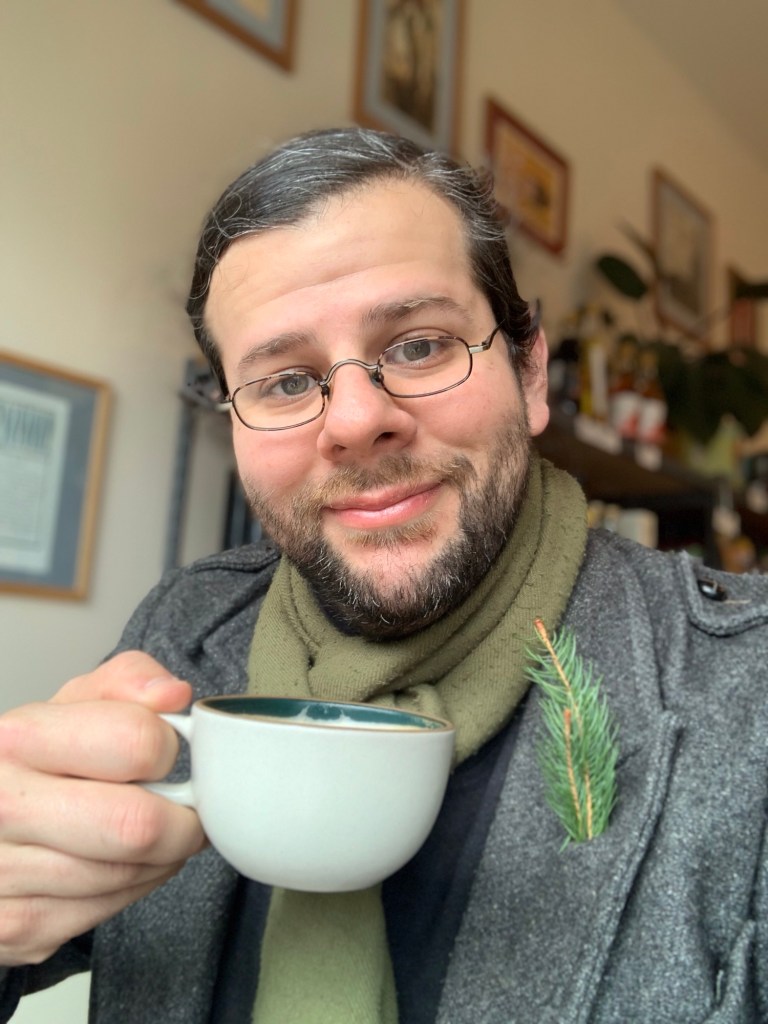
A Brief Homecoming

“A man would know the end he goes to, but he cannot know it if he does not turn, and return to his beginning, and hold that beginning in his being. If he would not be a stick whirled and whelmed in the stream, he must be the stream itself, all of it, from its spring to its sinking in the sea.”

― Ursula K. Le Guin, A Wizard of Earthsea

I knew that a lot had changed at my old culinary school before I turned off the Black Horse Pike in Mays Landing into the campus. There were better and brighter signs on the road to the parking lots, for starters. I peeked down drives slowly, trying to remember which lots were for students and faculty and which ones a visitor would go unnoticed in.

The larger one in the back of the campus- now shaded by sun covers that doubled as solar energy panels- fit the bill and it was right near the main entrance that I rarely used as a student. Students always went in a side door near a smaller lot, closer to the majority of the classrooms and kitchens. Not that too many young culinarians still used it. Class sizes apparently plummeted due to COVID and the Culinary Industry Brain Drain. Even coming from a community college, culinary school wasn’t a winning proposition for young people tight on money and prospects. It was a place now for two kinds of students- the passionate, and the lost.

Fortunately, those are exactly the kinds of folks that have kept the industry moving for years. I walked up the wide, low concrete steps and pushed open the door. Rather than noise from busy kitchens and clamoring students in pressed white uniforms, I’m greeted by silence- and the mingled smells of butter, hot fat, flour, bread ovens, and cold vegetables. I can never forget that smell. Some things haven’t changed at all.

Welcome back, Matt.”

The Academy of Culinary Arts
Continue reading

Time In A Bottle- In Praise of Whiskey

It’s easy to be staggered by even a small selection. If the legendary Fountain of Youth were real and the Water of Life changed character and flavor with every drop, I’m not sure I’d care which one I got. When each “drop” can cost between $20 and $2000+, though… one feels the need to be a little choosy.

While my dad loves wine and passed his knowledge of tasting and experiencing wine down to me well enough, wine just never sang in me the same way whiskey and beer have. No less an art form, requiring no less craft and patience and care, people have spent their lives in pursuit of their perfect dram, let alone the perfect one. Among my goals in life is to have my own little whiskey collection- not large by any means, but each bottle curated with care to suit any situation myself or my guest might bring to my bar.

What’s stopping me? In order to have a collection of whiskeys, one must either make enough money to buy more whiskey than one can buy quickly, or drink it slowly enough that a collection can accumulate. Either track is, alas, remarkably challenging.

Tellingly, the word “whiskey” is derived from the Gaelic “uisgebatha,” which translates to “water of life.” If legends and folktales tell us anything, the quest for the Water of Life is anything but easy or short. In my own meandering experience, however, it is incredibly enjoyable.

Piss on picklebacks at your own risk.
Continue reading

Checking In- Don’t Let Monstrous Times Make You A Monster

Where are you Matt?
What are you feeling?
Check in- what’s happening now?

This is the litany of questions that has gone through my head on repeat for the last few weeks. It’s one of the tools I use to ground and re-center myself when I catch my thoughts ruminating or spiraling.

You don’t “hate everything,” Matt. You are tired and sad. Hate and anger are easier to feel and parse than pain.

This is the other mantra I’ve found myself repeating over and over when I find myself slipping into depression. That’s been increasing over the last few months. The usual anxieties and tribulations of life seem to magnify themselves when you constantly poach yourself in a broth of bad news. It feels like everything hurts, and the world is too hard and painful to keep being kind in.

I insist on continuing to be kind, though.
My core values remain Patience and Compassion.
My “Way of the Floured Hand” dictates that “I choose love, I chose love, and I will always choose love.”
“It’s Chaos; Be Kind.”

I know that ideals like this will always be worth it in the end, always mebut that doesn’t mean it’ll always feel good.

Bilbo Baggins from Lord of the Rings saying "I feel thin.. like butter scraped over too much bread."
Continue reading

Our Insecurities Can Speak Out Of Turn

My exercise routine has been yielding interesting results lately. After injuring my lats by increasing weight too fast on overhead presses, I decided to switch it up and give Romanian Deadlifts a shot, and while I will be going back to running in the spring I really enjoy just taking long walks in Mount Tabor Park.

The Romanian Deadlifts don’t seem to be doing much for my weight, but I’ve noticed I’m able to touch my toes more easily. The walks, similarly, have become less about getting exercise in and finding time to be quiet and mindful and piece my way through life.

Continue reading

A Story Worth Telling in a Way Worth Hearing

Vixere fortes ante Agamemnona Multi: sed omnes illacrimabiles Urgentur, ignotique longa Nocte, carent quia vate sacro.
(“Many heroes lived before Agamemnon, but they are all unmourned, and consigned to oblivion, because they had not their sacred bard.”)

– Horace

I first read that quote on a webpage of Latin mottos where it was offered as just the first statement- “Vixere fortes ante agamemnona”- to mean that heroism exists even if no one notices it. Ironically, or perhaps appropriately, this is a perfect demonstration of the power of the pen. The quote itself extols the role of writers and poets in giving heroes immortality.

The metacontext of the quote is that when Horace wrote the passage in his Odes, he was simping for the original “sacred bard” Homer, author of the Iliad where Agamemnon’s story is recounted. Some translators have taken a little poetic license on this and interpret the passage (the way I first heard it) as “Brave men lived before Agamemon, but they died forgotten, for there were no poets before Homer.”

The meta-metacontext is that, if you read the Iliad at all, Agamemnon is pretty much an absolute knob, a coward, a monster, and absolutely responsible for all of his own failures including and especially his own death. So millennia of writers and poets have been needed to burnish his story into anything remotely resembling a hero.

That’s what we in the creative business call “serious workshopping.”

Photo by Suzy Hazelwood on Pexels.com
Continue reading