Paying the Piper- The Culinary Brain Drain

You can feel it all around the United States. With the massive push of vaccinations and the slowly declining COVID-19 case numbers, restaurants and venues are starting to relax their requirements. People still need to wear masks, yes, and social distancing is still a thing- but you can eat inside now. You can sit with friends. You and your buddies can, within reason, go out and grab a beer just like you used to. We are starting to get back to normal after a year in a plague-ridden Hell of our own creation.

Not all industries are ready though:

Hey, I need to hire two line cooks ASAP! Anyone give me any leads?”
Guys, I’m desperate. I need a dishwasher, a busboy, and at least three cooks NOW- the restaurant is packed every night and I can’t take it anymore!”

Why can’t I find capable help anymore?! Everyone I hire either flakes out, burns out, or just quits! WHAT HAPPENED TO ALL THE COOKS?!”

They found greener pastures, folks. They had no other choice. We need to raise a new crop of cooks from scratch- maybe we’ll be smarter about it this time.

Continue reading

The Right Hand Man- How To Be A Good Sous Chef

You would think that “servant leadership” would be immediately applicable to modern kitchen life, but as a leadership ethos it has yet to see the predominance it deserves. It is not at odds with the traditional brigade system as Auguste Escoffier envisioned it- though it is certainly at odds with the bullying and barbarism that has come to be associated with being “classically trained.” Hardly a terrible thing, since that “tradition” is itself at odds with little things like “health and safety of the worker” and “being a fucking human.”

“Servant leadership” is, at its core, an ethos that changes leadership from “Do what I tell you” to “This is what needs to get done- what can I do to help you do it better?” If you would like a masterclass in what that mentality can and should be like, look no farther than the sous chef– the second-in-command of a kitchen, and the chef’s “right hand man.”

Continue reading

Snapshots of the Bakeshop V- “Last Man Standing”

It’s been ten months since my day job changed to answer COVID-19. The last time I wrote one of these, the “A-Team” was in charge. We ran our asses off for 12-hour days, making ends meet for the dawn of the apocalypse.

Ten months later, and they’re all gone. Quit from stress and depression, walked out in a huff, or simply went on leave and never really returned.

It’s a new team now. Eager, curious, capable… and as a Great Old Sage of an employee at two years, I’m doing my best to help them keep their hands on the wheel. I thought being the “Last Man Standing” would be a heady, affirmative feeling- “I’m finally indispensable. I’m the one that could hack it.”

Instead, I feel beaten. Beaten, tired, and sad. The “last man standing” is usually pretty lonely.

Photo by Samuel Silitonga on Pexels.com
Continue reading

Life After the Line- When Chefs Change Careers

My friend Renee has- like most of our industry- had a rough couple of months.

Renee is a sommelier back east. She has enough skill that positions in her niche are scarce. She also has lifestyle demands that make the job pool even shallower- and enough contacts and familiarity with a particular scene on the East Coast that discretion is required. As we sip coffees and tea at a rainy cafe in Astoria, Renee spins a saga of staffing and management issues, attending the needs of VIPs, and protecting the restaurants reputation. It all culminates in a storm of uppity underlings, COVID protocols, and curiously nebulous budgets that lead to her (relieved but frustrated) resignation.

“I’m not even fond of wine,” she admits with a short snort. “I’m good at being a somme, but I honestly like cocktails more.” She didn’t even really enjoy the fine dining restaurant life. She was fine with the formality and artifice of high society. The social waters she navigates with ease gives me the willies just thinking about. Managing the wine at a restaurant, though, was “just a box that had to be checked on the way.”

“I think I’m going to pivot to distribution.” she muses as we finish our coffee. “That’ll keep my toes in the world. People keep suggesting I teach, so there’s that too.”

I recount my own experiences at the bakery (I’m almost afraid they’ll bore her- my own worries have been no less frustrating, but far less flashy) and we share a rueful laugh. The tragedy of it all is that none of this is new. “That’s the industry.” We’re both tired, both burned out- and wondering if we haven’t had enough.

It’s a question that a lot of chefs ask themselves. This foul year of Our Lord 2020, however, has stepped up a lot of professional timelines. With every successful night’s service, every broken freezer, every balancing of the books- chefs everywhere ask themselves “How much longer can I keep this up?

What will come next?”

Youtube https://youtu.be/pYLjHhSOE7s

Continue reading

Making Headway- Advancement in the Kitchen

If you had told me a year and a half ago that I’d be second-in-command in my bakery, I would have asked what the hell went wrong.

Well, obviously COVID did, but that was only part of it.

So far, my current employment has been where I could say my most “traditional” career growth has taken place. I started as a morning baker, became a shift lead, and then Production Lead- the right hand of my manager who runs the kitchen under the auspices of the owner. My usual station is Pastry Prep (previously considered the position for newcomers and students)- but in addition to my actual production work, my other responsibilities include:

  • Fielding questions to take weight off my manager.
  • Training, advising, and assisting the other bakers as necessary.
  • Troubleshooting problems with production or facilities.
  • Responding to the higher-ups when the manager is indisposed.

Not to toot my own horn, but I handle all of it quite well, and I feel that the responsibilities I have are well-placed. In the meritocratic lore of the kitchen, this is as it should be- employees develop, rise to the level of their capability and talent, and acquire new power, responsibility, and recognition each time.

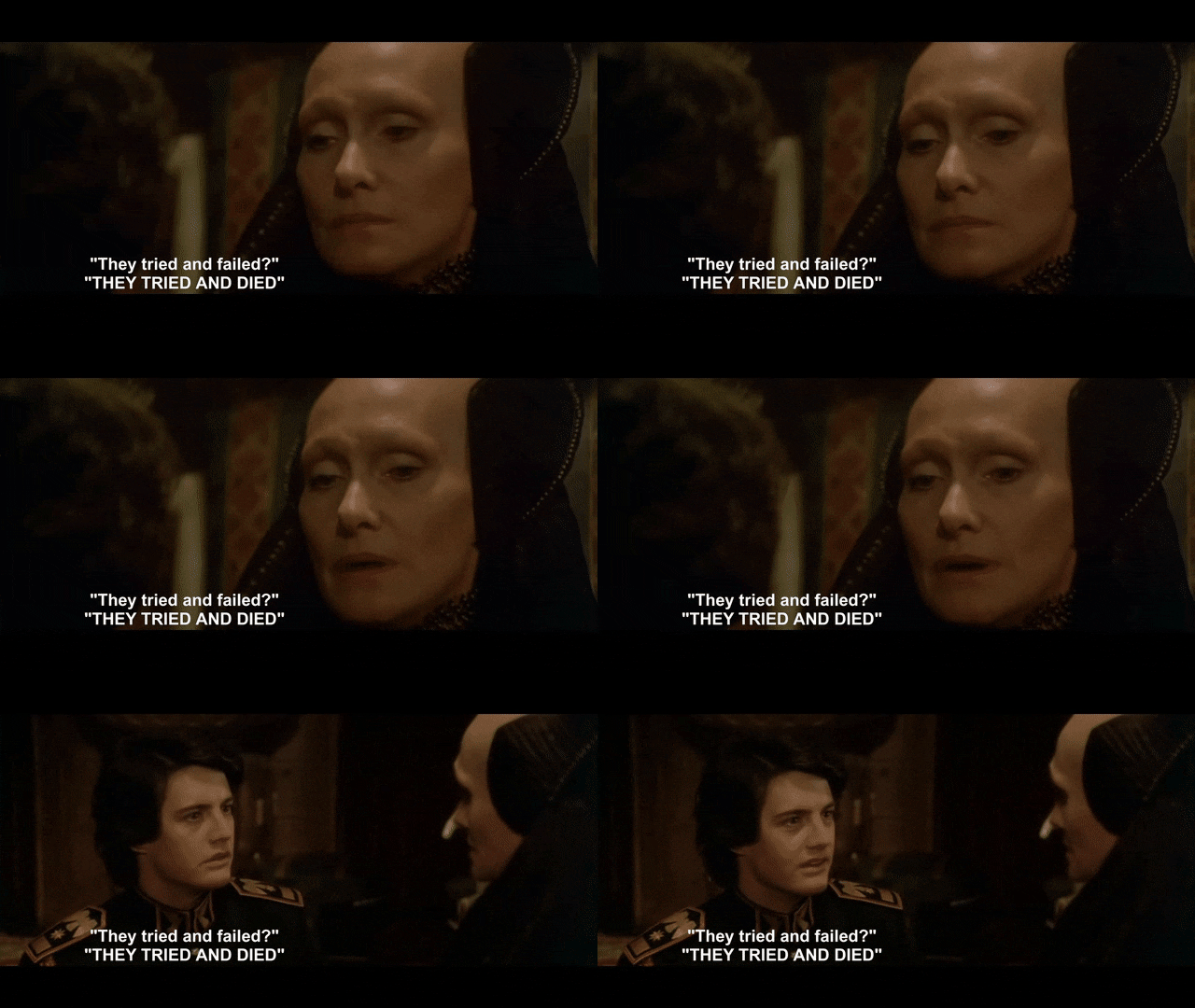
What is NOT part of that lore, or mentioned in my own ascendancy, is just how many good people I worked with deserved those roles and recognition more than me, but left for a variety of reasons. How much of advancement in the kitchen is actually meritocratic, and how much is “dead man’s boots?”

Animated GIF from David Lynch's "Dune" of Paul Atreides and the Reverend Mother talking. The quote is "They tried and failed? They tried and died."
“Many men have tried.” “They tried and failed?” “They tried and died.” (from Dune)
Continue reading