No one likes wasting their time, or feeling like their time is being wasted. If you can’t explain the impact of a task, why does the task need to be done by anyone?
I’ve been silent on here for the last few weeks. Between a very compressed event schedule at the winery, Yom Kippur, and the anniversary of October 7th, I haven’t had the energy or the will to do much at all. With the arrival of a slow period, though, I finally have time to rest, think clearly, and put something on this blog worth reading.
I also have time to take on some of the more… “long-form” projects that come through the kitchen. One of these was a process I’ve come to call “Quinceageddon.” It began last year when my chef bought about 40 lbs of locally-grown quince, dropped it in our walk-in fridge, and told me to do something with it.

For those who don’t know, a quince is the tsundere version of a pear. Historically called the “fragrant pear,” a quince looks like a giant lumpy pear that has a positively wonderful fragrance- floral, sweet, and sharp all at the same time- but is utterly inedible by itself. The fruit is so rich in pectin and tannin that it’s like biting into a rock-hard raw potato, but painfully bitter in addition to being actually painful.
The single most popular- and arguably the best- thing to do with quince is to make quince paste, or membrillo. The striking red color and tart/sweet flavor makes it a staple pastry filling in Latin America and Spain, as well as a classy addition to cheese boards. Membrillo can be bought from specialty stores, but it tends to be expensive because making it takes hours of work. First comes peeling, coring, and chopping the rock hard fruit. Then braising the fruit with water and citrus to soften it. Then milling, blending, mixing and cooking it slowly for hours until the puree turns crimson red, and finally blending and cooling… but if you (or the pastry chef you hired) have a bit of a blank day to spend, it’s easy enough to make it yourself.


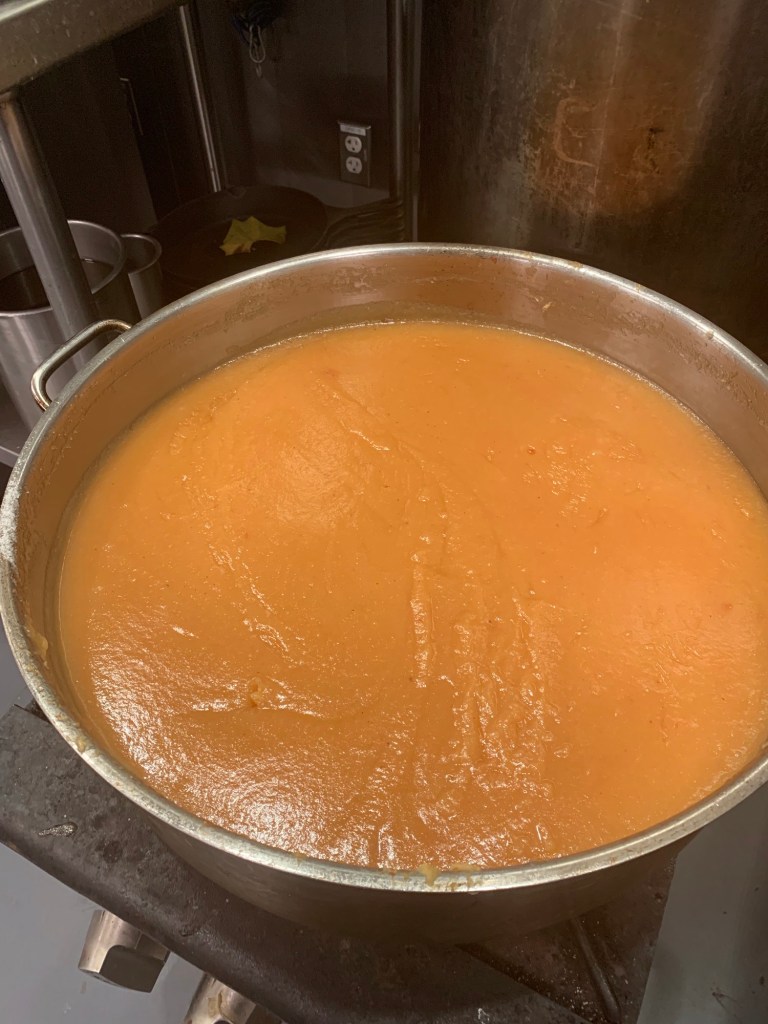


“8 Hours Later…”
The other project I found myself working on this week was seeing to the end of our tomato supply. All summer, we had an excellent supply of local tomatoes that we worked into sauces, salads, jams, platters, platings, and the like. With autumn in full swing and tomatoes leaving the markets, it was time to similarly see them off our menu.
That meant we had about 20 pounds of beautiful (if somewhat wrinkly) multicolored cherry tomatoes that would soon be attracting more fruit flies than customers if we didn’t deal with them soon, turning them into jam that could be reliably frozen for a future time… which meant they were handed over to me and my team.

Slowly, individually plucking the green stems and leaves off the tomatoes as I dropped them into a bucket on a scale, I realized, would probably make a cook fresh out of school (or a younger me, for that matter) go mad and question their life choices… if I just told them to do it.
While I was plucking through these tomatoes, my assistant Marisah was taking another crack at piping the gouger cheese puffs we use for events. As I plucked stems, I called back advice over my shoulder as she mixed the sticky pate au choux batter until I realized what I was doing and said “Augh, sorry… you’ve literally made this before, I’m preaching to the choir here.” To which Marisah graciously laughed and said “It’s alright, I enjoy the teaching.”
That’s when I looked back down at my tomatoes and realized a mistake that too many chef make and that I do my very best not to make- they don’t give the context for a task.
For too many “old school” chefs and cooks, when you are given an instruction, the correct answer is “Yes, chef” and then you do it. Maybe the almighty Chef will give you a reason or some instruction, but the key in that task is obedience. When the boss says “jump,” you ask “how high” on the way down. That was what made a good cook. “Kids these days with their questions and their ideas and their entitlement…”
Karen fixed that for me relatively quickly in my career over a batch of pastry cream.
“Your custard always gels too hard, Matt. What are you… wait, are you done mixing it already?”
“Um, yeah Karen- that’s what I was taught, mix it until the butter melts…”
“Matt, if you just put the butter in there, it’ll melt and then you’ll have brick. You move it until the butter melts and it’s cool. If you want a custard pie filling, that’s fine, but if you want it smooth and pipeable, you need to mix it longer.”
“Always ask questions, Matt.”

If I told Marisah or anyone else “peel and chop 40 pounds of quince” or “individually pull the green bits off 16 pounds of cherry tomatoes” without any other information, or if I answered questions with “because I said so,” why wouldn’t I expect shitty results? That’s stupid, capricious, annoying, and a massive waste of goddamned time.
If, on the other hand, I was honest and said “Peel, core and chop these quince. We’re making a shit-ton of quince paste for the year, and peels and seeds will make the milling more difficult” and “We’re throwing all these into jam and we don’t want the green bits,” suddenly there’s a reason to do a good job of it beyond “I have authority and you don’t.”
What’s more, being open to questions can help, change, or eliminate the task altogether. I think of it as “keeping me honest’ in the face of culinary orthodoxy, because if someone else says “why can’t we just food mill or process the tomatoes as they are” suddenly I, as a teacher and leader, have to think the task through.
In the case of the tomatoes, I need to be able to say “The food processor will chop up the green bits, and we don’t want them at all. The food mill will strain out the seeds which we do want.” The same logic applies for why we don’t process the parsley.
Occasionally, however, it gives me pause to say “Hey, why DON’T we do the task that way?” If I can’t find a reason, we experiment. If it works, voila- a useless task as been eliminated because I was able to say “Huh… let’s try it!” Instead of getting butt-hurt over my orders being questioned, an apprentice feels validated, labor has been reduced, and efficiency increased.
Put your ego aside, get your head out of your ass, and invest the tiny amount of time it takes to feed your employees curiosity. Create enjoyable teaching moments, and reap the benefits of ideas beyond your own.
Stay Classy,



 The Black Hat Baker