When I’m not exhausted beyond reason, furious at pompous bureaucracy and the odious input of “higher ups” that outsource their problem-solving to ChatGPT, I do still in fact love to bake.
I truly do still love making things for people. I love giving my work to others, watching them eat it, knowing their day got better for a moment because of my work, and maybe even teaching others how to do that magic for themselves.
As much as previous cafe jobs put me through, it was always the environment and the management, never the work. Even when I was dragging my ass out of the French bakery at 10am after starting at 2, hoping to find a place that wouldn’t question giving me a post-shift beer over brunch, I loved looking in the display case as I left. I saw everything I’d made that morning, people and kids pressing their noses against the glass at crusty kouign-aman and caneles, and think to myself “I helped make their day start better. It was all worth it.”
It took and takes a LOT for me to lose sight of that fact. Fine dining has always been a pleasure of mine and that kind of work- being a pastry chef- is the best way to gain access to good ingredients, new technology, and have excuses to experiment. Your local bakery cafe doesn’t mess around with agar agar (unless they are vegan.) They don’t need a PacoJet, and getting obscure or rare materials is not always a priority- or even in the budget. They’re making delicious breakfast pastries, cookies, and pies- not plated desserts for $15 a hit.
When you set off on a culinary career, it’s good to know what you love about it and find the path that support it. It’s never too late to learn more about yourself and change.
No one likes wasting their time, or feeling like their time is being wasted. If you can’t explain the impact of a task, why does the task need to be done by anyone?
I’ve been silent on here for the last few weeks. Between a very compressed event schedule at the winery, Yom Kippur, and the anniversary of October 7th, I haven’t had the energy or the will to do much at all. With the arrival of a slow period, though, I finally have time to rest, think clearly, and put something on this blog worth reading.
I also have time to take on some of the more… “long-form” projects that come through the kitchen. One of these was a process I’ve come to call “Quinceageddon.” It began last year when my chef bought about 40 lbs of locally-grown quince, dropped it in our walk-in fridge, and told me to do something with it.
For those who don’t know, a quince is thetsundere version of a pear. Historically called the “fragrant pear,” a quince looks like a giant lumpy pear that has a positively wonderful fragrance- floral, sweet, and sharp all at the same time- but is utterly inedible by itself. The fruit is so rich in pectin and tannin that it’s like biting into a rock-hard raw potato, but painfully bitter in addition to being actually painful.
The single most popular- and arguably the best- thing to do with quince is to make quince paste, or membrillo. The striking red color and tart/sweet flavor makes it a staple pastry filling in Latin America and Spain, as well as a classy addition to cheese boards. Membrillo can be bought from specialty stores, but it tends to be expensive because making it takes hours of work. First comes peeling, coring, and chopping the rock hard fruit. Then braising the fruit with water and citrus to soften it. Then milling, blending, mixing and cooking it slowly for hours until the puree turns crimson red, and finally blending and cooling… but if you (or the pastry chef you hired) have a bit of a blank day to spend, it’s easy enough to make it yourself.
*Frenchy SpongeBob Voice* “8 Hours Later…”
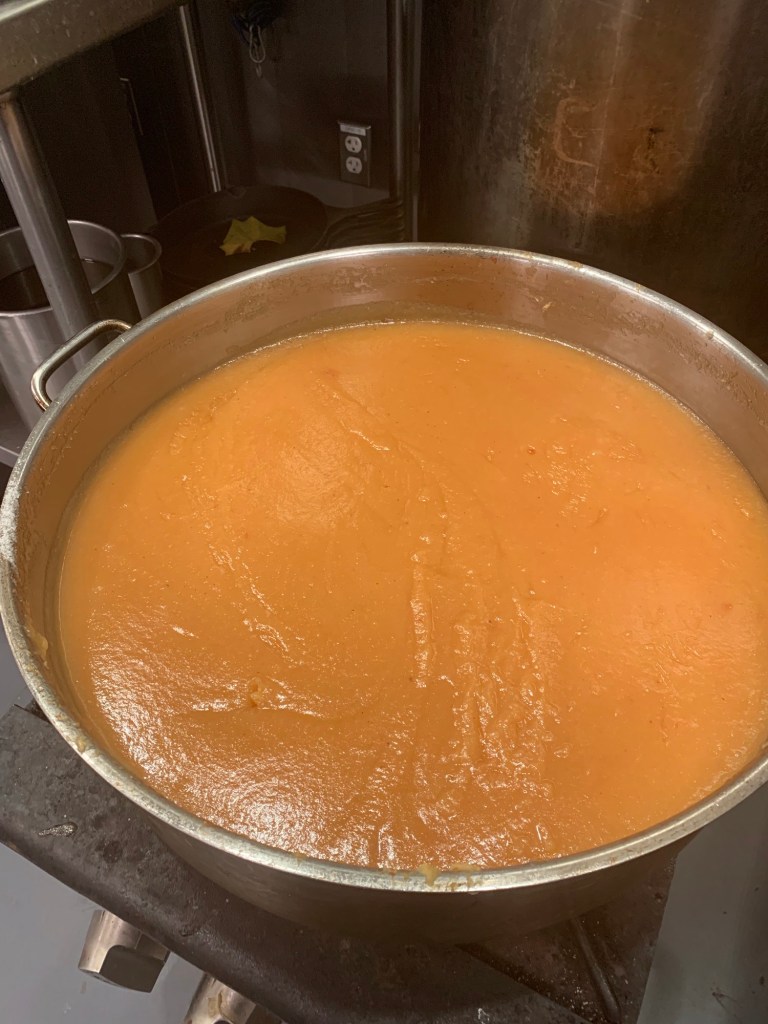
The other project I found myself working on this week was seeing to the end of our tomato supply. All summer, we had an excellent supply of local tomatoes that we worked into sauces, salads, jams, platters, platings, and the like. With autumn in full swing and tomatoes leaving the markets, it was time to similarly see them off our menu.
That meant we had about 20 pounds of beautiful (if somewhat wrinkly) multicolored cherry tomatoes that would soon be attracting more fruit flies than customers if we didn’t deal with them soon, turning them into jam that could be reliably frozen for a future time… which meant they were handed over to me and my team.
Slowly, individually plucking the green stems and leaves off the tomatoes as I dropped them into a bucket on a scale, I realized, would probably make a cook fresh out of school (or a younger me, for that matter) go mad and question their life choices… if I just told them to do it.
While I was plucking through these tomatoes, my assistant Marisah was taking another crack at piping the gouger cheese puffs we use for events. As I plucked stems, I called back advice over my shoulder as she mixed the sticky pate au choux batter until I realized what I was doing and said “Augh, sorry… you’ve literally made this before, I’m preaching to the choir here.” To which Marisah graciously laughed and said “It’s alright, I enjoy the teaching.”
That’s when I looked back down at my tomatoes and realized a mistake that too many chef make and that I do my very best not to make- they don’t give the context for a task.
For too many “old school” chefs and cooks, when you are given an instruction, the correct answer is “Yes, chef” and then you do it. Maybe the almighty Chef will give you a reason or some instruction, but the key in that task is obedience. When the boss says “jump,” you ask “how high” on the way down. That was what made a good cook. “Kids these days with their questions and their ideas and their entitlement…”
Karen fixed that for me relatively quickly in my career over a batch of pastry cream.
“Your custard always gels too hard, Matt. What are you… wait, are you done mixing it already?” “Um, yeah Karen- that’s what I was taught, mix it until the butter melts…” “Matt, if you just put the butter in there, it’ll melt and then you’ll have brick. You move it until the butter melts and it’s cool. If you want a custard pie filling, that’s fine, but if you want it smooth and pipeable, you need to mix it longer.” “Always ask questions, Matt.”
If I told Marisah or anyone else “peel and chop 40 pounds of quince” or “individually pull the green bits off 16 pounds of cherry tomatoes” without any other information, or if I answered questions with “because I said so,”why wouldn’t I expect shitty results? That’s stupid, capricious, annoying, and a massive waste of goddamned time.
If, on the other hand, I was honest and said “Peel, core and chop these quince. We’re making a shit-ton of quince paste for the year, and peels and seeds will make the milling more difficult” and “We’re throwing all these into jam and we don’t want the green bits,” suddenly there’s a reason to do a good job of it beyond “I have authority and you don’t.”
What’s more, being open to questions can help, change, or eliminate the task altogether. I think of it as “keeping me honest’ in the face of culinary orthodoxy, because if someone else says “why can’t we just food mill or process the tomatoes as they are” suddenly I, as a teacher and leader, have to think the task through.
In the case of the tomatoes, I need to be able to say “The food processor will chop up the green bits, and we don’t want them at all. The food mill will strain out the seeds which we do want.” The same logic applies for why we don’t process the parsley.
Occasionally, however, it gives me pause to say “Hey, why DON’T we do the task that way?” If I can’t find a reason, we experiment. If it works, voila- a useless task as been eliminated because I was able to say “Huh… let’s try it!” Instead of getting butt-hurt over my orders being questioned, an apprentice feels validated, labor has been reduced, and efficiency increased.
Put your ego aside, get your head out of your ass, and invest the tiny amount of time it takes to feed your employees curiosity. Create enjoyable teaching moments, and reap the benefits of ideas beyond your own.
“Experience is the hardest teacher there is- it gives the test first and teaches the lesson after.”
I’m still plugging away at my book at mentorship and training. It’s slow going, partially because of lack of metaphorical spoons on a given day and partially because going back over some parts involves frankly unpleasant memories. What I tell myself about why this particular book has taken so damn long compared to my last two is because I’ve been in a position of Actual Documented and Titled Leadership- first as the kitchen manager of the pie shop and now as the pastry lead of a winery.
I’ve told myself that these experiences were effectively ongoing research material and proof of concept for the book and that that’s why I effectively put the book on ice for a bit. “This is good advice? Ok, how’d it work when YOU tried it?”
On an interpersonal level, not badly. Plenty of folks left their jobs, a few stayed, those who stayed were happy. Not everything is for everyone, and that’s just how life goes.
On a professional level, though, and especially as a middle manager, there is a lot that went wrong no matter what I said or did. There is only ever so much one person can control, and the role of a leader, in my mind, is to lead, communicate, serve, and protect their team. Eventually people have to look after themselves- as a leader, I can only ever advocate and look out of them as much as I can.
Ifyou would not be forgotten, as soon as you are dead and rotten, either write things worth reading, or do things worth writing.’
– Ben Franklin
You don’t get to decide whether or not you are a mentor. Your apprentices decide that when they determine whether or not they can learn from you- and the absolute greatest feeling on Earth is when your apprentices succeed.
One of the best compliments I have ever received in my life is that I am a good teacher. Between that and being told I have a comforting presence and an “old soul,” I hope I’m well on my way to transforming into Uncle Iroh (Combination teahouse/pie shop/stout-heavy Shire-inspired taproom, anyone? Get at me investors.)
In all seriousness, I do take those kinds of compliments seriously and earnestly. Teaching is not easy- I’ve had both great and terrible teachers in my life, and I know how stressful it can be to make sure you are doing the job well (I’m married to one, after all.)
This applies even more to crafts and professions like cooking and baking, where mentorship is the lifeblood of passing on knowledge. Translating the skills, finesse, mentality, and spirituality of a craft is more than can be contained in a mess of cookbooks and videos. At some point, everyone will need someone to stand beside them, hold their hands and say “This is what it needs to feel like. This is how you tell it’s ready. This is what ‘done’ looks like.”
You can get pretty far teaching yourself if you have the will, love, and knack for it- but not nearly as far as you can by learning from those who went before you.
There’s No Getting Out of Experience
Let me tell you a story about two bakery owners who want to have profitable, flourishing businesses but see the same obstacle in the way- the people doing the baking.
Both are recognizing that it’s a job seekers market right now. In the wake of the pandemic, restaurant workers are feeling their power and demanding more from their management than ever in history. Better pay, benefits, better hours, better working conditions- the things whose very absence made the restaurant world even remotely profitable for generations. Cooks, servers, and chefs are sick of loving an industry that historically has survived by wringing the blood from them, and they are in a position to demand change.
Both bakery owners have decided that this is untenable for them. They either cannot or will not pay what the market now demands for experienced labor and do not feel that investing in people is the best way forward. They both come to the same conclusion- “If I can’t afford to get experienced and capable people, I will get inexperienced people and remove the need for experience.”
Rise(?) of the Machines
One bakery owner decides to get rid of the need for skills with automation. They throw a bunch of money into getting machines to do as many production tasks as possible and giant freezers to store everything. That way big batches can be made all at once and kept instead of making fresh pastries each morning. Yes, they know the quality goes down a bit, but the customers won’t.
The machines are expensive though. They also need to be assembled, programmed, and tested. The existing recipes (the ones the bakery had been making by hand for years) don’t come out right from the machines. Test after test, trial after trial, ingredients and time going in the trash until- finally- the machine makes something that will “work.”
The quality is paltry compared to the originals. The curd is gummy and filled with gelatin and the pastry is tasteless- but the customers probably won’t notice, and now they don’t have to pay someone who knows how to make those things well.
Even simple tasks like filling pastries with almond cream! Who knows how much money they were losing when employees might overfill by a couple grams? Now they have an extruder and hopper so that, instead of having someone who can handle a piping bag, all they need is someone who can pull a trigger on a gun to release the exact amount they want. That is, it will– once they get it to work. They’ve had to remodel their restaurant and get rid of half their dining room to make space for all the new tech they’ve bought. It’s not all working yet, but eventually…
RTFM
The other owner has a different idea. They think people are still necessary, but that the work itself isn’t so hard that the right person can’t teach themselves to do it well with the right systems.
The owner had a capable pastry chef in the kitchen, and that chef had a team of people they had personally trained to do their jobs well. Together they understood the flow of the kitchen- the chef taught anyone on the team anything they needed to know and went over it patiently until they got it right. The chef invested in the team- time, effort, faith- and was generally rewarded for it by a team with the knowledge and confidence to operate without them.
One by one, though, the team left. They loved the job, the work, and everything they were learning on the way… but they needed better pay and benefits. It was getting to the point that even the chef’s assistant had to quit because they simply couldn’t afford to keep working at the bakery anymore. Finally, the chef went to the owner and said the same thing.
For the owner, the answer was simple- have the chef make videos and document everything. Write down all of the changes they’d made and the processes they’d created, and make instructional videos so that future staff could watch and learn. The owner believed in systems and data- they didn’t like that the chef was taking time to teach the staff personally and wanted to make videos so that the chef could do other things instead and let new staff learn on their own.“Ideally,” the owner said, “anyone off the street should be able to come in, watch these videos, and be able to do your job capably if not proficiently.”
The chef shrugged and agreed. They liked teaching others and didn’t want to burn bridges with their soon-to-be-former boss. It was fun making the videos too. They thought it was a little galling that the owner seemed to think years of experience in a craft could be handed down in a manual and a couple video clips, but that wasn’t going to be their problem much longer. They’d do their best regardless, but quietly hoped that the owner would find a replacement for them quickly. This is a craft after all, and some things don’t translate well to video.
To quote a friend of mine, “A professionals job is to make something difficult look easy.”
No One Does It All By Themselves
There is something to be said about being an autodidact (self-taught person.) In a lot of ways, autodidacts are the very best kind of amateur you could hope to find. They (hopefully) have the love, attention, motivation, and self-direction to dive into a craft of their own will and (hopefully again) have the capacity to seek resources when they don’t know something and learn from their mistakes.
At the same time, there is no substitute for actual experience. I have taken several cracks at teaching through this blog, writing down recipes, and making videos, but I know there is no substitute for the training and insight that comes from directed practice and mentorship. I may be thrilled that a new baker loves baking at home, baked with their mom growing up, has a library of cookbooks, and binged every cooking video on YouTube and TikTok- that kind of passion is laudable. If they come in and say that that makes them ready to be a pastry chef though, I would have to disappoint them.
I’m glad all those videos and resources and services exist. I honestly am. It’s getting people excited about cooking at home again. It’s exposing them to new worlds and cuisines they might not have tried otherwise, and even the videos of people reacting to god-awful recipes can be hilarious and act as a horrible warning. Hell, I’ve even picked up a couple new techniques and ideas from those videos.
It’s not experience, though. It’s not training. It’s not mentorship– and it will only take you so far.











 The Black Hat Baker