Here’s a bit of news that might be upsetting to some of my readers- or comforting, depending on how you look at it: Nothing the universe does is personal. The world isn’t out to get you, “everyone’s” not out to screw you. The universe and the world are neither cruel nor kind, they just are– and thank God for that.
Understanding and acting on this won’t suddenly make life easier or more manageable either, but it will let you focus your attention, energy, and will on what you can do about it, rather than wishing it wasn’t so. Again, it’s not personal- the universe doesn’t care how you feel about it. It’s waiting for you to decide what you’re gonna do about it.
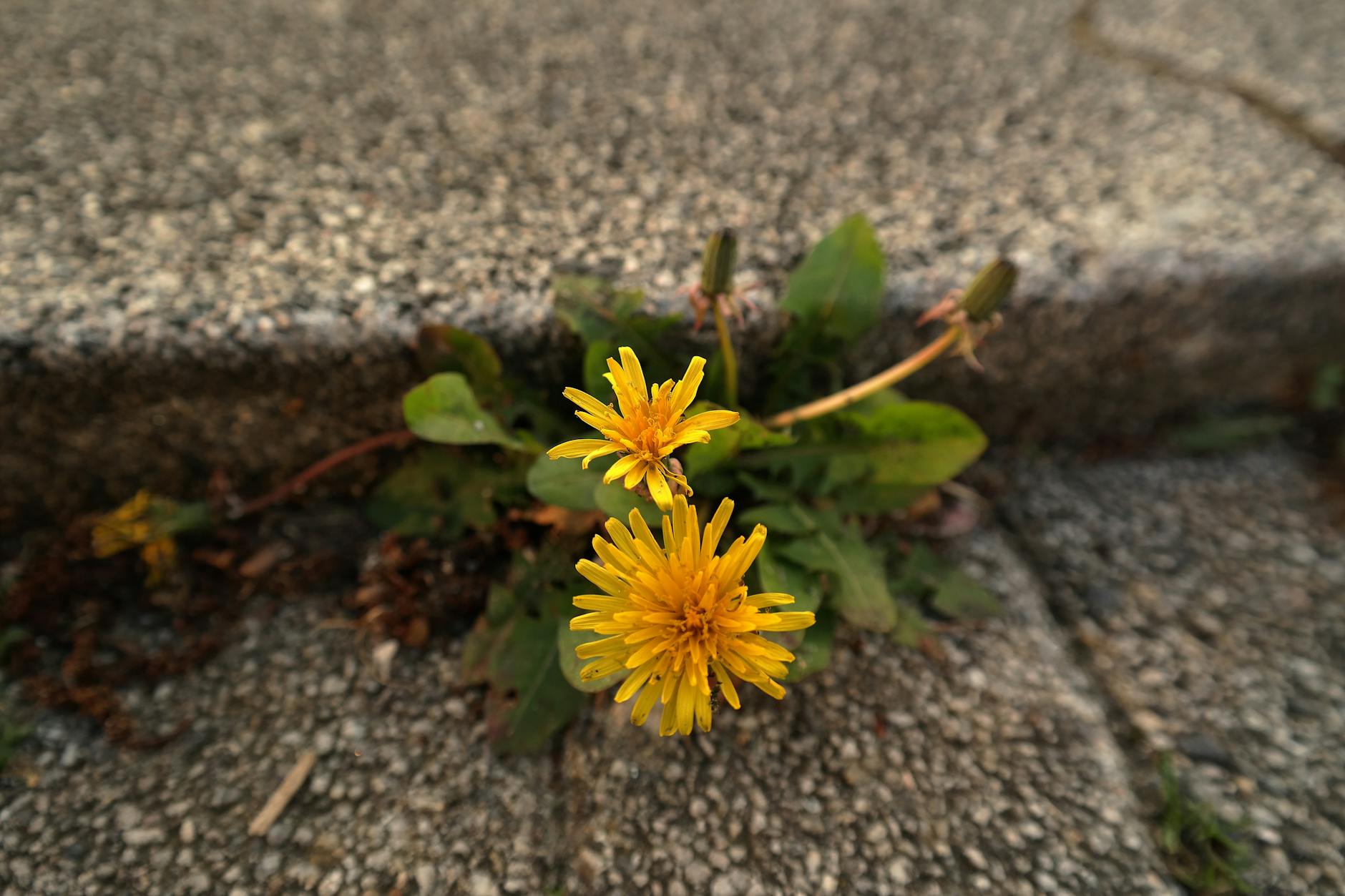
Dandelions don’t register an opinion about where those jackass humans put cement. They just grow. Photo by George Becker on Pexels.com
Having a “gratitude” mindset, a “gratitude” practice, or an “attitude of gratitude” can sound and feel a little weird. For myself at least, I like the idea of mindfulness a bit more just because being mindful inevitably involves being grateful- for everything, every moment, every unique second of your life- without leaning into overly humble-sounding BS.
Maybe it’s a bit of a linguistic trick, but follow me on this- it’s hard to take things for granted when you realize they won’t last forever.
If you’ve been reading this blog for any amount of time, you can guess what my state of mind has been like this last week and why I wound up skipping a blog post.
I’m not going to go over the recent election here except to say that while I’m frustrated and disappointed, I’m not wholly surprised. That can also be said for the anti-Jewish pogroms that seem to be all the rage in Europe again. Clearly going “vintage” doesn’t just mean aesthetics anymore- it also covers racial violence, and several groups appear to be giving 1939.
The Outrage and Angst Machines are running full tilt and their product remains what it always has been- Fear and Exhaustion, getting dumped into our lives faster than ever.
The idea is not to drown us, but to make it so we drown ourselves. To make us isolate ourselves in fear of everyone and everything and burn out all our energy over The Next Big Bummer so we’ll throw up our hands, sit down, shut up, and get on with dying quietly.
“Engage with the world around you at your own risk,” it all yells at us from the TV, from our phones, from stickers and posters and placards and screaming strangers. “Better and safer to Trust Us, give us your money and voices, and let us tell you who to hate today while we swaddle you in little luxuries. You can even choose which ones.”
You can absolutely love what you do and still be fucking tired.
Compared to a lot of folks, I’m lucky. I have a wonderful wife. I live in a decent town, and between the two of us we manage to make enough to live comfortably working in fields we love and trained for.
I’m going to go ahead and toot my own horn a bit here (my therapist said I need to improve my self-talk) and share that I am objectively very good at my job. The work of being a pastry chef, running and training a small team, and developing recipes is not an unmanageable burden for me. My team and I deliver excellent work for our employers and our customers.
Just because someone carries a burden well doesn’t mean it isn’t heavy, and even people who perform well at work they enjoy feel the need to put down their tools, scream into the void for a bit, and then take a nap.
The internal editor is both a writer’s best friend and worst nemesis because its voice sounds like all of our heroes, influences, instincts, talent, and tastes. The problem is that those voices are both encouraging us and criticizing us, simultaneously and constantly. I think writing only really comes out when you can shut all those voices off- even just for moments at a time. Between news of the world, work, and my own preoccupation with getting back in shape, there are precious few times when I can actually feel “still” enough to hear my own voice.
In the Hagakure by Yamamoto Tsunetomo, the samurai-turned-Buddhist monk writes “Lord Sanenori said, ‘In the midst of a single breath, where perversity cannot be held, is the Way.’”
Think about that for a moment. You’re breathing right now, right? I hope so, anyway. Don’t do anything to change your breath, but just kind of notice it. When people meditate, the reason we get told to “count our breaths” or “focus on our breath” so much is that it’s impossible to breathe anywhere butin the present moment.
So here you are, breathing, and just being aware of air going in and out of your body. Without changing your breath, though, try to notice the spots between the breaths. The point just before you inhale or exhale when the previous motion has just finished. Nothing in, nothing out, you’re not actively holding your breath… it’s just stillness.
Paying this kind of attention to something as ubiquitous as breathing- really just being still and present long enough to notice- can feel really freaking weird. It’s like suddenly noticing how your clothing feels on your skin, or realizing you can feel the structure of your teeth in your mouth.
Okay, that last one WAS seriously weird. Sorry about that, but when was the last time you stopped long enough to notice something like that, though? Before I started meditating regularly, that kind of sensation only happened when I was injured or something felt off/wrong. We’re not encouraged to stop or think or be present- there’s so much to do and see and consume and needs doing and we’ll be left behind otherwise, and therefore less-than therefore shamed therefore unfuckable therefore therefore therefore… It’s not a good way to live, but we’re used to it. We’re so used to it that stopping to think, feel, and be present in our bodies feels really goddamned weird.
I still don’t always feel as still or serene as I want to, or when I want to, but I have started to notice moments that make feeling present easier.
I’m a chef, so of course focusing on a taste or flavor is important. Whether it’s shutting my eyes to focus on what a new batch of nectarine jam needs at work or sitting up on my porch, determined to experience everything a dram of whiskey has to offer, those are moments of quiet focus, stillness, and presence that I need in my life.
When I run, that feeling of presence and stillness is called “the Zone” or “the Void.” The mind goes blank and there’s nothing but the slap of shoes on asphalt and wind on skin. Even physical pain is ignorable and thus endurable.
It’s a bit different when I’m sitting down at my writing desk because ironically it’s here that sensory presence can be a distraction. The candle I’ve made a habit of lighting when I write does less to inspire presence than encourage contemplation. Above my desk is a large print of Rene Magritte’s “Personal Values.” I chose it because it’s surreal, serene, and just odd enough to let you stare at it for a moment and think about other things, like watching fish in a tank.
“Personal Values, 1952”- Rene Magritte
Even as I sit here writing, there is that internal editor again. “Where are you going with this, Matt? Does this have anything to do with food? The culinary industry? Are you a food writer or aren’t you?”
Yeah, I am- and I could easily spin this whole article to be something about finding stillness in the creative life, maintaining mindfulness in the kitchen, or meditations over a medium-well-roasted tofu block. I’m not going to, though. Even in your creative life and the pursuit of a craft, you need to take the equivalent of a breath and find the stillness before it.





 The Black Hat Baker