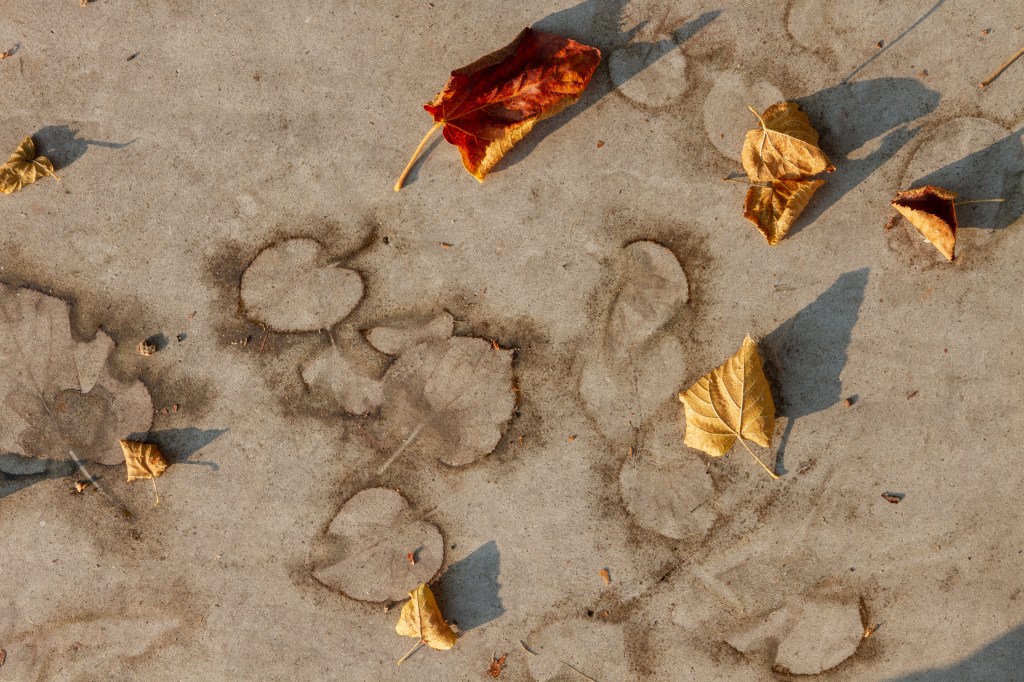
Portland is full of tannin shadows, and so are we.
It’s one of those things that you see, appreciate, but don’t know the actual word for until the memory tickles you enough to do a conversational, unspecific Google search. “What is it called when fallen leaves leave imprints on the sidewalk before they are cleared away?” The unsought-for “AI Summary” regurgitated the fact that there was no specific term, or that the term depended on whether they fell on set concrete and left an imprint or if it was set and left a stain from rotting.
As it was, the summary’s “scientific cause” description was adroit and perfect, because I am a sentimental nerd. Tannins are the compounds in leaves that, when they are wet, can leech out into the porous concrete and leave a “shadow” before the leaf itself is swept or blown away. Wine and tea snobs will also appreciate that tannins are the compounds that make their beverage of choice “dry” and crinkle the sides of the tongue, and cause the stains in a teacup. Equally poetic is the fact that consuming tannins too regularly or in high enough concentrations can cause anemia as they prevent the uptake of nutrients and minerals like iron.
For our autumnal purposes, however, “tannin shadow” is perfect because it’s the impact of a loss, left in bitterness. Fall in Portland is rainy and blustery, calling everyone to get cozy and reflect on the year, and the tannin shadows aren’t just on the sidewalk. Sitting in my sweaters and scarves, looking into my dark beers and whiskeys, and staring at patterns in pipe smoke on the back porch, I can’t help but acknowledge the legacies of losses.
If not “holiness,” then let’s call it “sanctity.” “Austerity” could also work, I think. Whatever word you want to use, it’s the idea of being in a very large place where a lot of people do a lot of generally serious things in the name of something arguably intangible, and it has a unique smell. The government buildings I have been in don’t have that kind of smell (“why” is something others can argue), but synagogues, the right kind of churches, and museums definitely do.
Somewhere a while back, I read that the reason people love the smell of “old books” is because lignen- the fibrous matter in plants and trees that paper is made of- has compounds that decompose over time into a yellowish color and is related to vanillin, the compound that (you may have guessed) gives vanilla its smell and flavor. Synagogues and churches inevitably have a LOT of old books in them unless they are brand new. Hymnals, prayer books, and holy texts to service a whole congregation don’t come cheap, and there aren’t “new editions” of ancient vows and praise that require refreshing the stock. The same prayer books (ideally) serve generations. The next time you walk into a place of worship, it might be interesting to wonder who held your hymnal before you. What were they going through? What were they thinking, if anything? What did they pray for if they could? Were they praying for you?
“Lovers and madmen have such seething brains, Such shaping fantasies, that apprehend More than cool reason ever comprehends. The lunatic, the lover and the poet Are of imagination all compact: One sees more devils than vast hell can hold, That is, the madman: the lover, all as frantic, Sees Helen’s beauty in a brow of Egypt: The poet’s eye, in fine frenzy rolling, Doth glance from heaven to earth, from earth to heaven; And as imagination bodies forth The forms of things unknown, the poet’s pen Turns them to shapes and gives to airy nothing A local habitation and a name.”
– A Midsummer Night’s Dream, Act V Scene I
At the end of his own weird and raunchy comedy A Midsummer Night’s Dream, Shakespeare lets us in on his own thoughts regarding passion and madness. Passion, Creativity, and Insanity are the coin of the realm in culinary arts. The work of food writers, celebrity cooks, and media like The Bear parade our damage for the public and make us heroes, horror stories, characters, and even martyrs when we die.
I don’t think for a second it’s somehow undeserved. That’s the part of our lives that kitchen veterans miss and swap stories about. What some people think needs to be done about- or with- that passion, however, has me wondering. How to do you temper, train, guide, and coordinate that kind of raw passion and madness? History would tell us we need to be like the military. Owners and executives who spend more time owning and eating in restaurants than actually making them work tell us we need to lead and manage like a business or a factory- possibly one that turns Dirt into Diabetes.
Personally, I think that the answer to leading and managing cooks is to stop seeking “employees” as much as finding acolytes.
Yesterday I was hurting for something to write about this week. It had been an exhausting week and there are always stand-by topics when it comes to food writing- exhaustion, mental health, how to not be a jerk when dining- the usual list. I’d covered most of these pretty well, though, so I wasn’t ready to cover old ground quite that churned up. I was about to head out for a walk when the following quote came across my social media: “You inherited more than generational trauma. Your ancestors also left you their wisdom and their strength.”‘
Given that I’m feeling very very Jewish at a moment when two entire cultures people have very recently had their generational traumas triggered at the same time by bad actors and pointed at each other (with a whole Western world primed to lay their own politics on the conflict no less,) the word “generational” leaves a strange feeling in the mouth. Whether regarding trauma or strength and wisdom, it comes packed with a lot of emotions that are best understood, managed, and then utilized- or dispensed with.
“L’dor v’Dor-” in Hebrew, “From generation to generation.” We keep living, we keep passing on what we are and what we learned, for good or ill.
I’ve written something about the specific nature of my Jewish upbringing in a fewblogposts. I don’t know that I always went into particulars, but “generational trauma” is something that Jews know a lot about and the lessons from it are some of the hardest, most spiteful lessons that we’ve had handed down. The kind that we describe to our Gentile friends with jokes like “Every Jewish holiday is based somehow on ‘They tried to kill us, we survived, let’s eat!” or “Why are Jews neurotic? It’s because we owe our survival to some of our ancestors waking up one morning and going, “the vibes are off- let’s get on a boat elsewhere right the fuck now.”
That’s dark humor right there. Combine that with some of the wisdom my grand-family handed down to me:
“Learn everything you can, Matt. Knowledge is something that can’t be taken away from you.”
“You‘ll always find bookstores in Jewish communities. Booksellers love Jews because we always have to remember the past.”
“Learn to be able to do a little of everything- you never know when it’ll come in handy.“
“You know your grandfather almost couldn’t practice medicine in this town because they wanted the town ‘Jew-Free,’ but they let him in because he was also a Freemason.”
Good advice for anyone, right? Then you read it again and you see the unspoken lesson- “Everything that we have can be taken away from us. We must never forget who we are and be ready to live wherever we go next.”
This all got ramped up to 11 after World War II when maintaining and rebuilding the community and Jewish identity became not just a necessity but (albeit understandably) a spite-driven burden to be explicitly handed down. I had female friends who were directly told that failing to find a Jewish husband and having lots of Jewish children would be “giving the Nazis a posthumous victory.” My previous blog post looked at this from a religious standpoint as spite is nothing to build a spiritual practice on, but from a cultural perspective this specific version of “never forget” became an obsession.
In my Jewish secondary schooling (which we called “Hebrew High,”) every year we’d be taught aspects of the culture and religion that were only touched on in the Jewish version of “Sunday school.” It almost became a joke that, every year, there’d be a class called “___ and the Holocaust.” “Art and the Holocaust.” “Music and the Holocaust.” “Film and the Holocaust.” “Holocaust Literature.”
A highly polished version of Israeli and Zionist history was included, of course. The timeline of those courses largely went “Dreyfus Affair, Herzl had a big brain idea, Britain was cool with it then wasn’t, America was okay about it, all the Arabs and Muslims hate us, but we fought them and won, still there now, so send money so we can plant more trees.” The division of the Middle East by the Entant after World War I was barely mentioned, nor was even the word “nakba.” The fact that Herzl was a bit of a classist with internalized antisemitism of his own, that Zionist philosophy has fractured 15 different ways since then, and that The Balfour Declaration was a (largely unsuccessful) ploy to get American Jews to pressure their government into joing the war were never mentioned at all.
As an aside, I’ve seriously had to unlearn more about Israel and Zionism than “activists” have picked up in hashtags and slogans since 10/7. If you don’t have skin in the game, your job is to listen- not lecture.
What does education like this create? What is being passed down “from generation to generation? The answer is a community held together by the holes poked in it. A religious and cultural community that keeps itself “strong,” but hypervigilant, spiteful, and scared. To quote Rabbi Zalman Schachter-Shalomi, when challenged by another rabbi in their discussions with the Dalai Lama that our insularity has made us strong- “There are terrible ways to be strong.”
“May Their Memory Be A Blessing”
When you are on the run, you learn to survive and pack light. You teach your children how to do the same. You teach them to do what you can with what you have, value knowledge and stories, and never forgetting who you are (because no matter what they say, the rest of the world will always remember.)
Persecution creates paranoia, and it creates ingenuity and resolve. Besides prizing knowledge and history, my parents and grandparents had more to say– about remembering that we had little, so when we have more we should give to those who don’t. Ashkenazic Jewish cooking itself is a story of Jews moving from place to place, making themselves a part of communities and learning how to enjoy the food as best they could.
We also learned that while the rest of the world marks Holocaust Rememberance Day from when the Allies liberated Aushwicz, in Judaism we mark it from the start of the Warsaw Uprising– when the Allies left us to our own devices and we as Jews fought back ourselves.
In Judaism, when we speak of someone who died, we don’t say “may they rest in peace.” We say “may their memory be for a blessing”- meaning that we should remember them when blessing the living. “You should be as strong as your Grandpa Larry.” “You should be the kind of woman your Bubba Mitzi was.” It’s one small way we pass more than pain l’dor v’dor- from generation to generation. We pass on gifts as well.
When and if I have children, though, I hope I live to have the presence of mind to pass the lessons on without the pain and spite, so they can enjoy the blessings more.