Master of the House

Good evening, friends and neighbors!

You likely don’t know who Jean-Anthelme Brillat-Savarin is. You MAY know of a creamy spreading cheese named after him, or possibly the rich, spherical dessert.
If you’re like me, however, and you loved watching Iron Chef Japan, you know the quote that started each episode before Chairman Kaga’s monologue:
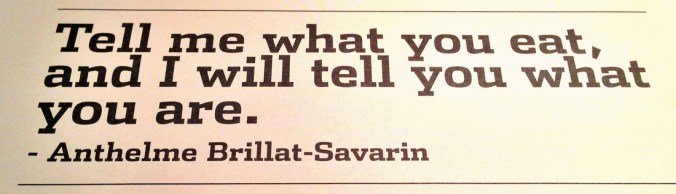
     Amazingly, the man who offered us this maxim was never a chef, a baker, or even a cook. He was a lawyer, a judge, a politician, and a violinist. He fled to America in order to save his head from the guillotine. He was a writer, a thinker, an amateur physician, and a singer- and he wrote the bible on how to be a host and a gourmand.
     When “La Physiologie du gout” (“The Physiology of Taste”) was published in 1825, a scant few months before Brillat-Savarin’s death, his words were treated like gold. His book was the latest on the science, development, society, and abject of food and the culinary arts. Memories of his parties- both recalled by attendees and recorded as anecdotes in the book- made him the final word in what it was to be a good host. How to throw a dinner party worth attending, how everything should be arranged and chosen to befit visiting nobility- all of it laid out with a physicians intellect, a gentleman’s decorum, and a party animal’s joie de vive.

     In 2016, however, we have Martha Stewart and Ina Garten on our TVs, and Alice Waters on our book shelves, offering an invitation to a different dinner party- one that most of us can only attend in our dreams, lacking the time or resources to make the TV show fantasies come true.

     If these pastel dreams are rare in the real world, then the classic dinner parties are all but dead. They’ve been left in the keeping of certain gourmet organizations that refuse to put them aside, or relegated to Masterpiece Theater.
     ​In this day and age, do the 190-year-old words of the legendary host still shine, or does their luster belong to a world long since past?

     Well, I read them- and I have thoughts on this.

Who Is Brillat- Savarin?
     Born in 1755 in the small town of Belley, France, Brillat-Savarin was a gourmand- a lover of fine food and wine- and was a magistrate to pay the bills. He eventually was elected mayor of Belley. However, when the French Revolution broke out, the heads of administrators (and a number of gourmands, for that matter) started to roll. Brilliant-Savarin would have been in line for the guillotine himself, had it not been for a chance encounter at a dinner party with a revolutionary’s wife. A shared love of music convinced the woman that “when a man cultivates the arts as you do, he does not betray his country,” and she persuaded her husband of the same. Even with this promise safety, Brillat-Savarin still feared for his life and fled first throughout Europe, then to America. 

     Returning to a calmer, less-deadly France in 1796, he became a judge in the French Supreme Court- the perfect thing to keep Brillat-Savarin’s finances happy while he pursued his love of entertaining. At the same time, Brillat-Savarin wrote prolifically of his opinions and meditations on food, dining, and everything to do with them. Every now and then, Brillat-Savarin would read some snippets at his dinner parties, much to the amusement of his guests (after all, a good host should never be without a few stories and jokes to tell!)
After much cajoling and goading from his friends, Brillat-Savarin published his writings as “La Physiologie du gout”, to almost immediate widespread acclaim- only to die a few months later of pneumonia in 1826.

Basic Gourmandism
First off, if you decide to pick up a copy of the book, this is absolutely a product of its times- with all the heteronormative, cisgendered, white ethnocentric thinking that time involves. While Brillat- Savarin (calling himself “the Professor”) fills most of the book with anecdotes about his life and doings, the first part of the book is given over to his understanding of physiology, gastronomy, and psychology. There’s a number of things you’ll likely be able to pick up as patently outdated and since disproved. Among them is Brillat-Savarin’s references to psychomorphology, the idea that certain body types and physical characteristics affect one’s personality and vice versa, such as “fat people tend to be jollier,” and “a smaller nose indicates greater intelligence.” 
While reading these chapters is certainly a fascinating look into the scientific understanding of the time, it should be regarded as just that- and since this blog post is aimed at his views of hospitality and food rather than the human body, I’m going to skip over those bits.

Picture

Relax, you’re fine.
     That being said, Brillat-Savarin thoughtfully starts off with a list of 20 aphorisms he has coined, forming the nuts-and-bolts of his philosophy. Some of my favorites include:

“Animals feed: man eats: only the man of intellect knows how to eat.”
“The pleasures of the table belong to all times and all ages, to every country and every day; they go hand in hand with all our other pleasures, outlast them, and remain to console us for their loss.”
“The discovery of a new dish does more for the happiness of mankind than the discovery of a star.” 

Thoughts on that one, Dr. Tyson?
     Perhaps most pointedly for this blog are these two additions-
The man who invites his friends to his table, and fails to give his personal attention to the meal they are going to eat, is unworthy to have any friends.”

“To entertain a guest is to make yourself responsible for his happiness so long as he is beneath your roof.”

    These lines form the basis of what it is to be a gourmand- that food and wine should be loved, studied, admired, and enjoyed in the same manner as a symphony or a novel. It is the recognition that food is an art form, and should be treated as such.
Brillat-Savarin, in his chapter on gourmandism, laments the fact that the word and concept are so misunderstood:

“I have consulted all the dictionaries about the word ‘gourmandism’ and am far from satisfied with what I have found. There is endless confusion between gourmandism, properly so called, and gluttony or voracity…”
Gourmandism is an impassioned, reasoned, and habitual preference for everything which gratifies the organ of taste. Gourmandism is the enemy of excess; indigestion and drunkeness are offenses which render the offender liable to be struck off the rolls.”


-The Phsyiology Of Taste, trans. by Anne Drayton

Today, most of us may confuse the word “gourmand” with its hipper, more modern cousin “foodie.” While there is certainly nothing wrong with considering oneself one or the other, one writer for the Orange County Register suggests that while both foodies and gourmands love food, “They are beyond foodies. Foodies dabble. These are gourmets.” Indeed, Nancy Luna charges groups like the Chaine des Rôtisseurs with keeping and protecting the traditions and decorum that Brillat-Savarin loved and espoused.
Thus Spake Savarin…
Throughout the book, Brillat-Savarin offers anecdote after anecdote to illustrate his points (often amusingly- the man really DID have a great memory for stories.) Thankfully, however, in his chapter “On the Pleasures of the Table”, Brillat-Savarin lays down his requirements for the perfect enjoyment of a dinner, or to invoke “…the pleasures of the table in the highest degree.”

First, the guest list:
“Let the number of guests be not more than twelve so that the conversation may be constantly general;
Let them be chosen with different occupations but similar tastes, and with such points of contact that the odious formalities of introduction can be dispensed with;…
Let the men be witty without being too pretentious, and the woman charming without being too coquettish.”

The atmosphere:
Let the dining-room be well lighted, the cloth impeccably white, and the atmosphere maintained at a temperature of sixty to seventy degrees;…”
Let the drawing room be  large enough to allow for a game at cards to be arranged for those who cannot do without, yet still leave space for postprandial conversations;

The schedule of the evening:
Let the progress of the meal be slow, for dinner is the last business of the day, and let the guests conduct themselves like travelers due to reach their destination together;…
Let the guests be detained by the charms of the company, and sustained by the hope that the evening will not pass without some further pleasure;…
Let retirement begin not earlier than 11 o’clock, but by midnight let everyone be in bed.”

And obviously, the food:
Let the dishes be few in number, but  exquisitely choice, and the wines of the first quality, each in its class; 
Let the service of the former [the food] proceed from the most substantial to the lightest, and of the latter [the wines,] from the mildest to the most perfumed;…
Let the coffee be piping hot, and the liquers chosen by a connoisseur;…
Let the tea be not too strong, the toast artistically buttered, and the punch mixed feelings with proper care.” 

According to “the Professor,” this was how you throw a dinner party for the ages.

Sorry, Doc… times have changed.

​According to “the Professor,” this was how you throw a dinner party for the ages.

Sorry, Doc… times have changed.

Entertainment Today
     Today, if people throw a dinner party, it is likely not based on the words of gourmands or society gurus- rather the size of their budget, and what they have at their disposal.
     The last “dinner party” Emily and I held was Thanksgiving dinner. It was our first in Oregon, and we invited three friends from her work. It was in our small, one bed/one bath apartment, gathered around a folding table in the living room.
     The tablecloth was green and folded awkwardly to fit the tiny table, as we had just picked it up (along with many of our plates) from Goodwill. It was placed in our living room as that was the only place besides the bedroom and kitchen to put it.
     No order was given to the wines, as our friend Nick had brought them and I supplemented with some choice beers and homemade mead. The order of the dinner was not arranged “light to heavy” for the sake of proper enjoyment- the turkey simply needed more time in the oven, and everything else was ready to go first.
     Afterwards, coffee and tea were offered, but generally refused- there was still plenty of wine, and the desserts I had made of Jewish Apple Cake and Pumpkin Pie were on the table.
     We talked, played guitar, and watched YouTube videos for a while- and then everyone left around 9 to get home. They didn’t have work in the morning, but I did. 
Picture

We don’t do “holidays.”
This is likely better-than-average for a modern dinner party. Even compared to the suggestions of Martha Stewart and Ina Garten, it was notably tacky and lack-luster.

Yet, I have a feeling that Brillat-Savarin himself would have had a good time and found no reason to complain. The reason, I feel, is very simple, and goes back to those two aphorisms of his-

The man who invites his friends to his table, and fails to give his personal attention to the meal they are going to eat, is unworthy to have any friends.”

“To entertain a guest is to make yourself responsible for his happiness so long as he is beneath your roof.”

Not to toot my own horn, but Emily and I put our all into that tacky little dinner. Emily spent the day cooking and prepping. I was up early baking the pie and cake- all just to make sure that our three friends could have one night of good food and good times. We shared stories, drank and laughed, and enjoyed the products of our labor.

THAT is what makes a good party, and while the decorum that Brillat-Savarin espouses is certainly grand and wonderful, it’s the effort and attention of the hosts that truly makes a gathering memorable. 

Times and food change, but good hospitality does not- and there will always be people like Jean-Anthelme Brillat-Savarin who love and study entertaining not just for its own sake, but to show the rest of the world something wonderful.

Cheers, Professor- Vous avez bien parlé, et un monde affamé est reconnaissant.

Rester chic,

​Rester chic,

What’s A Guy Gotta Do To Get A Drink (after work) In This Town?!

Good evening, friends and neighbors!

It’s been a while since I’ve done a simple, less-guided entry, hasn’t it? Ever since the move out to the Pacific Northwest, I’ve had to re-establish a few things that I generally took for granted in my daily (and writing) life: favorite dives, favorite restaurants, local bars that I’m pretty comfortable walking home from when I’ve had too many. With Portland’s fairly-excellent public transport, “stumbling distance” can mean a few miles- provided you can keep straight enough to hop the right bus/train combination.

Picture

Hey, you aren’t driving, right?

Continue reading

An Open Letter to Brand New Pastry Grads- From Someone Your Age

Good evening, friends and neighbors!

Ok, so I’ve been sucking a bit at updating (except Instagram- that’s annoyingly addictive.) Sorry about that, but part of the reason why? I finally got a job out here.

The job is at a restaurant and caterer, where I was hired to be a “relief baker.” Since their banquet season is in full swing, however, and since I have pretty decent kitchen skills OUTSIDE of baking as well, my job has more or less been catering prep and cooking. All in all, not a bad gig.
The experience of having a non-baking job for the first time in a long time got me thinking. About now, many culinary schools are ending their winter semesters, and some of my colleagues may be graduating, throwing themselves and their fates into the industry.

Picture

Continue reading

The Hunting of the Job: An Agony in 30 Fits

When I was a kid, a “job” was whatever my chores were- usually things to be bartered, swapped, argued over with, and foisted of on me and my sisters. “Work” was the thing that Dad did for most of every day- or a nebulous and vile entity that tended to call him at irritating hours.
“I have to go to work, Matt- school is YOUR work. Make sure it gets done.”
Picture

“Yes, Dad….”

Right now, I am in the longest stretch I have ever gone without work, and I would give almost anything to bitch about a case of the Mondays again.

The last time I was jobless, the Black Hat Bakery was born, based on what I then called “The MacGuyver Priniciple.”

The MacGuyver Principle“If you need something, and you don’t have it, can’t find it, or get it, get started making it.”

This tied in nicely with another cozy saying:

“If Necessity is the mother of Invention, Desperation is the mafioso godfather.”

There are any number of websites and articles out there that will give you tips on job hunting- interviews, your resume, negotiating a salary, and so on. I have been burning through them in my maddening search for employment, and trying every shred of advice people have offered me.

In the end, the decision of whether or not someone hires you is NOT in your control. All you can do is present yourself in such a way that they MIGHT want to.

Here, so far, are what I have learned in going to 6 interviews, 4 working interviews, and firing off an average of 8 applications a week since I have arrived in Portland.

So You REALLY Want A Job In Portland…

1. Don’t be like everyone else- including not being like everyone else.
One of the first pieces of advice I got on coming to Portland was to make myself memorable to interviewers- dressing uniquely, bringing samples of work, etc. This works great… unless everyone else is dressing weird and being crazy too. Eventually, I realized- this was Portland. I was from NEW JERSEY. So I put on my best suit, carefully picked out a tie, carried 3 copies of my resume to each interview in a briefcase, and looked every interviewer in the eye with a smile and firm handshake.
You can be as weird as you want- and sometimes the weirdest thing you can be is a professional.
Picture

Granted, a guy from Jersey showing up in a suit can have mixed messages…

2. Respect time- theirs, AND yours.
When I worked at a Scout camp in Barnegat, I was taught a simple rule about respecting time- “If you are 15 minutes early, you are on time. If you are on time, you are late. If you are late, you’re screwed.”
Hiring someone new is extremely costly- not just in time spent training, but in time spent interviewing and getting back to candidates that could be used more productively. Always respect your interviewers time, and come early.
By the same token, do not devalue YOUR time. If you want to be treated like a professional, BE one. Apparently, out here in Portland, it is common for employers to interview people and simply never get back in contact with them if they don’t wish to hire them. Anyone who has been on a job hunt knows that a job seeker is applying to many places at once, and crucial decisions may hinge on feedback from employers. Do not tolerate people that disrespect you or your time.
Picture

Seriously, it’s just common friggin’ decency…

3. Job hunting IS a job.
Yes, the pay sucks, but make no mistake about it. I am firing off resumes to jobs daily. I am searching my email for replies, filling my schedule around interviews and stages, and baking regularly to keep my skills up. That is DEFINTELY work. Don’t get down on yourself- if you’re trying to find work, you’re not a bum. You’re WORKING.
If you figure out how to remind yourself of this at all times, tell me how. My girlfriend will thank you.
4. Take time off now and again.
Like every job, sometimes you need time off. As my friend Karen said, “Life is a balance between making it happen and letting it happen.” Many aspects of this process are not in your control. Remember to take some time to NOT think about it. Read books that have been sitting on your shelf for ages. Watch movies you’ve been putting off forever because you had to be up in the morning. Take up new hobbies or challenges that working kept you away from before. Don’t be a slacker, but don’t be a workaholic either.
One of the best things you can do is learn new skills or refine old ones- you never know what a future employer might find useful.

Picture

Yeah, THIS ain’t happening once I get 4 AM shifts again…

5. Reach Out To EVERYONE.
Don’t shy away from talking to people or introducing yourself to anyone. You never know who might know somebody who knows somebody who might need someone like you. Just one personal connection can carry more weight with an employer than any CV you’d care to write.
Take advantage of any groups or connections you might have- religious groups, civic organizations, social clubs, whatever. The more eyes and ears you have looking out for you in the job market, the better- even more so if one of them can slip your resume to the top of the pile on someone’s desk.

Picture

That dude you met at the coffee shop with the pizza-baking brother? CALL HIM.

Good luck to all you job-seekers out there. I’ll advise you all of my progress as well- truly I am a stranger in a strange land, but I’m slowly grokking the area.

Stay Classy,

P.S.- Bonus points to everyone that got that last bit.

Discipline- In The Pursuit of Perfection

     Good evening, friends and neighbors!

The other day, my girlfriend and I were talking about our work over dinner. She’s a piano teacher, specializing in teaching very young children, ages 3 to 9. At this age, the children don’t learn to read music so much as listen and learn by ear, memorizing pieces and which keys make what notes to play them.
As we were talking, she mentioned that one of the hardest things to teach students of any age isn’t so much the material, as the characteristics of a pianist- attention to detail, feeling the music, investment and passion in playing, and most of all the diligence and discipline for practicing.


    I couldn’t help but smirk and agree. “Discipline” sounds like a dirty word these days, recalling images of ranting, groundings, spankings, and generally other forms of punishment that parents are warned they shouldn’t use on their kids because it will turn them into cold-hearted, dead-eyed shamblers of the twilight world that is their fate.
Picture

“Calm down, Damien…”

But I’m not talking about that- at least, not directly.


Continue reading