Whimsy isn’t something you have to earn- it’s something you possess and cultivate, and if you are drawn in a direction out of whimsy and authenticity you are too lucky to ignore it. That’s the kind of thing that shows you who you are meant to be.
At the bottom of the hill where my winery is located, there’s a little bar in a shopping plaza. They have decent beers and a few hard liquors to choose from, but they’re really more of a taproom than a full bar. All the same, they are the semi-official post-shift watering hole for cooks, servers, and occasionally office people in the winery. We’re all regulars by face if not by name.
When the beer offerings aren’t tempting me after a long day, I tend to go with whiskey. They have a few pricier bottles to pick from and their cheapest bottles I’d call “middle shelf-” whiskey’s that would be in the $30-$50 range if I got one for myself. Better than rotgut and bottom-shelf well whiskey, but not as speedy as ultra-premium brands. If I’m not feeling like Jameson’s “Black Barrel” expression or one of the slightly spendy local whiskeys, the Old Forester “Bottled-in-Bond” is a reliable choice with a couple small rocks in it.
It was an evening after a rough day. I got my little glass, sat down at a table outside facing in to the parking lot and up the hill, and decided to update the family that it was in fact That Kind Of Day.
My father sent back his approval. “Old Forester was your grandfather’s favorite. There was always a bottle in your grandmothers den.”
I stared at the little glass and thought to myself, “Finally, after 40 years, I’m turning into an Old Man.”
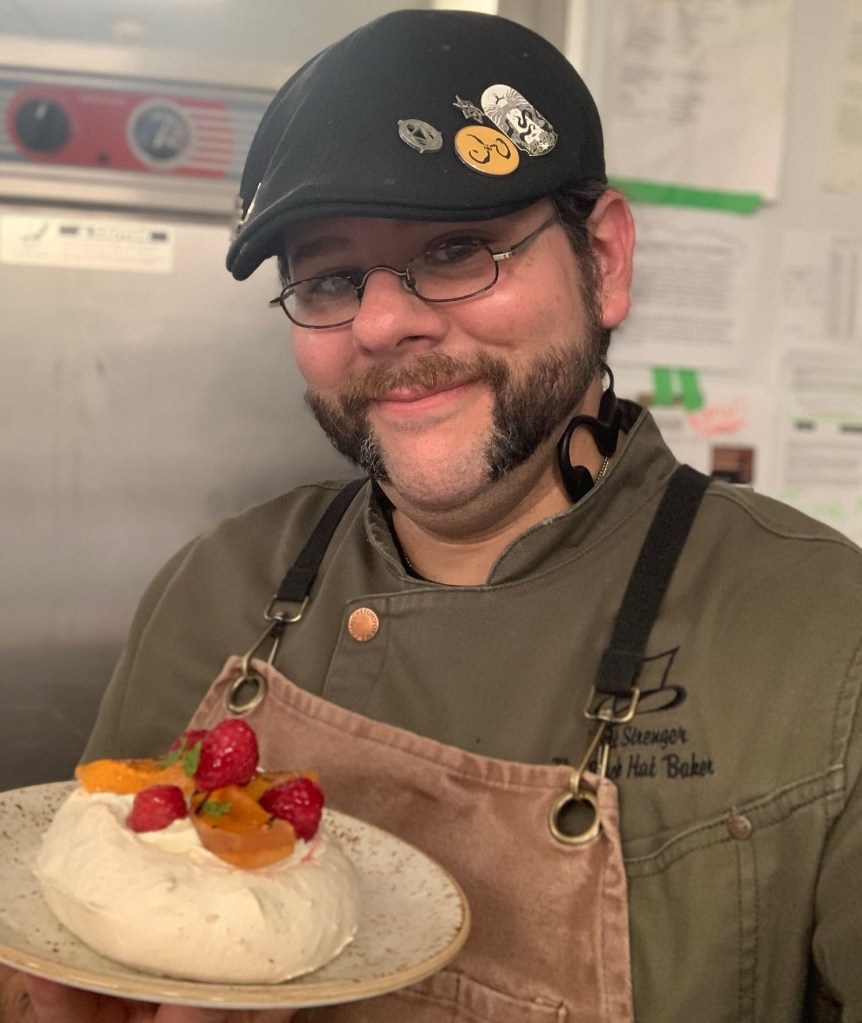
Pavlovas are a dessert that always impress for how simple they are. I have them on the brain right now because I’ll be making a couple dozen for a VIP dinner the day after tomorrow and I’m coming off a bit of an inspirational drought. I’m on the porch in the shade with a lowball of grog beside me and a cigar I may or may not smoke.
Named for the ballerina Anna Pavlova, they are giant baked merengue bowls filled with whipped cream and fresh fruit. If you’ve ever made angel food cake, macarons, or “forgotten kiss” cookies, you already know how to do the hardest bit. Pavlovas look so impressive and dainty, it makes people think they are difficult when the truth is they are a masterclass in Technique, Patience, Fresh Ingredients, and Not Getting Too Fancy.
Simple things are always like that. No space to hide when you fuck up a step. It’s a “you had ONE JOB” scenario, and how well you did that One Job is there on the plate. Overdone? Underdone? Cracked? Everyone’s going to see and then eat it anyway, because it’s sugar, cream, and fresh fruit that you worked hard on. In that way, pavlovas are a reminder that it’s all just food.
Writing can be like that too, I’ve found. You work at it, you pace it right, tease out the story, don’t outsmart your common sense, and hopefully you end up with something people will enjoy.
My boss and I had loosely discussed the VIP dinner dessert. The last dinner we did, he chose a riff on carrot cake because he knew it was the winemaker’s favorite and she would be in attendance. I did my best work on it and everyone loved it. Happy ending. The winemaker enjoyed it, but wondered if it really paired well with the wine that had been selected. I’d never gotten to taste the wine or even get notes on it, so the carrot cake was good… but overshadowed the wine at a VIP dinner at a winery. We could do better.
This time around, the winemaker showed me their advertising copy with tasting notes and poured me a little scoot to try. It was tangy, floral, and spoke of peaches and stone fruit. I jotted down notes in my phone along with her suggestion to avoid going too sweet, or the wine might taste sour in comparison. That’s easy to do with anything that isn’t “dessert wine”- ice wine, ports, or the kind of muscats you find glued to the lips of bridal shower attendees. A pavlova might actually be the perfect answer.
Initially, the boss and I had discussed a riff on another dinosaur Oceanic classic, Peach Melba. Instead of the poached peaches and raspberries on ice cream, however, my boss very much wanted a tart for the dinner. Tarts are easy to plate, clean to cut, and are easy to get cute with. Pile on the flavors, the textures, the colors, and a good cross-section will shine on anyones Instagram, hopefully tagged with the location and brand of the wine,
We both did trials of our tart ideas but neither quite fit the bill, and I kept assembling pavlovas in my mind. I’ve learned that some ideas won’t leave me alone until I take a crack at making them. Writing is a bit like that as well- you pay attention, and you’ll find a story worth telling the best you can.
The pavlova shell would be flavored with jasmine green tea. The herbal/floral scent compounding the flavors above and giving a bittersweet foundation- a blank sky for a flock of birds to be seen against.
I debated a diplomat cream filling- pastry cream lightened and folded with Chantilly- but decided even that would be too much. Pastry cream is a custard. Custard means egg. Egg is earthy, sweet, and grounding- a distraction. Instead, whipped creme fraiche with vanilla- a little sweet, a little sour, not too fancy, This and the shell would be vehicles carrying the fruit- important to do well, but no one marvels at the foundations of a house.
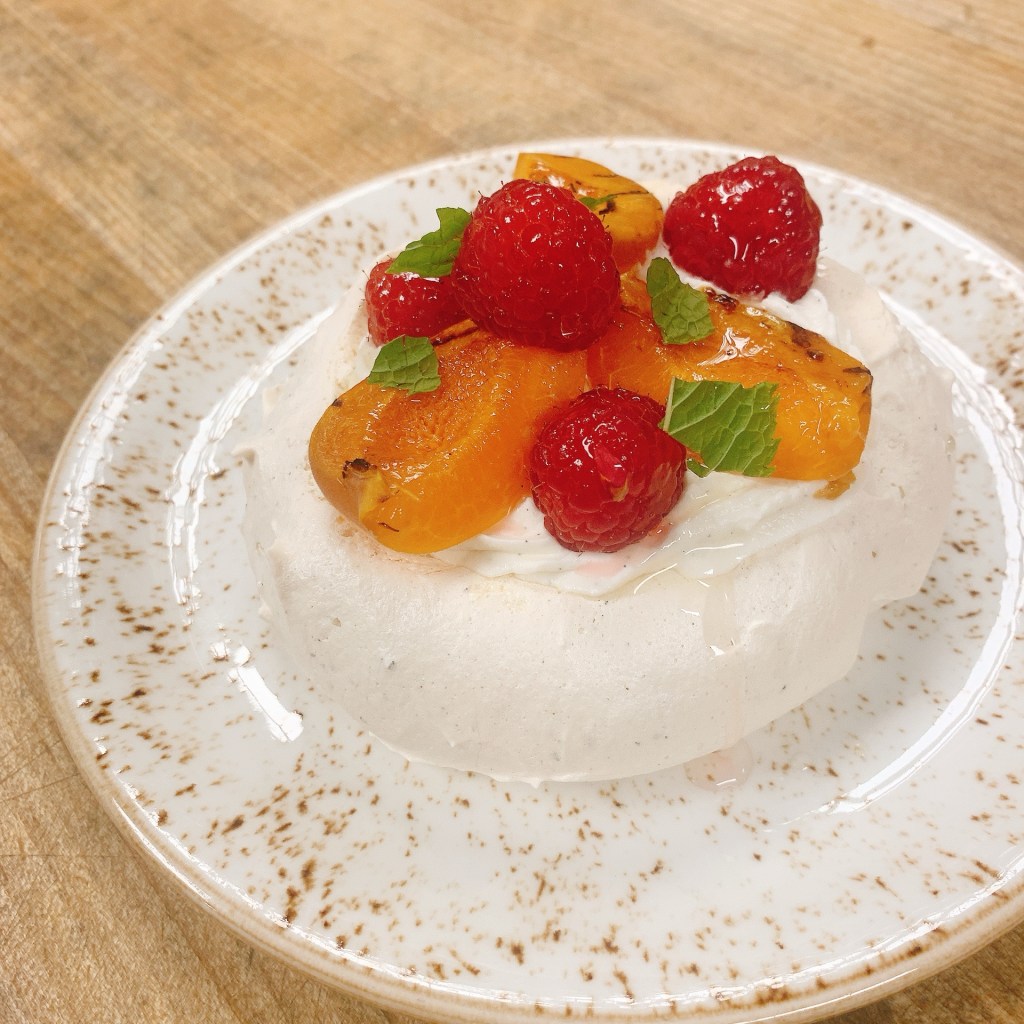
It would be Peach Melba inspired, like the chef and I agreed. Stone fruit was coming into season, and this would be what spoke to the wine. It would have to be gently handled. Highlighted. Elevated to stand out on the plate and point toward the wine. I imagined grilled apricots- another touch of bitterness in the char to caramelize the sugars and announce the sunshine in the golden flesh. Fresh raspberries are always good as they are.
You glaze the fruit on a plate. That’s just how it is. Cooks are craftsmen, and it’s our job to imitate nature and make it look like whatever we served you just grew like that. If there is fresh fruit on a plate, it needs to look like we just ran out to a garden and plucked a fistful of raspberries wet with morning dew from the bush. We have to make ourselves disappear in your mind when you look at the plate– wizards and elves and faeries just poofed this perfect plate of sustenance in front of you with no human hand intervening.
Glaze adds sweetness, but done right it can add more without drawing attention to itself. I imagined the berries and grilled apricots, shining in the light on the plate atop their hillock of whipped cream and egg. A little hill. On the hill up to the winery, I knew there was a honeysuckle bush- I smelled the blossoms every morning. Pungent, light, floral, fresh… I needed THAT on the plate.
Early one morning last week, the idea couldn’t live in my brain anymore, and I put it together. “Just make it happen, get it out of your head, and don’t fuck around.”
That’s why the VIPs this week are getting pavlova, you got to read about how it was made, and I have an empty glass beside me. Putting the right things together and putting the work in to treat them right means you’ll more often that not have something to enjoy.
Grilled Apricot Pavlova with Raspberries and Whipped Creme Fraiche
Go far enough down a rabbit hole, and you’ll find more than Wonderland. No subject or history happens in a vacuum and, if you are curious enough, you’ll find links to people, moments, movements, and concepts you might not have thought possible.
I’m reading an oddly engaging book that is, ostensibly, about a famous sibling rivalry in Battle Creek, Michigan at the dawn of the 20th century. The book is also about American foodways of the time, the history of medicine, and the beliefs of various Christian sects in America- namely the Millerites, the Grahamites, and the Seventh-Day Adventists.
You might think that’s a little far afield for a book on sibling rivalry- until you realize that the brothers in question were Dr. John Harvey and Will Kellogg. Together, they created the “wellness” industry, pioneered the mass production of food… and so helped give 21st-century weirdos something else to obsess over.
Yesterday I was hurting for something to write about this week. It had been an exhausting week and there are always stand-by topics when it comes to food writing- exhaustion, mental health, how to not be a jerk when dining- the usual list. I’d covered most of these pretty well, though, so I wasn’t ready to cover old ground quite that churned up. I was about to head out for a walk when the following quote came across my social media: “You inherited more than generational trauma. Your ancestors also left you their wisdom and their strength.”‘
Given that I’m feeling very very Jewish at a moment when two entire cultures people have very recently had their generational traumas triggered at the same time by bad actors and pointed at each other (with a whole Western world primed to lay their own politics on the conflict no less,) the word “generational” leaves a strange feeling in the mouth. Whether regarding trauma or strength and wisdom, it comes packed with a lot of emotions that are best understood, managed, and then utilized- or dispensed with.
“L’dor v’Dor-” in Hebrew, “From generation to generation.” We keep living, we keep passing on what we are and what we learned, for good or ill.
I’ve written something about the specific nature of my Jewish upbringing in a fewblogposts. I don’t know that I always went into particulars, but “generational trauma” is something that Jews know a lot about and the lessons from it are some of the hardest, most spiteful lessons that we’ve had handed down. The kind that we describe to our Gentile friends with jokes like “Every Jewish holiday is based somehow on ‘They tried to kill us, we survived, let’s eat!” or “Why are Jews neurotic? It’s because we owe our survival to some of our ancestors waking up one morning and going, “the vibes are off- let’s get on a boat elsewhere right the fuck now.”
That’s dark humor right there. Combine that with some of the wisdom my grand-family handed down to me:
“Learn everything you can, Matt. Knowledge is something that can’t be taken away from you.”
“You‘ll always find bookstores in Jewish communities. Booksellers love Jews because we always have to remember the past.”
“Learn to be able to do a little of everything- you never know when it’ll come in handy.“
“You know your grandfather almost couldn’t practice medicine in this town because they wanted the town ‘Jew-Free,’ but they let him in because he was also a Freemason.”
Good advice for anyone, right? Then you read it again and you see the unspoken lesson- “Everything that we have can be taken away from us. We must never forget who we are and be ready to live wherever we go next.”
This all got ramped up to 11 after World War II when maintaining and rebuilding the community and Jewish identity became not just a necessity but (albeit understandably) a spite-driven burden to be explicitly handed down. I had female friends who were directly told that failing to find a Jewish husband and having lots of Jewish children would be “giving the Nazis a posthumous victory.” My previous blog post looked at this from a religious standpoint as spite is nothing to build a spiritual practice on, but from a cultural perspective this specific version of “never forget” became an obsession.
In my Jewish secondary schooling (which we called “Hebrew High,”) every year we’d be taught aspects of the culture and religion that were only touched on in the Jewish version of “Sunday school.” It almost became a joke that, every year, there’d be a class called “___ and the Holocaust.” “Art and the Holocaust.” “Music and the Holocaust.” “Film and the Holocaust.” “Holocaust Literature.”
A highly polished version of Israeli and Zionist history was included, of course. The timeline of those courses largely went “Dreyfus Affair, Herzl had a big brain idea, Britain was cool with it then wasn’t, America was okay about it, all the Arabs and Muslims hate us, but we fought them and won, still there now, so send money so we can plant more trees.” The division of the Middle East by the Entant after World War I was barely mentioned, nor was even the word “nakba.” The fact that Herzl was a bit of a classist with internalized antisemitism of his own, that Zionist philosophy has fractured 15 different ways since then, and that The Balfour Declaration was a (largely unsuccessful) ploy to get American Jews to pressure their government into joing the war were never mentioned at all.
As an aside, I’ve seriously had to unlearn more about Israel and Zionism than “activists” have picked up in hashtags and slogans since 10/7. If you don’t have skin in the game, your job is to listen- not lecture.
What does education like this create? What is being passed down “from generation to generation? The answer is a community held together by the holes poked in it. A religious and cultural community that keeps itself “strong,” but hypervigilant, spiteful, and scared. To quote Rabbi Zalman Schachter-Shalomi, when challenged by another rabbi in their discussions with the Dalai Lama that our insularity has made us strong- “There are terrible ways to be strong.”
“May Their Memory Be A Blessing”
When you are on the run, you learn to survive and pack light. You teach your children how to do the same. You teach them to do what you can with what you have, value knowledge and stories, and never forgetting who you are (because no matter what they say, the rest of the world will always remember.)
Persecution creates paranoia, and it creates ingenuity and resolve. Besides prizing knowledge and history, my parents and grandparents had more to say– about remembering that we had little, so when we have more we should give to those who don’t. Ashkenazic Jewish cooking itself is a story of Jews moving from place to place, making themselves a part of communities and learning how to enjoy the food as best they could.
We also learned that while the rest of the world marks Holocaust Rememberance Day from when the Allies liberated Aushwicz, in Judaism we mark it from the start of the Warsaw Uprising– when the Allies left us to our own devices and we as Jews fought back ourselves.
In Judaism, when we speak of someone who died, we don’t say “may they rest in peace.” We say “may their memory be for a blessing”- meaning that we should remember them when blessing the living. “You should be as strong as your Grandpa Larry.” “You should be the kind of woman your Bubba Mitzi was.” It’s one small way we pass more than pain l’dor v’dor- from generation to generation. We pass on gifts as well.
When and if I have children, though, I hope I live to have the presence of mind to pass the lessons on without the pain and spite, so they can enjoy the blessings more.
Like most of the internet, I’ve gotten a real kick out of the Tik Tok videos of Dylan Hollis. The vintage style aficionado and self-described amateur food historian has carved a space for himself on the internet with his bombastic personality and humor while testing out recipes spanning the 1800s to early 2000s.
The recipes he tries vary wildly in quality, and the recurrence of typically timely ingredients (especially lard and gelatin) regularly turn into comedic gold. More than once, Dylan strikes oil in his search for tasty recipes (“magic” peanut butter cookies and an eggnog recipe from the 1800s spring quickly to mind) and I sometimes use his videos as inspiration for things I can make at the pie shop.
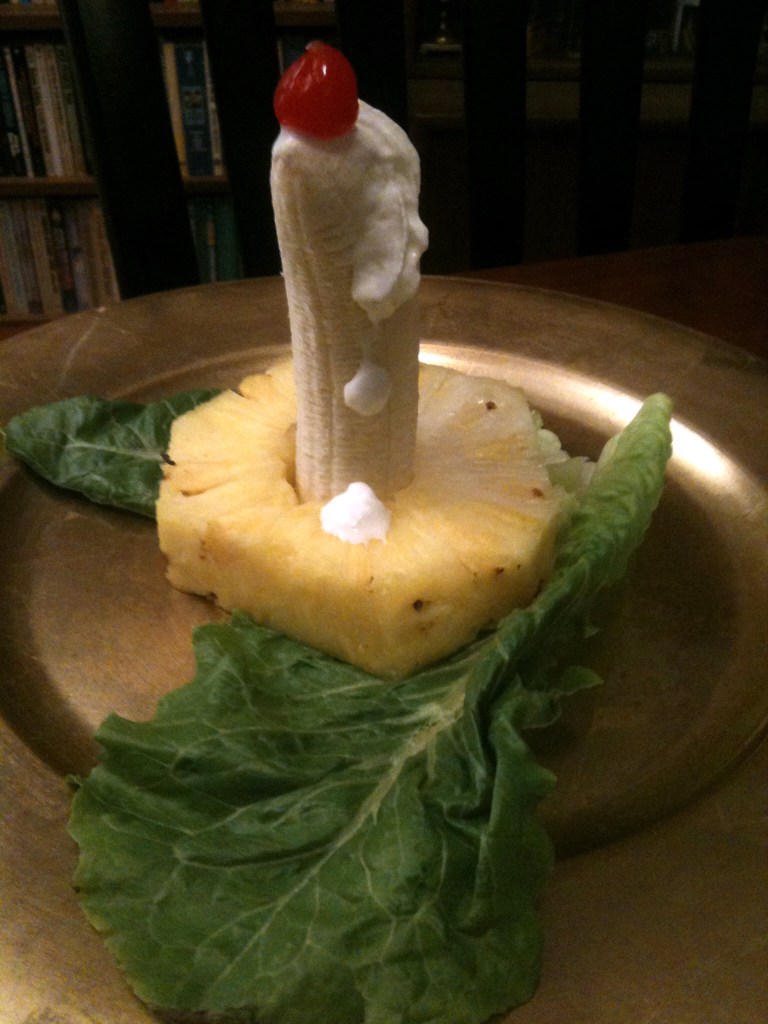
Most often, I find myself intrigued by the recipes he picks and the trends they exhibit. WHY so much lard in everything made before the 60s? Why so much gelatin in mid-century America? Just HOW freaking high, lonely, horny, or all three must someone have been to create the “Candlelight Salad?”
The answer is, simply, that these recipes- like the books, movies, and music that were enjoyed then- are products of their time. Foodways are a part of culture and one can track the historyand trends of a period of time as easily in a cookbook as you could a textbook.
Someone back in the 1920s decided that this was a salad. James Beard described it as “culinary eroticism.” Picture from Wikipedia.