The ups-and-downs of the hospitality industry are no joke. Bosses and owners use words like “feast or famine” to describe the activity between the “busy seasons” and “slow seasons.”
I came from a beach town, where “slow season” meant quiet time. It meant half the local, non-chain ice cream stands and places on the boardwalk simply shuttered from Labor Day to Easter. Kids who wanted/needed summer jobs near their parents summer homes knew they needed to have their applications and resumes in shortly after Valentines Day if they wanted an apron waiting for them by the time Mom and Dad aired out the “life’s a beach” and “Island state of mind” decor.
The winery’s busy season starts around Easter- our “dress rehearsal” for Mother’s Day Brunch- and lasts the entirety of Wedding Season (May- September) with possibly a small lull before the Holiday Party. After New Years Day, however, business goes off a cliff. Hours get cut, and employees cash out reserved PTO to fluff up their checks and pay bills. They find gig work, pursue side hustles, or even pick up per diem jobs at places with skeleton crews and sick time policies.
If not “holiness,” then let’s call it “sanctity.” “Austerity” could also work, I think. Whatever word you want to use, it’s the idea of being in a very large place where a lot of people do a lot of generally serious things in the name of something arguably intangible, and it has a unique smell. The government buildings I have been in don’t have that kind of smell (“why” is something others can argue), but synagogues, the right kind of churches, and museums definitely do.
Somewhere a while back, I read that the reason people love the smell of “old books” is because lignen- the fibrous matter in plants and trees that paper is made of- has compounds that decompose over time into a yellowish color and is related to vanillin, the compound that (you may have guessed) gives vanilla its smell and flavor. Synagogues and churches inevitably have a LOT of old books in them unless they are brand new. Hymnals, prayer books, and holy texts to service a whole congregation don’t come cheap, and there aren’t “new editions” of ancient vows and praise that require refreshing the stock. The same prayer books (ideally) serve generations. The next time you walk into a place of worship, it might be interesting to wonder who held your hymnal before you. What were they going through? What were they thinking, if anything? What did they pray for if they could? Were they praying for you?
“Lovers and madmen have such seething brains, Such shaping fantasies, that apprehend More than cool reason ever comprehends. The lunatic, the lover and the poet Are of imagination all compact: One sees more devils than vast hell can hold, That is, the madman: the lover, all as frantic, Sees Helen’s beauty in a brow of Egypt: The poet’s eye, in fine frenzy rolling, Doth glance from heaven to earth, from earth to heaven; And as imagination bodies forth The forms of things unknown, the poet’s pen Turns them to shapes and gives to airy nothing A local habitation and a name.”
– A Midsummer Night’s Dream, Act V Scene I
At the end of his own weird and raunchy comedy A Midsummer Night’s Dream, Shakespeare lets us in on his own thoughts regarding passion and madness. Passion, Creativity, and Insanity are the coin of the realm in culinary arts. The work of food writers, celebrity cooks, and media like The Bear parade our damage for the public and make us heroes, horror stories, characters, and even martyrs when we die.
I don’t think for a second it’s somehow undeserved. That’s the part of our lives that kitchen veterans miss and swap stories about. What some people think needs to be done about- or with- that passion, however, has me wondering. How to do you temper, train, guide, and coordinate that kind of raw passion and madness? History would tell us we need to be like the military. Owners and executives who spend more time owning and eating in restaurants than actually making them work tell us we need to lead and manage like a business or a factory- possibly one that turns Dirt into Diabetes.
Personally, I think that the answer to leading and managing cooks is to stop seeking “employees” as much as finding acolytes.
It’s perfectly understandable to me how haunted houses can exist. We have the idea of “ghosts in the machine,” “Artistic DNA,” and omnipresent-but-unspecific “vibes”- why not “ghosts in the interior design?” Ghosts that can follow a person or people from place to place, creating the sense of where they’ve been before, and writing an intangible living atlas in the frontal lobes of Those Who Know.
The house where I was raised is a minimum hour drive away and five-plus years back in time from being swiftly and silently bulldozed. My parents now live in an ivory tower of an apartment, nineteen floors above center city Philadelphia. They brought some of their favorite decor from their old house was well as my Bubba’s similarly-leveled house, and have moved into an apartment roughly a twentieth the size of where we used to all live together.
Ghosts in the decor, then, is the only way I can explain spending a few days in the cluttered but cozy guest room and walking out the door in the morning expecting a staircase to the right. It’s the only way I feel like the living room of the Philadelphia high-rise has a piano and fireplace in it that I can feel but not see in their decor of wood, white, cream, gray, and Judaica.
Everything about our old house is there, tucked under the carpet or back in a closet, felt but not seen until you cross the threshold out to the hall. Then I am most certainly in Philadelphia.
I’ve gotten back into watching the classic “Twilight Zone” episodes lately. They are the right mixture of length and creep factor that I like to unwind with after work. I’ll usually crash out in my rocking chair, pour a little whiskey, put on an episode, and try to make Cleo share my legs with a knitting project.
Yes, I’ve got a thing for being cozy.
My favorite episodes are the ones that feature Ed Wynn (“One for the Angels”) or Jack Klugman (“A Passage for Trumpet” and “A Game of Pool,”) in addition to “The Changing of the Guard.” It’s pretty easy to see why, beyond Rod Serling’s work being patently incredible. I’m still thinking about legacies and impacts, and those episodes are about people coming to grips with theirs.
Everything we do impacts those around us in some way, so even when we act to create a legacy, we don’t (and can’t) always know what shape that legacy may take.
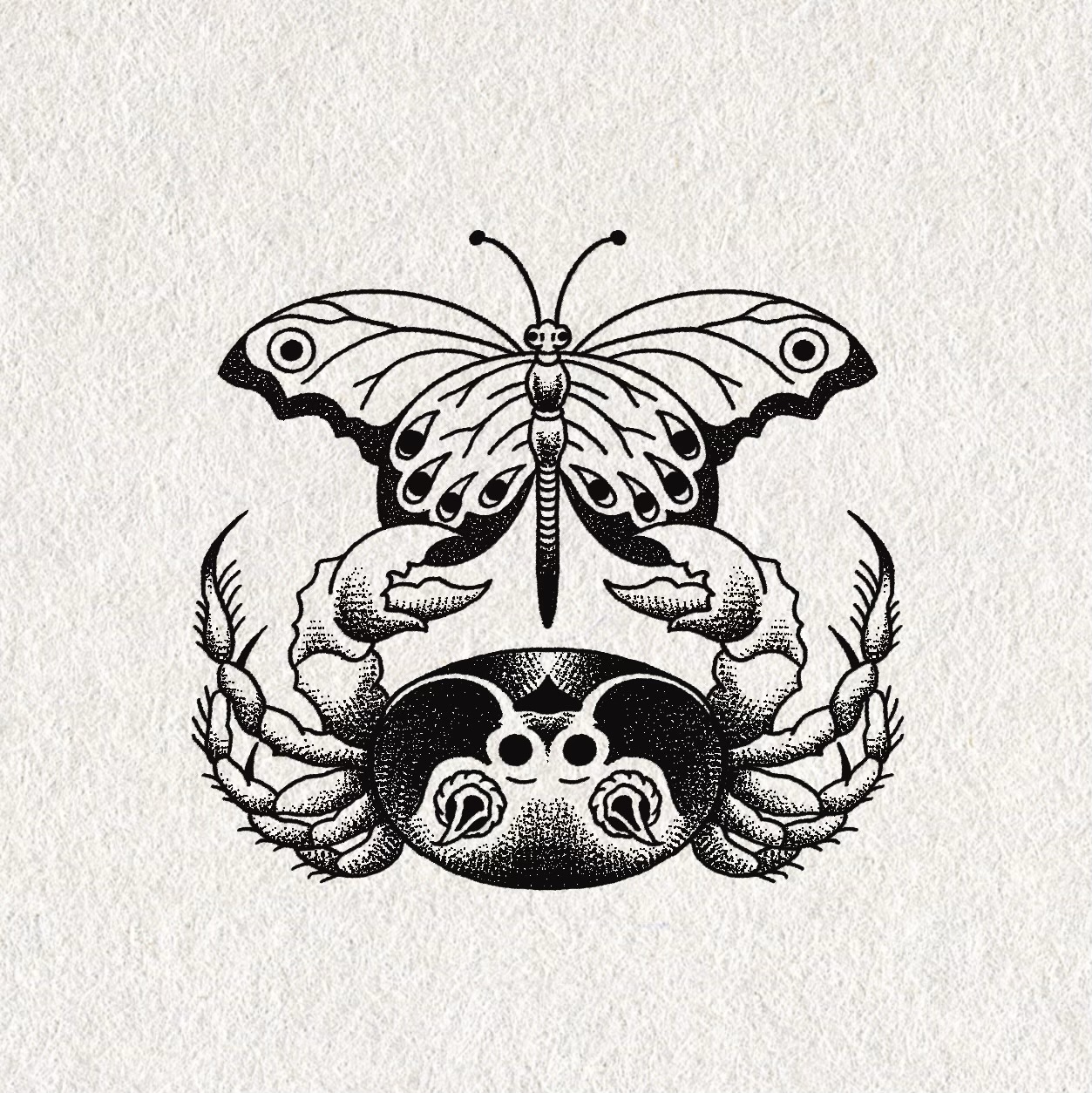
One of the banquet cooks at my winery has been learning to be a tattoo artist and not long ago got the go-ahead to find some clients to train on. After working with pen and paper and then fake skin, he’s got to do 50 pieces on other people under the supervision of his teachers. Offering yourself to be trained on can seem jarring, but it’s a wonderful way to get new work done for cheap- and if you know the artist (and where they work), it makes it more comfortable.
The reference picture and Tyler’s treatment for the tattoo
As I leaned back in the chair and Tyler put the stencil on me, his teacher walked up and said “Aw fer… you’re killing me, Tyler.” That’s kinda like hearing your surgeon go “Oops” just before you go under… but he followed it up by looking at me and saying “Friggin’ overachiever, this guy… made progress faster than anyone else, leans hard into everything, and now this. Tyler, how many does this make for you?”
Tyler chuckles and grins slightly under his beard at the praise and says “Well, uh… this is actually my first on someone else.”
Tyler and I are work acquaintances. We get along fine in the kitchen but don’t chat much. My head is always down in my pastry work and he buzzes about prepping for banquets. We both share in the community that kitchens everywhere create. This was the first time I saw him come alive, leaning into what he was passionate about and fully engaged.
Throughout the session, his teachers came over with praise and sent other students to watch him work. It was clearly his calling. I leaned back and couldn’t help but remember my squadmates eating my first pastries from home and saying “Why are you on an ambulance, Matt? You should be doing this!” I remember my therapist warning me not to walk away from the culinary life so lightly- “Matt, this is your calling. You come alive when you talk about it. Your eyes light up.”
The tattoo came out perfectly, and I get to be part of Tyler’s story about finding his calling, just like his work gets to be a part of me.
A Simple Dice Game
I think it’s got to be the feeling that makes dice games so enjoyable. I’ve always been a bit of a fidgeter, and the feel, look, and sound of rolling dice signals a particularly fun kind of gameplay. It “feels” more aggressively random and chancey watching dice skitter across a surface before coming to rest than pulling cards out of a deck or watching a marble whirl around a roulette wheel.
After my tattoo, I wandered into Montavilla Brew Works for a pint and they had a few of my favorites on tap. Montavilla Brew Works and its neighbor Threshold Brewing are where I got a make a small mark on the Portland beer scene. Montavilla in particular has several beers inspired by The Lord of the Rings, such as their “Palantir” Dark Ale, “Old Fellowship” Barleywine, “Peregrin” Palo Santo Wood-Aged Porter, and “Extra Special Baggins” Bitter.
Some time ago, I reached out to them with a suggestion- either an imperial stout as dark, strong, and evil as Morgoth, or a beer as bright, light, and cheery as Tom Bombadil. A few weeks later, they released their “Bombadil” Bright IPA. I might have liked the stout better, but I was thrilled to have played a part however small.
Today, as I walked in, Morgan the bartender came straight up to me with a grin and said “YOU sir, have caused an UPROAR.” She then turned around and shouted to the room “Hey all! It’s him, DICE GAME GUY!” and at least five people yelled in response “DICE GAME GUY!”
The “dice game” in question is part game, part logic/deduction puzzle called “Petals Around the Rose” when I learned it in college. It’s a simple but frustrating little challenge where one person who already knows the game rolls dice repeatedly and another person guesses the “answer” for a given roll. The object of the game is to figure out what rule is being followed to get each answer. When I first played it, my friend Jessica drove me nuts for three days trying to figure it out.
Some weeks ago, after Morgan and another patron were playing Yahtzee during a slow point in the day, I borrowed the dice and showed them the game just for a bit of fun. Apparently, Morgan then took the game and played it with other staff, who played it with other customers, and so on- each seeing how long it took the others to figure out the rule. When asked where it came from, Morgan just said “There’s this pastry chef named Matt who comes in and is a HUGE nerd, he showed it to me.”
So on a cloudy cold Sunday, I walked in to get a beer, and was greeted by a room of people all telling me how long it took them to figure out Petals Around the Rose (the fastest was & minutes, apparently) and Morgan gently scolded me saying “See, now you need to be more of a regular here. Everyone knows you.”
We can never tell just what it is about us that people will remember, and that’s a good thing. If we had to extrapolate every action of ours out Butterfly Effect-style, we’d go mad and paralyze ourselves into stagnation. We can’t walk around all day debating what every little thing we do will mean in a hundred years. All the same, to a lawyer in California, I’m the guy he used to drink with in Portland who came up with his favorite toast. To a cook, I was his first tattoo commission. To a brewery in Portland, I helped name one of their beers and introduced them to a new bar game. To an extent, our legacies and memories are in the hands of other people.
When you realize you never know what you’ll be remembered for, it makes you choose your activities wisely, treat others kindly, and live a more engaged and joyous life.









 The Black Hat Baker