The ignorance, the arrogance, and the eager cruelty on parade into our eyes and brains (whether in caution or praise) gets to be way too much after a while.
Earlier this week was Passover. We didn’t do a Seder this year because timing and activity didn’t work out in our favor. Instead, Emily made chicken satay for dinner. I sat on the porch typing away at this piece after having scrolled through far too much nonsense. That’s one reason this blog post is so late- I simply haven’t had the bandwidth after coming back from Philadelphia.
I finished a small glass of grog (because rum is alright for Passover and I had rice lager waiting to be paired with dinner) and I chatted with a dear friend about the logistics of making Sephardic matzo for a change- as opposed to the hard, cracker-like Ashkenazi matzah I’ve had my entire life.
I wore white linen, watched the light change on Mount Tabor as the sun went down, and I’m listened to Ladino music as I wrote (but Zac Brown Band’s tribute to Jimmy Buffett, “Pirates and Parrots,” is still in my head.)
I spent the day in the sun. Here’s what I have to say about it all.
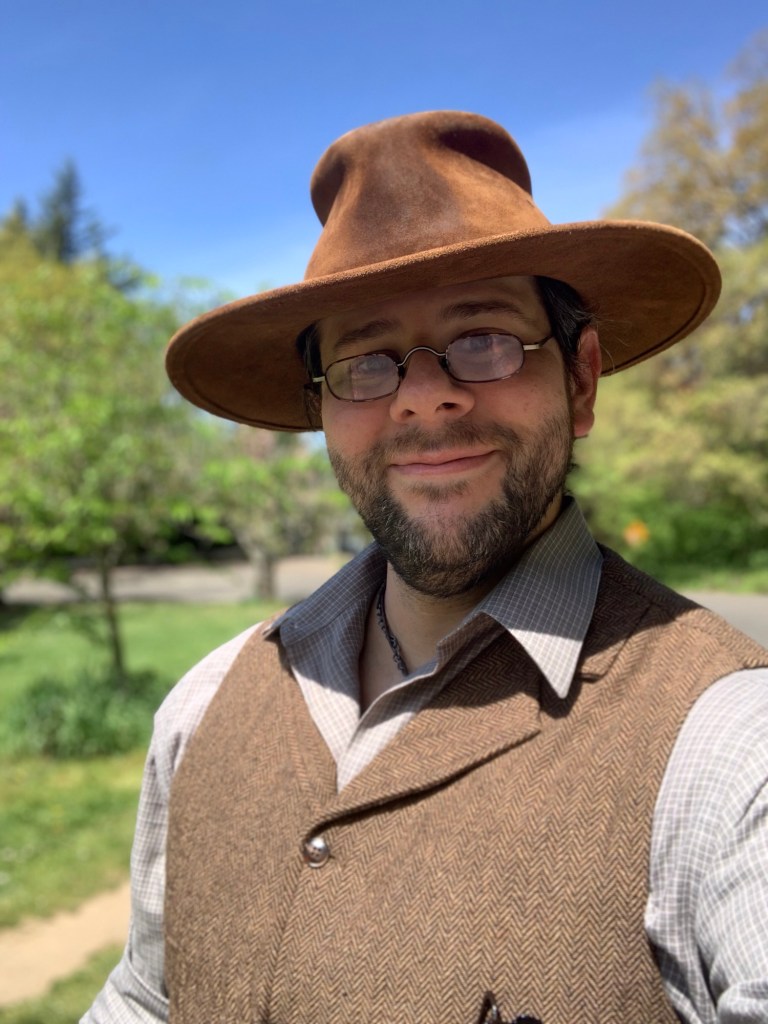
Glad I finally found a tweed vest that goes with that hat. Thanks Goodwill!
a person who is an adept conversationalist at table
– Dictionary.com
Whenever I get asked why I got into music and writing young, my pat answer has always been “because pens and clarinets don’t stammer.”
Most of the people I call friends today who didn’t know me as a kid find it hard to believe I had a speech impediment. It’s taken me quite a long time to get some control over the how and why my tongue would tie itself up, and I still stammer when I get excited or upset.
“Stammer” isn’t quite accurate, though. I think it’s actually called a hesitancy, but everyone knows what a Stammer or Stutter sounds like. Hesitancy in speech is when your brain gives orders to say words faster than you physically can manage them, so you buffer with a lot of “Uhs” and “Ums.”
Why yes, this does like both a symptom and cause of Anxiety- as does my tendency to hate recordings of myself speaking where I’m not reading off a script. Coping mechanisms for a hesitancy include the tendency to mentally “rehearse” statements and deliberately speaking slowly with pauses between sentences, both of which increase the likelihood of being spoken over or interrupted.
Neither is great for ones self-confidence, especially in a Jewish household in New Jersey where conversation is more like a demolition derby than an exchange of information.
Here I am though, describing myself as an amateur storyteller, a deipnosophist and a raconteur– all of which are very fancy words for “chatty bitch.” I’m an introvert who frequently “runs out of people minutes” but who extols the Life-Changing Magic of Talking to Strangers.
Clearly there was a grand struggle, a great effort made to conquer my disability and emerge from my Bullied Child Cocoon as a Magnificently Eccentric Social Butterfly.
Nope. Nothing nearly so interesting as that. I just became really really good at telling stories. I don’t stammer when I’m reciting from a script- so I learned to treat telling stories as recitations.
“Confidence is what we call the equanimity we see in others.” The ability to look social anxiety and fear in the eye and say “Whatever, I’m not going to let you affect me.” Some liquid courage may or may not be involved in shaking off social inhibition, but when it comes to Talking To Strangers or being a raconteur, I don’t really have “tricks” or “hacks” for being a good conversationalist. At least, I don’t have any that aren’t covered in greater detail by others.
There was no “a-ha” moment of conquest over my anxiety and stammer. The only “trick” I can point to was literally just building that confidenceequanimity for speaking to strangers… and that developed over time.
It’s psychological, and it won’t be shaken off overnight- or ever completely really- but the first step for me was finding opportunities to be brave and practice pushing the anxiety aside for a few minutes, an hour, the length of an evening.
I won’t lie to you, it’ll feel really weird. As a relatively tall, bearded, hairy dude, I was terrified of coming off as a creep. That’s where deciding to let equanimity rule will come in clutch, and the best feeling in the world will really just come from finding kind people.
The best way to find kind people? Start off with something kind. Even if it doesn’t turn into a stirring conversation, you will have made someone feel good. It can- and probably should– be something casual and surface-level. “Dude, love the suit.” “That’s a super cute outfit!” To this day, I sometimes worry that that’ll sound creepy, but truth be told? Most folks are just happy to be noticed kindly.
After that, for me, came something harder. The fact is people are really good at picking up on sham or fakeness. Any place you have to act fake to “fit in” isn’t somewhere you belong OR will enjoy being. Being told to “be yourself” is trite bullshit and too easy- you have to learn to be okay with being yourself. To quote Dr. Brene Brown, “We belong anywhere we show up as our authentic selves. Everywhere, and nowhere at all.”
That is a tall order… and having friends, loved ones, and the company of kind people make it easier. My friends don’t care if I stutter when I’m excited- they know I have something worthwhile to say. Enough kind people have responded well that, despite the anxiety, I know that I can be my chatty, eccentric, Anthony Bourdain/ Jimmy Buffett/ Bilbo Baggins mashed-together self.
That’s one thing I should mention, though- it probably is my single biggest “trick” to being a storyteller. Any storyteller, writer, artist, or creative of any type will likely tell you something similar, but here’s my version.
To have space made for you, make space for others. If you want to tell great stories, you have to listen to the stories of others.
That’s the biggest perk of talking to others- you don’t always talk. You listen, you learn, you absorb, and you connect.
At least until you run out of people minutes… then you get to hide out, recharge, and think of more brave ways to tell and hear new stories. Not a bad way to spend a night out in any case, right?
First responders have a saying- “Being a first responder leaves you with two kinds of stories- ones you don’t want to tell, and ones others don’t want to hear.” It also leaves you with a LOT of quirks and habits that only other folks who’ve been there will notice.
A friend claimed she thought I had PTSD from my time as an EMT. I personally don’t think I do. I go to a therapist, and it’s never once come up. For a brief time after a particularly bad situation in 2005, I definitely had flashbacks and triggers- but not since. At least, nothing more than what Anxiety gets me to ruminate on.
I simply don’t think I saw enough stuff long enough to give me honest-to-God PTSD. I know it doesn’t necessarily take repetitive or long-term exposure to trauma to cause PTSD, but I can honestly count on one hand the number of calls I’d been on that might be considered “traumatic.” If anything, most of them were of the “ok, you won’t believe this shit” genre of anecdote. There are no Misery Olympics and I wouldn’t want a medal if there were.
What I think being an EMT did leave me with were a couple of trained behaviors and responses that others would find odd- especially in the kitchen.
What does it mean to be present? Not just physically but mentally? Spiritually? It doesn’t just mean being in a particular place, like during roll call at school. For yourself in your own life, no one’s checking off an attendance list.
We owe it to ourselves to stay present and keep ourselves aware of just who, what, and where we are if we want to live not just good lives but deliberate ones.
There’s just something soothing and beautiful about the folded flaky layers of handmade pie dough.
“You cannot change how your story started, you can always change how your story ends.”
For plenty of people, those are wonderful and hopeful words of wisdom. It is hard, and we often need help to do it, but it is possible to rise above our pasts towards a future we want. That is an empowering, terrifying, and beautiful thing. A hallmark of our intelligence as sentiment creatures is the ability to internalize what we’ve experienced and use it to make decisions in the future.
This can be both a blessing and curse. We learn from traumatic experiences as well, and healing from that is as much a (re)learning process as a spiritual/emotional practice. When things happen that really and truly shake you to your core, you can’t always just dust yourself off and go again. If you think you can, I congratulate you on your compartmentalization and/or sociopathy.
The truth is that, even if you think you’ve recovered from a difficult experience, there is no returning to the person you were before. It’s a “what is known cannot be unknown” sort of thing. Before, you didn’t know you could be hurt like that. You didn’t know you could fail that hard. You didn’t know whatever it was could hurt so much. It’s the price we pay for being thinking, feeling, loving creatures- but it’s a price we never consciously think we must pay until it happens.
When it does, we learn. We learn to wake up the next morning and keep trying. We recover, we hope, and we carry on. We also need to mourn the people that we were- because that is never coming back, and it’s something I’ve been wrestling with a lot recently.




 The Black Hat Baker