Baking Like A (Mad) Scientist

     Good evening, friends and neighbors! I hope everyone’s spring is going well, and you’re enjoying the warmer weather! 

        Last entry, I talked about how baking was similar to alchemy- a mix of science, art, and magic. Tonight, I’m going to focus on the science part, and specifically how to develop a recipe, tweak a recipe, take notes, keep track of changes, and generally turn your kitchen into a laboratory- just because you don’t have bubbling beakers and Bunsen burners doesn’t mean you can’t do science with an oven and and stand mixer!

     To start with, we go back to basics. A long time back, I told you what the most useful and important tool you can have in a kitchen, baking or otherwise. Remember what it is? Here’s a hint: 


NOTEBOOK.


     Yes, the humble notebook. Pocket size, composition book, binder, whatever you like. Something with blank pages eager to be filled, and a thing to write with. You will be writing down EVERYTHING: Temperatures, procedures, ingredient amounts, ingredient forms and types, scalings and calculations, ALL OF IT. When you want to keep track of all the changes you will be making, having a hard record is vital. 


      Got a notebook? Good. Then we can begin.


All of culinary arts involve some kind of scientific knowledge and method. A fry cook needs to understand how proteins behave with heat so he can grill a steak. 
In baking, the name of the game is chemistry- your goal is to arrange ingredients in such a way that, with heat applied over time, you get accurate replicable results- meaning, if you hand your recipe over to someone else, ideally, your two products should be identical.  


The BHB’s Guide To Scientific Baking 

  • Keep the original recipe 

             “Hmmm.. what kind of flour did this recipe have in it to start with? How many eggs? Grr.. where did I put that recipe?” Keep yourself organized. Everytime you make a change, attach it somehow to the original, but KEEP THE ORIGINAL INTACT.

  • Work in ONE unit of measure whenever possible. 

             Home recipes out of cookbooks (at least in the US) tend to go off volume (cups, teaspoons, etc.) There are numerous problems with this- a cup could be a level cup, a heaping cup, a scant cup, a packed cup, etc. Professional bakers tend to use “formulas” rather than recipes, and almost all ingredients go by weight, rather than volume (i.e. a pound of flour rather than 2 cups flour) It increases the reliability and replicability of your work. ALWAYS work in the same measuring system- there is no percentage in bouncing between metric and imperial in a recipe.

  • Leave space for random notes in your book. 

             Did a little something different that time? Want to remind yourself of something in the future? A garnish? A flavoring? Keep notes.

  • Document from ALL 5 SENSES. 

            Your senses are the most basic and finest scientific apparatus you have. Did your cookies taste too sweet? Have a weird smell? Crumbly texture when you want chewy? Don’t JUST rely on numbers. Keep notes on EVERY thing related to your product- what you want to change, what you want to keep the same, and how.

  • Quantify as much as possible. 

            Yes, I know I just told you not to rely strictly on numbers. They DO, however, help create exactitude. How many times did you fold the batter? How long did you let it sit after baking? Remember- the goal of a good recipe is to give you the SAME PRODUCT, regardless of when it’s made or who makes it. No flukes- if you got lucky, keep good notes so yo can get that lucky AGAIN.

  • Mess up your cookbooks. 

            You know how your folks told you never to draw or write in books? Screw that. Cookbooks are meant for the kitchen- they are SUPPOSED to be scrawled in and messed up with notes, calculations, and food stains.

  • Scale into a separate column– NOT IN YOUR HEAD.
    At the moment, I do not care to say how many recipes I’ve botched because I was clever/ in a hurry and tried to scale up or down a recipe in my head, only to get confused and ruin everything. Keep separate columns on your recipes for multiplying or dividing batches. 
  • Keep track of variations, and note changes between. 
    You just finished a new batch of a recipe you’ve been tweaking. You’ve been working at it for months now- this batch though is missing something you liked from the one before.  Keep track of all the variations of recipes, and mark down every change between them so you don’t get yourself lost.
  • Get and value feedback

          This one is incredibly important. You are naturally going to be biased toward your creations, so you need to get honest feedback from people.  BE OBJECTIVE. Don’t take anything to heart. Learn especially to tell the difference between constructive and destructive criticism- and do not deal with anyone that gives you destructive criticism. 

Tomorrow, I’ll get into baker’s percentages, and give you the development sheets I use for hashing out new products. In the meantime,

Stay Classy,

Alchemy

Good evening, friends and neighbors! I apologize for the silence as of late- I promise to get better at updating here. What might help remind me, while we’re at it, is a little feedback- what would you like to see in this space each week? Recipes? Demos? Stories, and my philosophical musings? The comments and email work- let me know what you’d like!

Speaking of philosophical musings, tonight is going to be another one.

Since I’ve been writing on here, I’ve described baking as a science, an art, a passion, and a craft par excellence. I do NOT think I have described it yet (and if I’m wrong, send me the quote and I’ll thank you for reading!) as alchemy.

Alchemy was an extension of natural philosophy, and is the root of the fields of medicine, chemistry, and pharmacology. The most well-known goals of alchemy were turning lead into gold, discovering the key to eternal youth/ immortality, and creating a semblance of life outside of the natural order. Alchemists were famous (and in many cases, infamous) for their secretive nature. Formulas and concepts were recorded not just in notebooks, but in beautifully embellished pages, with elaborate symbols and diagrams representing materials or abstracts that would only be understood by other alchemists- or more likely, the alchemist that created them alone. 

This was chemistry in its infancy- the complex interplay between different substances was understood at only the most basic empirical level, and frequently was described using mystical notions derived from the cultures or religions they were created within.

In summary, alchemy was a combination of art, science, and magic.

What, I may ask, is a better way to describe baking?

Consider for a moment, the following:
– The pounded seed of a tall, golden grass.
– Water from the nearest well or brook.
– Crushed, translucent white rock from a certain hole you found.

Combine them all into a curious, stiff paste.
Let it sit until it has swollen.
Place next to your fire to see what happens.

The result is bread- a source of carbohydrates and has kept humans alive for over 10,000 years.
This was done before humans understood yeast, the Maillard reaction, the development of gluten,  or the result of different temperatures being used on the dough.

For all intents and purposes, this is what you did to magically generate food from whatever it was you found around you. Cooking was similar, but easier to understand at the time. It was easy to see meat change and blacken as it roasted, or vegetables warming and softening as they cooked. Much of the action that makes baking possible, however, happens at the microscopic level- beyond human vision, and therefore, possibly beyond comprehension at the time.

Bakers today have quite a few advances and advantages over our Stone Age ancestors, but while the ingredients, tools, and understanding may have changed and advanced, the basic rule has not:

Take fresh ingredients.
Prepare and combine them well.
Keep track of how so you can do it again.
Feed yourself and others.

Kitchen alchemy.

Stay curious.
Stay intriguing.
and of course,

Stay Classy,

-BHB

Bubba

Good evening, friends and neighbors! Happy belated Mother’s Day to all my maternal readers, or any who serve that function in their lives.

About a year ago this month, I lost my grandmother, Mitzi, after a long illness. This came at a time when I was nearing the end of culinary school, and had just gotten my first professional baking job at one of the casinos in Atlantic City, so her passing was especially poignant.

For me, Bubba Mitzi was the notion of hospitality made manifest. When visiting her house, the first words from her mouth were asking if I had eaten, if I was hungry, and specifically wanted some chicken soup. (Like all Jewish grandmothers, my Bubba made the best matzah ball soup to be found on this Earth, and I’d argue to the grave anyone who said otherwise.)

Memories of my Bubba tend to center around her giant dining room table- the sight of all the best family dinners of my childhood. Showing up at Bubba’s house meant delicious things to come, and anything bad in this world could wait until after dessert was cleared away. The table would almost groan with cucumber and onion slaw, marinated tomatoes, chicken, brisket, long golden loaves of challah, heavy green potato kugel, glorious noodle kugel, rainbow-colored jello molds studded with fruit complementing each flavor, and cakes that you would pray some survived to have again tomorrow.

Alongside all of these things, though- all these beautiful culinary memories- I remember the stories the most. Family dinners meant stories- people laughing, joking, remembering things from the past, and recounting them all into my eager ears as I filled my belly.

I like to say that my mother and sisters were the first ones who taught me to bake as a child, but it was my Bubba Mitzi who taught me WHY I should bake- to create those moments over again. To fill a table with food that people can laugh around and swap stories over, to create a magic circle in which all there is to be worried about is what’s going on your plate next.

This was the hospitality my Bubba taught me- that it’s not the food you make so much as the people you share it with, and that the secret ingredient in all the best recipes is love- for the work, and for those who will enjoy it.

Happy Mother’s Day, Bubba- I miss you deeply, and if I can give people half the happy memories you’ve given men, that would be more than enough.

Stay humble, my friends.
Stay healthy and warm,
and of course-

Stay Classy,

-BHB

Onions

Good afternoon, friends and neighbors!

A while back, I mentioned a conversation I’d had with a relative of mine. He expressed frustration and concern that I did not share the same vision of professional success as he did-

Relative: “Just think about it, Matt- you make the right moves, and wouldn’t ever have to bake again! Buy gigantic ovens and extruders for the product, hire and train people to use them, and then all you’d have to do is show up once a week, make sure no one’s hurt themselves, and collect your paycheck!”

Me: “Except that doesn’t sound good to me- I want to keep my bakery small. I LIKE the idea of coming into work and baking everyday. I want to work alongside the people I hire so they can be trained right.”

Relative: *waving hand dismissively*. “Yeah yeah yeah, I get that, that’ll just be for now. Eventually you’re going to grow it bigger though.”

In the end, we walked away shaking our heads, agreeing to disagree- him muttering that I was naive, and me grumbling that he “just didn’t get it.”

I had mentioned before that, in a way, we were both right. I’ll explain this with a story I heard a long while back.

—–

In a small desert town, there was an old man sitting at his stall in the marketplace. Hanging in front of him were 20 strings of onions. A man from the city came up to the old man and poked at the old man’s wares.

“Hey pops, how much for a string of onions?”

“10 cents.”

The city dweller poked at a few more strings. “How much for 5 strings?”

“50 cents,” the old man replied simply.

“50 cents? No bulk discount?” The young man asked, eyebrow raised. He looked at a few of the other strings. “Those onions aren’t as big as the others… I’ll give you 5 cents for them.”

“No,” grunted the old man, nonplussed by the city dwellers rudeness. “10 cents a string.”

The city dweller eyed the old man suspiciously and sneered. “Hmmf! You need to learn some business sense, pops!” he hissed, inkily. The young man then stepped back and looked at all the onions yet again. “How much for all your onions?” He asked with a smug smile, nonchalantly pulling out an expensive leather wallet.

“I would not sell you all my onions,” muttered the old man, barely bothering to look up.

“You wouldn’t sell me them? Why not?” asked the surprised city dweller, interrupted in pulling cash from his wallet. “Isn’t that why you’re here? To sell your onions?”

Here the old man finally looked up and leaned forward, staring right into the city dwellers eyes.

“No, boy- I’m here to live my life. I’ve been visiting this marketplace since I was a child. I love coming here. I love seeing the colors of the beautiful rugs the women pull out to sell. I love the smell of the food they cook. I love eating lunch then taking a nap right here in the middle of the day. I love when my friend Tom comes by, and we sit and smoke and talk about our wives and families. Y’see boy- if I sold you all my onions, then I wouldn’t get to meet or talk to anyone else coming to buy them. My day would be over- I’d have to pack up and go home. I would have given up the life I love- and I wouldn’t do that for anything.”

———–

Money is lovely for the things it buys and security it offers. Success is lovely for the doors in opens.

There are more and finer things in life than money though- and success has different definitions for different people.

Baking is not just a money-making venture. It’s my passion- it makes me happy. It calms me down. It relaxes me when everything else is going wrong. I love talking to people about their favorite flavors. I love figuring out the delicate science of how to make a new recipe work. I love working with like-minded people, teaching them and learning from them.

When you buy from someone who owns a small business, you’re not just getting whatever they are selling- you’re buying some of their time. You’re buying pieces of their heart and soul, and a bit of their passion. You’re not buying from a faceless giant corporation- you’re buying from a friend.

Success has different definitions- and for me, that’s getting up every morning, working hard at what I love, and making a living off of it.

Stay classy,

-BHB

What’s in a Name.

Good evening, friends and neighbors! I apologize for my absence last week- this month has been very active for me- one activity of which I’ll be talking about here.

First off, I feel like I should mention something personal about me. I do not like titles. They make me feel stuffy and uncomfortable, at least as far a titles directed at me are concerned. I have had a few titles in the past, related to different accomplishments or jobs, and I always specifically asked for people not to use them- “Nurse,” “Counselor,” etc. The most I ever accepted was “Mister” or “Sir” from complete strangers. 

It should come as no surprise then that every time I have ever been referred to as “chef,” I took it with a grain of salt. Chef is a title given from having the job OF a chef- running and managing a kitchen and being the boss of a kitchen crew. In my life, the only person I have ever been in charge of in a kitchen is me, so I always referred to myself as either a baker, a pastry cook, or just a cook.

Bearing all of this in mind, flashback to last week.

I recently joined a gastronomy group called the Chaine de Rotisseurs– an international brotherhood of gourmands, chefs, restauranteurs and professionals that like to get together and encourage advancements in the culinary world. Through this brotherhood, I made the acquaintance of a young chef named Joe Muldoon. Joe own and operates a small restaurant in the South Jersey area called Roberta’s, and has quite a revolutionary mind when it comes to food. He combines French techniques with Asian-inspired ingredients and vice versa to create an exciting, vibrant menu. If you find yourself in the Northfield area, I highly recommend getting a table and strapping in. You WILL be blown away.

Recently Joe was asked to host a dinner for the local chapter (or “Baillage”) of the Chaine, meant to seat something to the tune of 50 people. He has it in his mind to offer a mindblowing 7 course meal- but he needs an intermezzo and a dessert.

He asked me to step in.

At first, I was ecstatic and thrilled- I was being asked to serve a dessert to 50 movers and shakers of the local culinary world!

Then I was terrified- I was being asked to step into a strange kitchen, work with people I have never met before, under a chef I liked but never worked with before, AND serve a dessert and intermezzo to 50 movers and shakers of the culinary world.

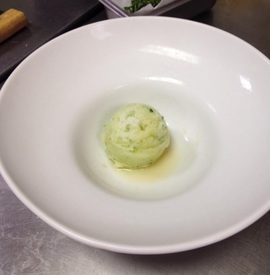
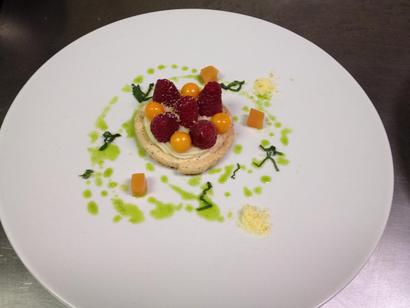
The first few meetings with Joe went smoothly and easily- we discussed the menu, and exactly what kind of dessert he was looking for to finish it off. Together, we finalized the intermezzo and dessert- a cucumber- winter melon sorbet with plum sake and sea salt, and the dessert an Earl Grey dacqouise tart with truffle honey buttercream, berries, and Meyer Lemon sugar.

Then came the first night I came in for production. Previously, all of our meetings had been just the two of us talking. This night, I walked in on a full house, and his kitchen staff going balls-to-the walls. He waves me in, ushers me into the kitchen, and quickly says “Everyone, this is Chef Matt- he’s helping us out with the Chaine dinner. Matt, ask anyone for anything. My kitchen is your kitchen. Set up wherever. Later!”
Then he’s gone, and I’m standing there almost catatonic.

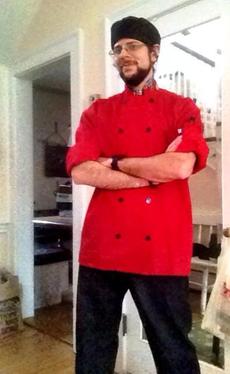
“Chef Matt.”

Picture

“Chef Matt?”

     I’d had friends call me “chef” and laughed it off. I do not think of myself as a chef. I DID not think of myself as a chef. 
      This time, however, it was serious. For the purposes of pastry, this kitchen and these people were at my disposal. A strange kitchen that I was utterly unfamiliar with, and people I had never met before. Initially, I had no idea where to start. 

      But when in doubt- bake. I dropped my stuff, popped open my gear, and got to work. 

      I worked feverishly, my mind constantly bouncing back and forth between getting everything done in the best order and taking up as little space as possible in a crowded, busy kitchen than I still felt like I had invaded. The other cooks and wait staff would come by and eye me curiously- and I had assumed suspicion- as  I worked. 

    Until they started coming up and asked what I was doing. Not accusatory, but interested. 

     INTERESTED. These people had never seen pastry being made before. 

     They showed honest curiosity and interest in what I was doing, how I was doing it, and what the product would be. As I worked, I answered them- and it helped me calm down and go through the step-by-step of what I needed to do. Everyone I met in that kitchen was friendly and warm (in their way, of course- the dishwashing guy started in with cracking jokes immediately, which is kitchen-speak for “Welcome brother! You are one of us!” If they hate you, NO ONE talks to you in a kitchen.) 

 This past Friday was the tasting for the dinner- the head guys of the baillage come in, have the dinner, work out the wine pairings, and give critique on the dishes. It went off without a hitch, and the menu was locked in. My intermezzo and dessert got rave reviews.

Picture

Intermezzo- Cucumber and Winter Melon Sorbet with Plum Sake and Sea Salt

Picture

Dessert- Earl Grey Daquoise Tart with White truffle honey buttercream, raspberries, gooseberries, and Meyer Lemon sugar.


     As I left, Joe shook my hand and said, “Chef, thank you very much.” 

 Chef. 
He said it and meant it. 
And for the first time, I didn’t mind- I felt like I had earned it. 

 Stay classy,