(None)

Tonight finds me writing from a very familiar place- the hammock in my sunroom in my own house.

Tonight’s topic is a little different than some of the others I’ve done. It doesn’t really concern food so much, or fine beverages. It doesn’t really concern culture either- not literature, music, poetry, or even the folk stories I’ve occasionally featured here.

I suppose- to some readers- this may seem a cop-out due to writer’s block, or a lack of inspiration. In a way, that may be partially true. I had thought of exactly one topic I wanted to write about tonight, but I decided to hold off until I had done some more research (in order to keep it from being another whiny opinion piece on a hot-button issue.)

I spent most of the day and the entirety of this evening trying to think of a different topic. It wasn’t until this very moment though- with my feet up in the hammock, keyboard on my lap- that I found what I was looking for. In a way, I’ve been looking for it for the last few weeks at least.

I find myself at home, in a slightly-hotter-than-comfortable sunroom, at nearly 10 pm. The room doubles as a lounge/bar area. Since I’ve been living in this house, this room has been my special project- decorating, furnishing, everything meant to promote entertainment and hospitality. Now I find myself the guest in my own house.

Sitting beside me is a small shot glass of very good tequila- Hotel California Anejo. It’s a bottle I spent several years trying to hunt down. I’m nursing the shot straight up and neat. The refreshing agave flavor is mellowed with age, turning the bright crispness slowly into lustrous gold.

Besides the typing of keys on the keyboard, I can hear the crickets outside. The traffic on the highway a few blocks away, and the planes taking off and landing at the airport a few miles down the road.

No music, no tv, no news.

No Facebook or Twitter, no texts. My phone is silent, and my computer is solely focused on the same thing I am- typing this entry.

Eventually I will have to come out of this room. I will finish the tequila, turn off the light, post this entry, and head off to bed- looking toward a brief rest before I must rejoin the world at large, and all the beauty, horror, wonder, anger, rage, sadness, and warmth it has to throw in my face just for opening my eyes.

Not right now though. For the moment, I have found something I have been seeking for the last two weeks, and only realized I wanted it while searching for something to say.

A moment of quiet.

They are rare, but they are wonderful, and they are free.

I highly suggest having one regularly.

Stay classy,

BHB

The Beautiful Itch

Good evening, friends and neighbors! Sorry about the missed week- the 9 to 5 has been rougher than usual recently. I’m not sure how much longer I’ll be able to maintain at the place, but it’ll at least have to be until I’m in a slightly more secure position.

Tonight, I’m writing from the Iron Room in Atlantic City, NJ- a place that’s becoming warmer and homier to me with every meal. An excellent beer selection, a wall of whiskey, small plates of exquisite food, and the exact kind of atmosphere I like- not too spread out and empty, but not SO intimate either. The perfect place to take the rough edges off the day with a few glasses of beer and some high-quality nibbles. If you’re in the area, I highly suggest it. My current writing fuel/ companion is a glass of Flying Fish’s NJ 350- a hoppy, yet pleasurable brew celebrating New Jersey’s 350th birthday. If you are a beer fan, and you like hops that show up in the front and then fade away to semi-sweet, malty goodness, this is for you.

None of this talks about the title though.

The Beautiful Itch has been discussed by people far more famous, influential, and eloquent than myself. It is a condition especially afflicting those who travel a lot in their work- musicians, writers, truck drivers, etc. The best way to describe it is “wanting to be home when you are away, but then wanting to be away when you are home.”

I do not travel nearly so much as I want to. I remember feeling envious when I would read the works of Kerouac (On The Road and The Dharma Bums) and Steinbeck (Travels with Charlie) and imagine myself traveling with them, only to come out of my reverie and find solace in the fact that the America they traveled and explored in the 60’s is likely no longer there- that I was born too late to miss anything. Hollow comfort at best.

(Interruption: Just had the head-on Gulf prawns with the fresh grated wasabi. Get it if it’s on the menu. They change stuff up a lot.)

I have friends that travel extensively- for work or other reasons by obscure means. I cannot help but envy them as well. The farthest abroad I have been is Israel, and that was fully 5 years ago. There is a veritable laundry list of places I want to go and things I want to see. There are a FEW tourist spots I want to see- Macchu Picchu, the Sistine Chapel, Petra in Jordan, etc. Most of all though, I want to see how the PEOPLE live. Most Floridians DON’T spend a week at Disney World (unless they work there.) Most Pisanos DON’T hang out at the Leaning Tower, either. They go to cafes. They go to local pubs, and hole-in-the-wall restaurants. Joe Schmoe working the ticket kiosk at the Louvre is a regular somewhere.

(Interruption 2: Korean BBQ Hangar Steak with sweet/sour Brussel sprouts and bacon. Get it.)

When you are traveling abroad, it is VERY tempting to stay on the tour bus- see what they want to show you, do the stuff that appears in the brochures, and exit through the gift shop.

Screw that. Go on your own and get lost. Listen to locals. If you stay at the hotel, don’t ask the concierge for good places to eat- ask the bellhop, or the cleaning lady. If you really want to get a feel for a city and find out where the people who LIVE there spend the time, ask them and find it.

You might encounter hostility, yes- some smaller local joints are fiercely “locals only.” You may even face some discrimination in favor of the locals and regulars. Don’t get angry, take it in stride. If the place is in with the locals, you likely will not regret it.

The quality of the food is NOT always proportional to the bill total. You may find that the best food you’ve ever had in your life came off the grill of a little shack down a Grecian alley, or a greasy spoon diner in a backwater American town.

Stay curious.

Stay worldly,

and most important-

Stay Classy,

-BHB

Pastry Cream- How to make that Creamy Center

Hello friends and neighbors! Sorry for yet another delayed entry, but this one has been long in coming. When I first asked friends and family if I should cover making pastry cream on here, the answer was a sonorous “YES.” I then suggested that I should cover pate au choûx as well (the puff pastry that gets filled with pastry cream to make cream puffs, eclairs, etc.)

“No, no- we just want to eat it a big bowl of it in front of the tv.” – several relatives and friends

…Right. I can’t really conceive of doing that, but it’s your call. Now, while I await the no-doubt annoyed letters from the First Lady for reversing her work against obesity:


Pastry Cream

Pastry cream (or Creme Pastissier, if you want to be all French about it), is one of the staple recipes a pastry chef- or at least a French-trained one- knows. As I mentioned above, pastry cream is the tasty, rich custard filling found in eclairs, cream puffs, and Boston Cream Pie. This recipe is for a regular vanilla bean custard, but feel free to experiment and make any kind of flavor you like!
The pictures here show the double batch I make for my job, but I’ll be giving you the recipe for a single batch- the method is absolutely the same.

INGREDIENTS
1 qt. whole milk
8 oz. sugar, divided into 4 oz. amounts.
1 vanilla bean (or 1 tsp. vanilla extract)
2.5 oz. corn starch
2 large eggs
4 large egg yolks
1 oz. butter

TOOLS/EQUIPMENT NEEDED
-Whisk
-Wooden Spoon
-Saucepan/Pot
-Sieve or Strainer with fine mesh
-Either a stand mixer OR a large bowl and one larger bowl with ice.
-Container and Plastic Wrap

Picture

Ingredients and tools all assembled. Remember- Mise en place!

Step 1. Mix the milk with 4 oz. of the sugar. Try not to have too much settle on the bottom of the pot, otherwise it may burn.

Next, you slice and scrape your vanilla bean. I prefer using vanilla bean over extract whenever I can just because the flavor is infinitely better, and the smell is GLORIOUS.

Picture

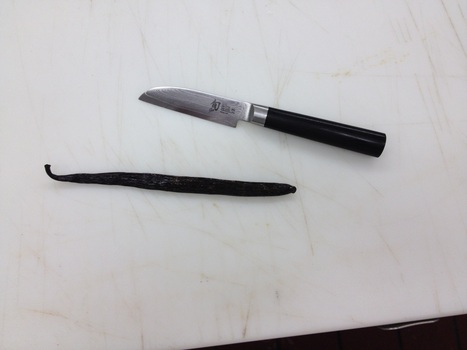
Lay your bean out flat and get a paring knife…

Picture

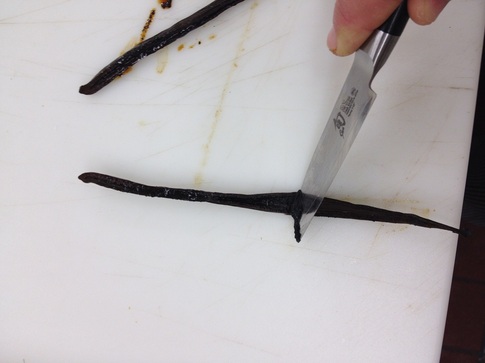
…and slice it right down the center.

Picture

Using the back of your knife, gently but firmly scrape the inside of the pod, gathering up all the little black grains inside.

Picture

Here it is. This is what those little black flecks in French Vanilla ice cream are.

Once you’ve scraped both halves of the bean pod, drop the grains into the milk and stir. If you want, you can throw the pod in there as well- nothing wrong with a little more flavor, and you’ll be straining them out later anyway.
Just a note- vanilla beans ARE admittedly expensive, so if that’s a concern, you can substitute a teaspoon of vanilla extract (albeit, this is like going out on the town in a golf cart instead of a Ferrari.)

Picture

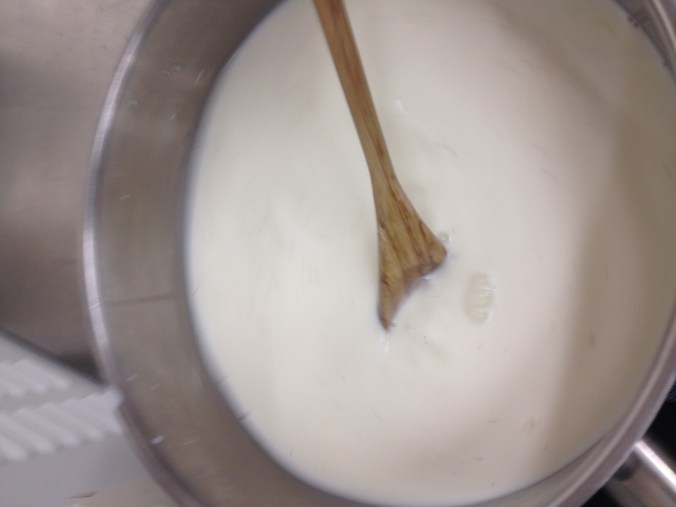
Once the vanilla is stirred in, put the pot over medium to medium-high heat, and bring to a boil. DO NOT LEAVE THIS POT ALONE. Leaving something on the stove in any case is foolish, but just remember the old saying: “A watched pot never boils, but an unwatched pot of dairy will boil over and ruin your day for the next 3 hours while you clean it up.”

Picture

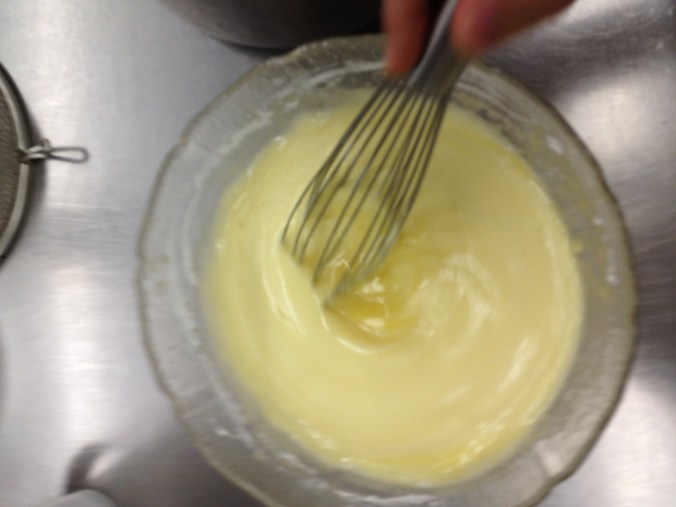
While the milk is heating up, whisk together your eggs and yolks with the remaining sugar and cornstarch. Ideally, everything should be around room temperature, and you don’t want any lumps. If there ARE some lumps, don’t worry too much- you’ll be straining it all later.

Picture

Now you just wait for the milk to boil. Keep a VERY close eye on it- milk will go from a light simmer to an explosive rolling boil VERY quick. As soon as you see the foam start to rise, take it off the heat IMMEDIATELY.

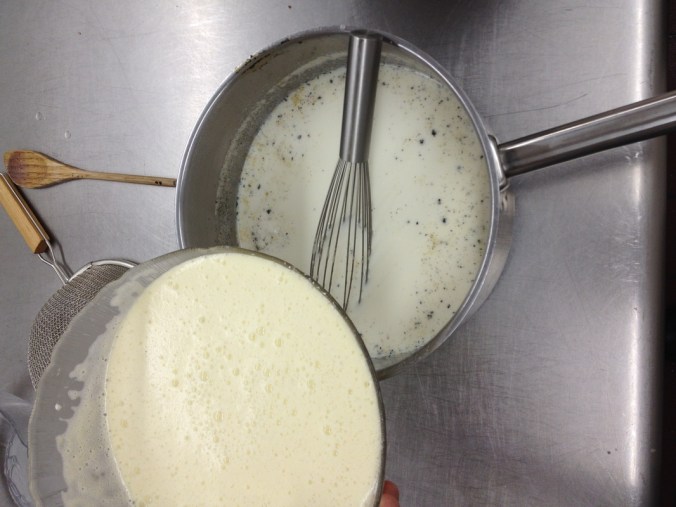
Now, it is time to TEMPER your eggs- this means pouring some of the hot milk into the eggs first and mixing it briskly. What this does is gently raise the temperature of the eggs before you add them in to the bulk of the milk. If you pour your egg mix right into the hot milk, you’ll wind up with sweet vanilla-flavored scrambled eggs- not exactly pleasant. 


Picture

So you add a LITTLE of the milk….

Picture

And stir briskly.

Picture

Repeat until you have about a third of the milk mixed in to the eggs…

Picture

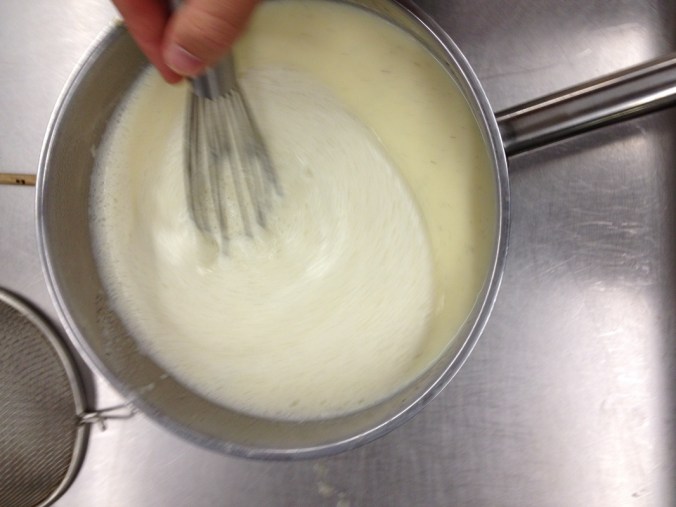
… and then pour the eggy-milk mix back into the pot, mixing well. You may notice the mixture thickening up almost immediately. This is supposed to happen- don’t worry!

Next, back on the heat (medium-low to medium this time!), and you will be boiling the custard for a minute, whisking constantly.
No, that was not a figure of speech- you will be boiling it for ONE MINUTE. The mixture will thicken considerably first, and then boil with thick, slow, blorping bubbles. Whisk constantly to keep the custard from burning, and when you see the first bubble, count to sixty, and then take it off the heat for good.

After one minute of boiling, your pastry cream should look like this:

Mmmmm… Don’t worry, you’re almost done!
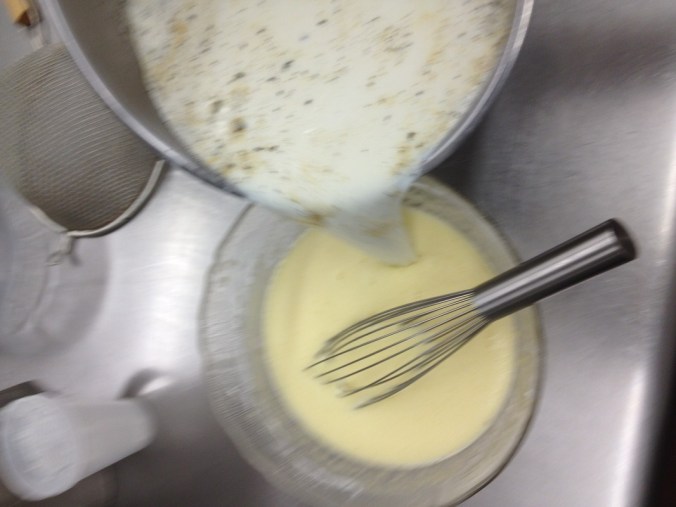
Next comes the straining. Set your strainer or sieve over a large bowl, and pour the pastry cream in (a bit at a time if necessary.) Use your wooden spoon and gently stir the cream so it goes through. 
Once it’s all strained, you need to cool it down and add the butter, and you can do this one of two ways. The way I have shown here uses a KitchenAid electric mixer- strain your pastry cream into the bowl, and mix it on the lowest speed possible with the paddle attachment. Add the butter, and mix until A. the butter is melted and gone, and B. The cream is cool enough to touch the bowl.

If you don’t have a mixer, you can go the more traditio
nal route. Strain you pastry cream in a bowl, and set it in a larger bowl with ice. Add the butter, and slowly mix with a wooden spoon until the butter is completely melted.

Once you’re done, get a piece of plastic wrap and lay it DIRECTLY ON THE SURFACE OF THE CREAM. The reason being that as custard cools, it forms a very unappealing skin. The plastic wrap will prevent this. Try to have as few air bubbles as possible.

Stick it in the fridge to cool, and you’re done!

There you have it- your own pastry cream, ready for mixing, flavoring, filling pastries with… or sitting on the couch and eating out of a big bowl.

Still waiting for those angry letters from Mrs. Obama.

In the meantime-

Stay classy,

Baking Like A (Mad) Scientist, Part 3- Why Weight? Go for it!

Good evening, friends and neighbors! I apologize for the lack of posting last week- the 9 to 5 got the better of me, and I desperately needed a brain break. I’ll try to be more on top of it in the future. Tonight’s entry comes to you, powered by green tea.

Tonight continues this months apparent theme of Baking like a Scientist with a crucial, often miscalculated, and widely feared aspect of the math behind the tasty sciences….

#2. Measuring and Weighing

In the entry before last, I mentioned the importance of putting a metric on as much as possible- times, temperatures, amounts, motions, turns, etc. This is necessary for exactitude, and therefore consistency. An exact amount of ingredient A, under the same conditions, with react with an exact amount of ingredient B the same way whether it’s today, tomorrow, or in 20 years- whether it’s you, or someone else.

Here, I feel the need to mention something very important. Consistency is being able to produce something the same way, tasting exactly the same, over and over again. For a professional baker, this is crucial- if you are intending to sell a certain product, it CANNOT vary from day to day. If you are baking for just yourself though, it’s important to know which ingredients CAN be messed around with, and with ones can’t. In general, anything that contributes to the chemical and physical reactions necessary to make the product happen must be measured carefully- I’ll do a future post about how to dissect a recipe prior to experimentation.

For right now, though, let’s discuss the crucial difference of…

WEIGHT vs. VOLUME

For the most part, the recipes you will find in books with be volumetric- meaning, the amounts of ingredients are listed in terms of volume, or how much space they occupy. In the USA, this is usually in terms of cups, pints, teaspoons, tablespoons, quarts, etc. Almost everywhere else in the world, the metric system is used- liters, milliliters, and so on.

Volumetric units are handy because they require very little skill or practice to learn- just the ability to count. They have a few significant drawbacks, however-

1. Density

Different amounts of product can take up the same amount of space. For example, almost every recipe that calls for brown sugar requires the measure to be “packed”- that is, the brown sugar should be pressed into the measure very tightly to ensure there are no gaps. This is because brown sugar is clumpy, and an unpacked cup of brown sugar is significantly less that a packed cup. Similarly, a cup of sifted flour is noticeably less than a cup of unsifted flour.

2. “Level” Measurement

Ideally, every volumetric measure should be level- a knife or ruler scraped right across the top of the filled cup to make a completely flat measure. Some ingredients, however, defy this- how do you scrape a level across the top of a cup of nuts, or berries? Additionally, some recipes will call for a “heaping” spoonful, or a “scant” cup- what do THOSE look like? Different for everyone who makes the recipes, every time they make it.

3. Different Volumes

In measuring, a “pint” (abbreviated as “pt”) is 2 cups, or 16 fluid ounces (fl oz.) Most bars in the world, however, recognize a “pint” of beer as being around 12 fl oz.

Additionally, there is the question of what KIND of ounce a recipe means- a fluid ounce (volumetric), or an ounce of weight (16 to a pound.)

For these reasons and more, professional bakers (and most anyone who uses the metric system) prefers to work in terms of WEIGHT, rather than volume.

Working with weight lends itself VERY well to the precise nature of baking. A pound of flour is a pound of flour, whether it’s sifted or unsifted. 6 oz. of brown sugar is 6 oz, whether pressed into a lump or broken up- thus making for quicker, easier, and more accurate measuring. Ingredients in small amounts, such as baking powder or salt, may still be done in volumetrics, but in general a professional bakers formula is given in weights.

The other reason weight is used is because of….

CONVERTING

Imagine you want to quadruple a recipe that calls for 4 cups of flour. That’s 16 cups of flour you have to measure out and level… without losing count. Little ridiculous, right? Too much time, too much work, and too many chances for a screw-up. Additionally, consider the following:

3 teaspoons (tsp) = 1 tablespoon (Tbs)

2 Tbs = 1 fluid ounce

8 fl oz. = 1 cup

2 cups = 1 pint

2 pints = 1 quart

4 quarts = 1 gallon.

So you’ve worked out the recipe you’re multiplying out calls for 18 cups of milk- how many quarts will you need to buy from the store? What if they only have gallons?

As much as I love math, I like doing as little as possible when I’m in the middle of something. Now, if we were doing weight-

16 ounces (oz) = 1 pound (lb or #)

That’s it. All there is to remember- and that’s just in America! Anywhere that uses the metric system, it’s…

1000 grams (g) = 1 kilogram (kg)

Simple, isn’t it? And all you need is a kitchen scale. Instead of scooping, leveling, guessing, figuring… you just pour your ingredient on to a scale until it’s the amount you need. When you are working in a busy bakeshop, anything to make your job faster and easier is a good thing.

Well, I certainly think that’s enough for tonight! Any questions? Ideas for what to cover next? Something in the kitchen that puzzles you still? Leave me a message in the comments! Next week, it’ll be back to more fun food stuff- promise!

Stay classy,

– BHB

Baking Like A (Mad) Scientist, Part 2: Bakers Math- Attack of the Numbers

     Good evening, friends and neighbors! 

    Last week, I talked a bit about how to approach baking scientifically. At its heart, baking is edible chemistry- a careful and calculated combination of substances with the intent of causing a series of chemical reactions that produce a different (tasty) material.  If you haven’t read the last blog entry yet, I suggest you do so- and read the rest of the blog while you’re at it. A lot of cool stuff is discussed!

     This week, we are going to be discussing one of the most vital parts of scientific baking, and also one of the most feared and intimidating parts- baker’s math.

*”O Fortuna” plays in the background*

In what has almost become a scripted discussion, when I ask people why they don’t like baking, these are the answers I get:

  • “Oh, I just don’t get it!”
  • “You have to be so careful about everything! I’m not good at that.” (This came from a nurse.)
  • “It’s so much work!”

Far and away, though, the most common answer I get is:

“I stink at measuring- all those numbers and everything.”

Ok, I get it. I’m not heartless. Not everyone “gets” math- or so they think. People use math every single day. They are so accustomed to seeing math as a monolithic wall of formulas in a textbook, that they fail to realize just how much they rely on it every moment of their lives. Here’s the big secret:

If you can count money, slice a cake, or make a cocktail- you can do baker’s math.

Wait… cocktails? Money? What?”
Hold on, stick with me. We’ll start with…

#1. Formulas, and Bakers Percentage

In the last blog entry (have you read it yet?), I mentioned in passing that in professional baking, it is more common to use “formulas” rather than recipes. This choice of words is not just to make bakers feel smug and smart. Bakers math was formerly known as “bakers percentages,” but people got confused because they don’t ACT like the percentages people understand, as I will demonstrate soon.

First of all, quick crash course- a percentage is a way of describing part of a whole. It is another way of depicting a fraction or decimal number. For example: 

1/2         =            .5                =            50%
Fraction                      Decimal                            Percentage
1              =              1.0            =           100%

This is the way percentages work in any other walk of life- demonstrating fractions in relation to 100. This is the same way U.S. currency works-

100 ¢        =              $1

Still with me so far? Good.
Bakers formulas don’t work like that.

In a bakers formula, percentages are used to show RATIOS- that is, different amounts relative to EACH OTHER, rather than to a whole. (Here’s where the cocktails I mentioned before come in.)

As a treat for reading this far, here is my personal favorite recipe for a Gin and Tonic-

The BHB’s Gin and Tonic
1 part Tanqueray Gin
2 parts Tonic Water
splash of cucumber juice
Garnish with cucumber slice

Besides a tasty beverage with which to relax on a summer day, I’ve also just provided you with a ratio- whenever you make this drink, you use twice as much tonic water as gin, whether making it for yourself (advisable!) or making a giant jug of it (inadvisable, unless you share), and it will always taste the same. 

This is a little thing called “scaling”- and it’s what allows me to make one loaf of bread or a hundred loaves from the same formula, and have them all come out the exact same without doing an insane amount of extra calculation.
Yes, using math to prevent more math. You’re welcome!

With the idea of ratios still firmly in mind, consider the following formula, borrowed from Realbreadcampaign.org:

100% Strong Flour
68% Water
2% Yeast
1% Salt

After everything about percentages above, you can already see there’s a problem here:
“100% flour?! That’s the whole thing, isn’t it?!” “That adds up to 171%! Impossible!”

Remember though: we are dealing with RATIOS. All the ingredients are in RELATION to something else- in this case, the flour (100%.) In most breads, flour is obviously the most prevalent ingredient, so it becomes the standard against which all the other ingredients are related- 100%. 
Therefore, in making this formula, you are being told that your water should be 68% the amount of your flour, your yeast should be 2% its amount, and salt 1%.

Now the astute among you might notice something else- what amount? Pounds? Cups? Handfuls? Stone? 

That’s the beauty of using bakers math: it doesn’t matter. It can be anything. As long as you apply the same unit to everything, it will come out right. 
Want to make the 100% flour equal ounces? 

100 oz. Strong Flour
68 oz. water
2 oz. yeast
1 oz. salt

You’ll come out with a LOT of dough (nearly 11 lbs), but it will work. 

That’s quite enough for tonight I think- next week, we’ll be talking about measurement: weight vs. volume, scaling, and more!

Till then…

Stay classy,