In Hoc Crustulo Vinces, Part 1- The Season Is Upon Us!

 Good evening, friends and neighbors! Still trying to get back on schedule with weekly updates, I’m afraid. New and interesting topics are getting harder to devise. What might alleviate the situation? Leave comments about what you want to see here! Recipes? Philosophical ramblings? How-tos? Puppy memes? Drop a comment either here, on the Facebook page (http://www.facebook.com/blackhatbakery) or even shoot them off to me on Twitter (@blackhatbakery.) I want to write what you want to read!
That said, moving on to tonight’s topic!

With fall having already *officially* started, the air feeling noticeably cool in the mornings, hoodies and light jackets starting to find themselves more in use, and Halloween costumes and decorations appearing in shop windows, those of us who know and love autumn find ourselves eagerly anticipating the true harbinger of the season.

No, not pumpkin spice (insert item here.)

…Nope, not piles of crunchy leaves.

Nope, not even the Great Pumpkin.

My friends, we eagerly await PIE SEASON.

I have always considered myself more of a pie fan than anything, and it took some time and navel-gazing to determine why. If you can think of a better product of introspection, I invite you to go after it and write your own blog.
The reason I love pies so much is because they are my food philosophy in a pure, recognizable, and delicious form. There are few things that recall memories of home, happiness, and simpler, warmer times more readily than a fresh-baked pie (Sweeney Todd and Miss Lovett notwithstanding.)

At the same time as they are quickly reminiscent of simple joys, perfectly crafted pies are works of diligence, care, grace, and finesse. The texture of the crust, the color and appearance, the seemingly effortless affectations of vents and fluting- all under the bakers control, with the precision and premeditation of a sculptor.

Simplicity with elegance, made physical.

It is not without reason that the old idiom goes “easy as pie.” Pies are, from their very origins, meant to be simple, efficient, and entirely self-contained. Savory meat pies can be an entire balanced meal sealed into a crust, all baked together at once.

When I discuss piemaking, the following issues are usually raised:

1. Don’t know how to make pie crust/ any good recipes.
2. Requires a special pan.
3. Takes too long/ they have no time.
4. Why not just buy it?
5. They don’t like pie.

#2 is a non-issue. A pie is, by definition, a filling baked in a pastry crust. You can use a reusable metal or glass one, a disposable foil pan, or make hand pies, crimped and baked by the sheet.

#3 and #4 tend to go together, and involve a critical misunderstanding about pie. Fillings can be made days ahead of time, dough (if frozen) can be months. Few pies take more than an hour to bake, and as was stated before- a well-made pie can be an entire meal in one plate.

Those who claim #5 are a lost people- let us not speak of them again.

Therefore, this entry will mainly deal with #1, which is entirely reasonable and easily remedied.
———————

Pie dough is what is called a “short” dough- yes, akin to shortbread cookies. The reason it is called short dough is because the amount of fat in it (whether butter, lard, shortening, or oil) inhibits gluten bonds from forming as long as they might in other doughs (bread dough, for instance). Consequently, short dough has a crumbly, flaky texture. The amount of fat also makes it an ideal sealant- perfect for keeping the juices/gravies of your filling from running out.

The absolute basic short dough can be made using a simple formula:
3 parts flour
2 parts fat
1 part liquid

Those of you who read my series on kitchen math will have seen notation like this before- baker’s formulas are represented as ratios rather than recipes to allow for easy scaling (making different sized batches.)

This will create an extremely simple, all purpose short dough. Add sugar, it becomes sweet. Add herbs, it becomes savory. Switch the liquid from water to iced tea to juice to whatever you like. It will work. Towards the end, I will give you my personal favorite recipe.

Pie dough is also an excellent example for how the HANDLING of ingredients can make a difference in the final product- particularly the fat, in this case. If you’ve ever drooled the perfect flaky pie dough, or the melt-in-your-mouth crumbliness of shortbread, the difference is entirely in how the fat is worked into the dough.

As you will see in the recipe below, the butter is “cut” into the dry ingredients- meaning, it is worked in to the flour by cutting it down into smaller and smaller chunks. You can use your fingers, a pair for butter knives (if you are exceedingly patient), or a special device called a pastry blender (if you feel like getting one and pretending to be Wolverine.)

When working the butter in, if you leave relatively large solid lumps of butter intact, these lumps will form paper-thin layers within the dough, leading to the flaky perfection you seek in a pies top crust. If you work the butter into smaller and smaller pieces, the butter will melt more readily in the oven and absorb into dough, leaving a mealy texture- ideal for bottom crusts and shortbread cookies.

Here is my personal favorite pie dough recipe- with minimal tweaking, this makes an ideal crust for savory or sweet pies. It will make enough for one double-crust 9 inch pie, or two single crust pies.

Pie Dough

Ingredients
2 1/2 cups (350 grams) all-purpose flour
1 teaspoon salt
2 tablespoon (30 grams) granulated white sugar (leave out if you want it savory)
1 cup (226 grams) unsalted butter, chilled, and cut into 1 inch (2.5 cm) pieces
1/4 to 1/2 cup (60 – 120 ml) ice water or other chilled liquid (experiment with different liquids to get interesting flavors!)

Herbs or Spices as you see fit

Mix all the dry ingredients together, and cut the butter in until it resembles coarse corn meal (or some pellets of butter the size of peas.) Add the liquid and continue to work until the dough forms. Dump out onto a lightly floured surface and work into two even-sized balls. Flatten the balls slightly and wrap in plastic. The dough can now be refrigerated or frozen until ready for use.

When rolling, roll the dough out on a lightly-floured surface and rotate 45 degrees with each pass. This will keep the dough from sticking as readily, and it will also even out your rolling (as you will instinctively press harder with your dominant hand.)

Tips and Tricks for Pie Dough
———————————
– The butter (and dough itself) should be kept as cold as possible while you work with it. If the butter is allowed to get too warm, it can melt into the dough too quickly leavve you with greasy, gritty crust. You can keep things cool by working quickly and lightly, and by picking a cold, dry surface to work on. Marble slabs are ideal, but expensive- a good quality wood tabletop will do fine. 

– Keep an eye on your dough. You do not want to overwork it- despite the fact that it is short dough, gluten bonds HAVE formed. If you notice your dough shrinking back after you roll it, it is being overworked. Relax the dough by letting it sit covered in plastic for a few minutes.

– You will want to flour virtually every surface your dough comes in contact with while you work with it- your hands, the tabletop, and your rolling pin. You do NOT want to overflour, however- in the course of work, the dough will absorb the flour and get drier. Therefore, use the bare minimum flour you need to keep things from getting sticky.

– The best rolling pin to us
e is… the one you like. Pins come in all shapes and sizes- the best one for you will feel balanced in your grip, comfortable in your hand, and will be made from material that is easy to clean and doesn’t warp. Wooden pins should NOT be washed with soap and water- instead, they should be rubbed down vigorously with a clean cloth or paper towel.

That’s all for tonight! Next week, I’ll discuss a couple of my favorite recipes, as well as some aesthetic touches that will really make your pie yours.

Stay Classy,

-BHB
Where To Keep Your Pride

Good evening, friends and neighbors! 

     I apologize for the long silence- it’s been a manic few weeks, and Thursday nights have found me mentally/ physically drained to the point that I couldn’t think straight, let alone type. 

     Tonight, however, finds me in- you guessed it- another taphouse. This one is Vagabond in Atlantic City, just off of Albany Ave./ the Black Horse Pike. It definitely has a sports bar vibe, but somewhat more homey. The rotating selection of interesting craft beers doesn’t hurt either- right now, a Cape May Brewery Honey Porter is keeping the rain’s chill at bay. 

     Part of what has kept me so frantically busy for the last two weeks was catering my friend Lauren’s wedding- my first wedding gig, and an interesting one at that. Lauren and her (now) husband Keith are Revolutionary War reenactors as a hobby, and they wanted their wedding to be period 18th Century- from their attire, to the location, to (of course) the food. 

     No, I did NOT squeeze myself into a pair of stockings and a waistcoat. No one needs to see that. Besides, 18th Century professional bakers- given the conditions of their bakeshops, in front of open roaring fires- tended to work in their underwear or naked.
 
     NO ONE needed to see that. 


     What it meant instead was that all of the desserts I made (with the exception of French macarons and the cake itself- the bride requested Red Velvet) would be from recipes from the 1700s. A fascinating and interesting challenge to say the least.
 
   The website for Colonial Williamsburg in Virginia was incredibly useful- their kitchens acquire recipes from 18th Century cookbooks and their measurements and instructions in modern equivalents, offering both the original text and the 21rst Century ingredients and instructions they’ve hit upon- I highly recommend it for anyone interested in food or culinary art history!

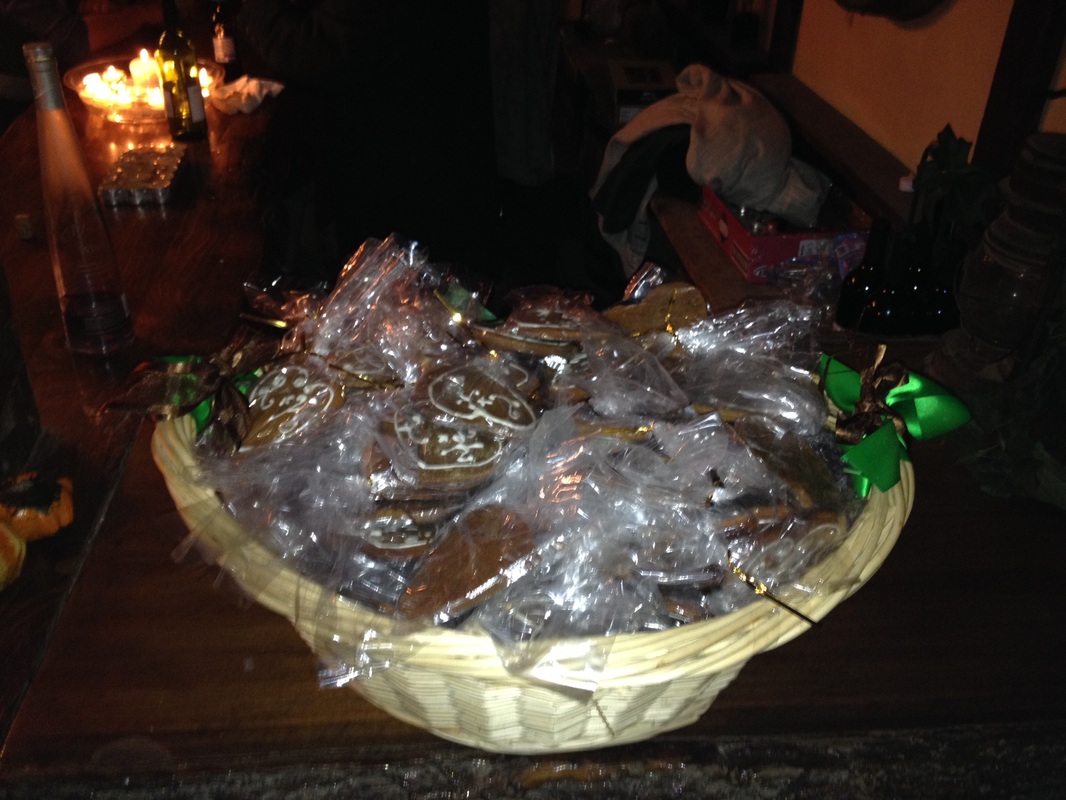
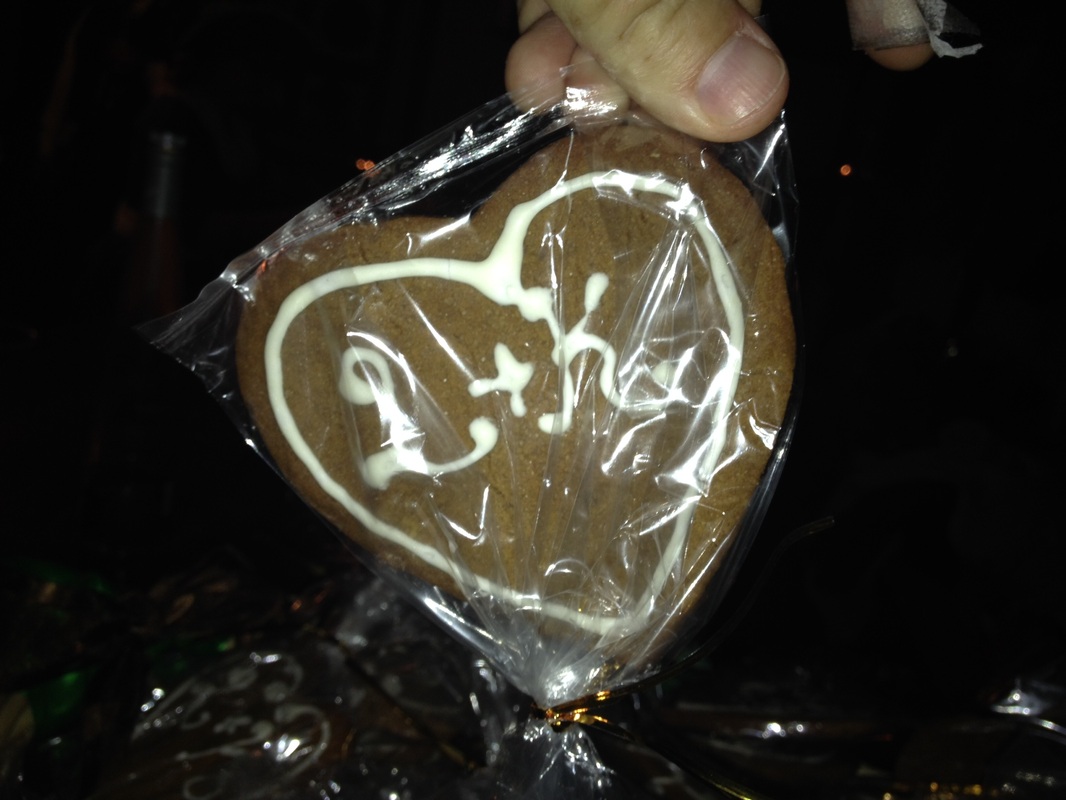
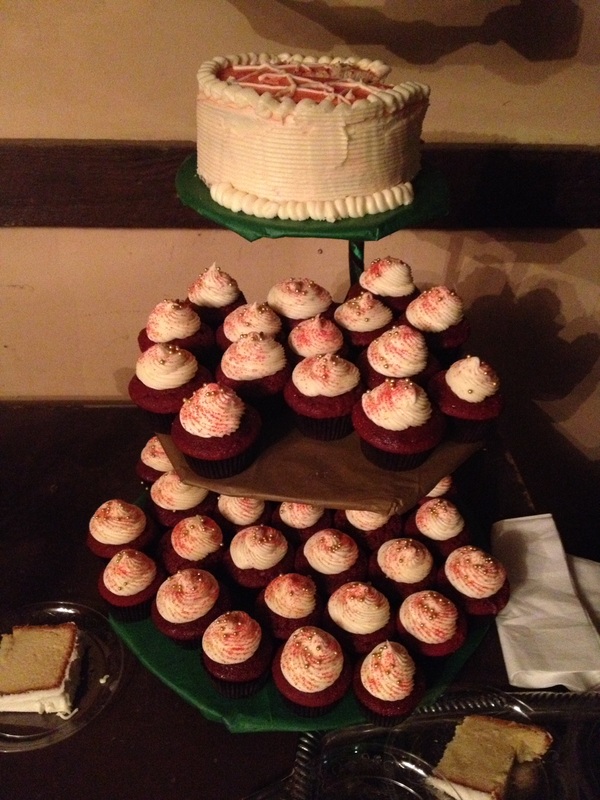
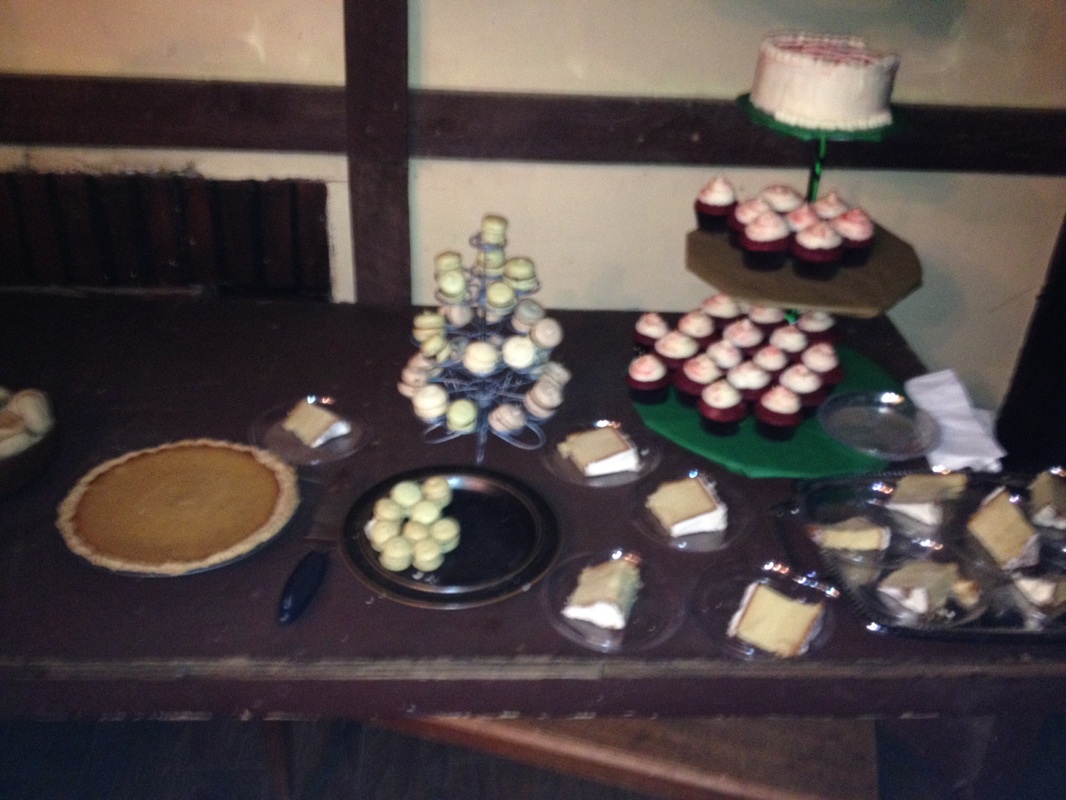
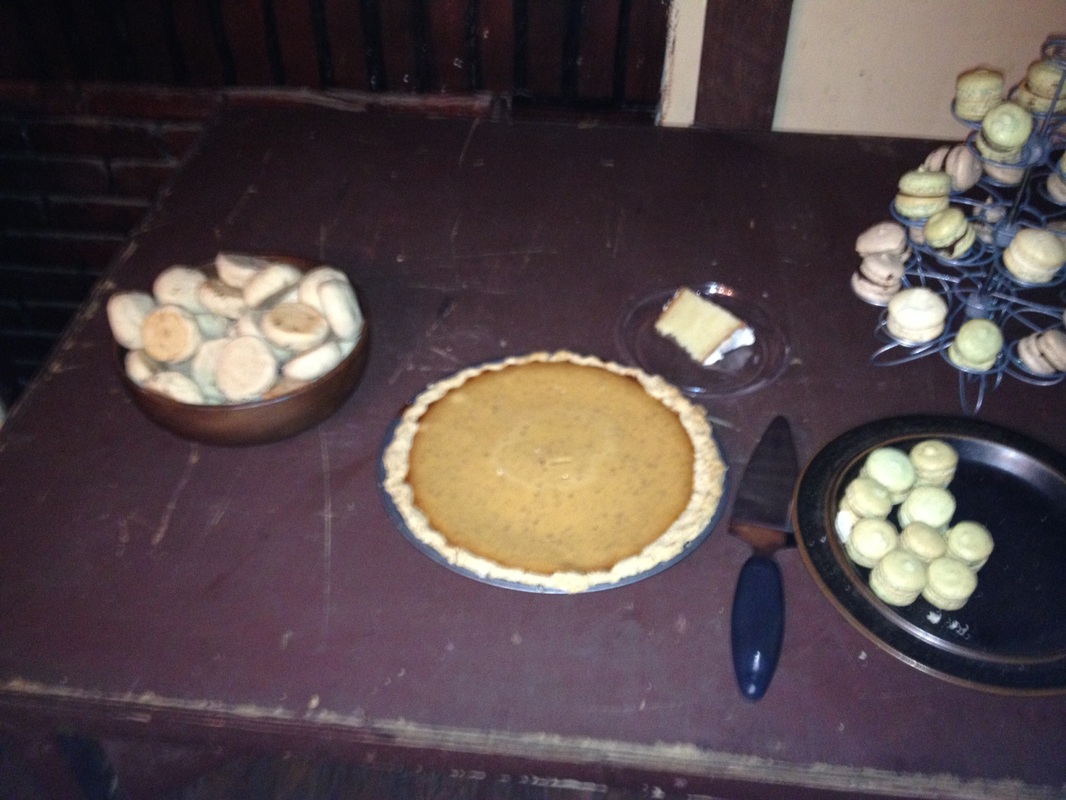
But now, a brief break for… PICTURES!


The wedding was a great time, and everyone loved the food.

Perhaps you are wondering by now, though, what the title of this entry means. It is a lesson that I have had a hard time learning, and got a full-on education in at the wedding and the day after.

In my discussions with the bride and groom, I was told that instead of a traditional tiered wedding cake, they wanted a tree of red velvet cupcakes and a small 6 inch cake on top for them to cut. Later on, the bride informed me that the groom’s mother had insisted on making a cake for the wedding as well, and that it would be a “groom’s cake.” Traditionally, groom’s cakes are not as large as the wedding cake, are gifts from the bride to her groom, and usually are made to represent the grooms personality and interests. I had no problem with this, seeing it as insurance that there would be plenty of food for all.

On my arrival at the wedding venue, however, I discovered that the groom’s mother had not simply made a groom’s cake, but a full-blown 4 tiered wedding cake, and had placed it on the front table, where it was reasonably assumed to be *the* cake. The cupcake tree and 6″ cake I had made were subsequently relegated to the dessert table with the rest.

At first, I felt rather annoyed and irritated- in my view, I had worked hard on a wedding cake, and it was no longer to be *the* cake because someone else showed up first. To add insult to injury (in my mind,) I was then asked if I could slice and serve the wedding cake, since no one else present knew how. I felt put-upon, cheated, and betrayed that my friends wouldn’t speak up and say that I was already making the cake.

A day or so later, once I had time to calm down, I put it in perspective. I realized that, in all truth, I was being egotistic, selfish, and generally stupid.

It may have been awkwardly arranged, but it was entirely reasonable that the groom’s mother would want to have SOMETHING to do with her son’s wedding, and that keeping her happy would be higher up in their priorities than the ego of a friend.

I was being selfish in that I had made the entire affair all about me and my wounded pride, where the entire point of the day had nothing to do with me at all- it was my friend’s wedding.

Lastly, what I learned was that, in the end, my pride had nothing to do with ANY of it. I could absolutely take pride in the quality of my work (and I do), but in the end, it was THEIR cake and cupcakes to arrange or prioritize as they wished. A friend of theirs I may be, but it was also business- I was there delivering and setting up food. I had no right to expect any kind of ego stroking for what, in truth, was just the filling of a contract.

It’s perfectly right and acceptable to take pride in your work. In fact, if you don’t, you have other far more serious issues at hand. When you are selling your work, however- your pride doesn’t matter at all. All your hard work is to help make your CUSTOMERS event happen , your CUSTOMERS day a good one, and your CUSTOMERS guests and family happy.

Keep your pride in your work… and leave it there. 

“No, I don’t like work. I had rather laze about and think of all the fine things that can be done. I don’t like work – no man does – but I like what is in the work – the chance to find yourself. Your own reality – for yourself, not for others – what no other man can ever know. They can only see the mere show, and never can tell what it really means.” – Joseph Conrad, “Heart of Darkness”

Stay humble.
Stay content,
and of course,

Stay Classy,

Meditations on the Bench- Altruism

Good evening, friends and neighbors!

One thing the profession bakeshop is never short of is mundane tasks- repetitive, dull, simple jobs that take forever and threaten to put your mind in a permanent torpor.

When it falls to me to handle on of these necessary (but dull and generally thankless) jobs, I usually find my mind wandering and ruminating on topics I had been reading about recently, or that current events bring to mind. Now and again, I’ll remember enough of my thoughts- or get to a pen and paper in time- to write them down.

These entries tend to wax philosophical, so if that isn’t your speed, hopefully I can offer something more appealing next time.

——–

The other day, I found myself having a brief conversation with the owner of a little deli near where I work. I was just coming off my shift, and we were talking about our respective days. I had just ruminated on the fact that 16 hours worth of preparation would be swept away in a banquet for about 750 people, in the space of an hour.

    The shop owner said, in a heavy accent that I have not yet placed, “It is a shame- they are eating and eating and never stop to think of who made it. They do not appreciate.”

    I nodded and, without really knowing why, I confessed- “Recognition and praise are great, but all I really want is to meet them- to look them in the eye and see that they are satisfied. I want to know I made a difference to them that day, and for them to know the face behind their food.”

    Altruism is a sticky subject, and one that philosophers and students much wiser and more educated than I have been fiddling with and working out for centuries. Its dictionary definition is “belief in or practice of disinterested selfless concern for the wellbeing of others.” In common use, it means giving of oneself without the expectation or desire of receiving anything in return- not even something intangible and self-bestowed, like a “warm fuzzy feeling.” In Zen Buddhism, it is possibly best described as being virtuous with no thought of virtuousness- doing the right thing, but not because it is the “right thing- it’s just what is to be done.

    If I’m honest- it’s something I suck at. Even my confessed wish to be recognized as the creator of their food and to simply know they are pleased- that is a reward, and thus my desire is not altruistic.

    I found myself thinking afterward, “Is that so wrong?” I am not a monk or a saint. Is it truly wrong to crave such a simple pleasure as the recognition of a job well done, or the knowledge that a creation’s objective has been met?

I don’t think so.

I have long been of the opinion that a creator or artist is blessed three times: first in the work itself, second in the completion , and third in giving the work away. Why would anyone willfully deny themselves such a blessing?

Or perhaps, it is not denying the blessing, but only the knowledge of it?

Thoughts worth thinking… but later.

Stay thoughtful.

Stay wondering.

and of course,

Stay classy,

BHB

“When The Going Gets Tough, The Weird Turn Pro”: A Look at System D.

     Good morning, friends and neighbors!
     Sorry this post is late. Due to factors not QUITE beyond my control, but enough that I was too tired to see straight last night- let alone think straight- I am writing to you down in the wee hours of a rainy Friday morning.

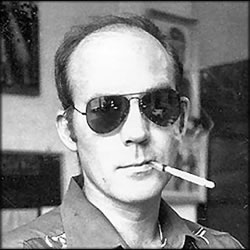
     This post is going to bring together a lot of different observations, but as always- even obliquely- I WILL pull it all together for you, my dear readers. To start with, the quote I picked for the title,  originally uttered by this man:

     Hunter S. Thompson. Father of gonzo journalism, sports writer, political writer and activist, founder of the “Freak Power” party,  professional weirdo, remembered for his love of recreational drugs, alcohol, gambling, and firearms- and one of the most important writers of the 20th century. If you haven’t read anything by him and you REALLY want to send your head down the rabbit hole of 60’s- 70’s America, I highly suggest it.
     The “gonzo” philosophy, illustrated by Thompson, called for a complete abandonment of any pretense toward objectivity. Thompson would report of happenings and stories from his own point of view, writing himself and his actions directly into the story and offering opinions and perceptions from his point of view. It called for experiencing things viscerally.

Again, I promise- I WILL tie all of this together, one way or another, through System D- a semi-archaic, obscure bit of kitchen jargon, resurrected through the writing of Anthony Bourdain.

To quote Wikipedia:

System D (in French, Système D) is a shorthand term that refers to a manner of responding to challenges that requires one to have the ability to think fast, to adapt, and to improvise when getting a job done. The letter D refers back to either of the French nouns débrouillardise[1] or démerde (French slang). The verbs se débrouiller and se démerder mean to make do, to manage, especially in an adverse situation.

To summarize, System D is the ability to solve problems on the fly, using whatever is on hand and no small amount of ingenuity.

To summarize the summary, it means slapping something together in the nick of time to keep things from going properly to hell.

Those of you who know me (and I say this because I’m not sure if I mentioned it in this blog or not) know that baking was not my first career. I spent a total of 10 years in medicine, 8 of them as an EMT. EMT training was pretty extensive, covering the ins and outs of saving a persons life in a variety of situations, getting them help, and making sure they didn’t get worse in the meantime.

As you no doubt guessed though, training doesn’t cover everything.  More than once my crew and I found ourselves in situations where what truly saved the day wasn’t training, mnemonics, formulas, or complicated procedures. Often it was simply being observant, being creative, and thinking on one’s feet. I recall cutting the thumb off a glove to make a waterproof bandage for a kid’s toe, and wrapping a blanket into a splint for a broken ankle.

In the kitchen, I have seen a cake weight used to crush nuts, a broomstick used for a narrow rolling pin, fishing line to cut a cheesecake without leaving residue, and clean dish scrubbers and pencil holders used to make impressions on rolling fondant. 

“When the going gets tough, the weird turn pro.”

See, I told you!

Stay interesting.
Stay weird,
and as always-

Stay Classy,

Go Your Own Wei Wu Wei: Taoism in the Kitchen

Good evening, friends and neighbors!

Early this week, I was talking to my friend Karen at work. The day was promising to be hectic- we were two people short, and everyone was doing at least one other person’s job along with their own. I had just amassed my production list (a.k.a. my to-do list), and was beginning one of the jobs when Karen told me I was “getting in my own way” and it was driving her crazy.

“Getting in my own way?”, I asked, looking down at my station- a bit crowded to be sure, but clean and organized.

“Yes! You have things out for jobs your not doing yet, and it will take you forever!”

At that moment, I realized she was right- I had plates, tools, and all manner of things piled up on either side of my workspace, limiting me from a 2.5′ x 7′ table to an actual workspace of maybe 2′ x 2′.

I had worked myself out of working.

When I was in school, our chefs would constantly remind us to work clean, but two chefs in particular- Chef Tree McCann and Chef Annmarie Chelius- would remind us to work ORGANIZED, and have NOTHING on the tabletop that wasn’t important to what we were doing AT THAT MOMENT. It didn’t matter if we were going to be using it for the next thing, or picking it up again just as soon as we were done- if it wasn’t being used, it didn’t belong on the table.

At first, it seems like a pain in the neck, and a load of extra steps to take. After clearing away what was not immediately necessary, though, I found I had more space to use on the CURRENT task- I spread it out, and wound up completing it in a third of the time it might have taken me as I was used to.

Those who know me, or who have read this blog for any amount of time (thank you!) know that I have a penchant for comparative theology and philosophy, and that recently I have been enamored of Taoism. In a nutshell, Taoism is based on the idea that there is a specific nature and order to the universe, the Tao (the “Universal Way”) The Tao says that winters are supposed to be cold, summers to be hot, flowers are to bloom in spring, and leaves are to fall in autumn. When people expect things contrary to the natural order, or try to fight against it, that is when people have troubles.

I mentioned one of the key practices of Taoism in the title of this entry (typically in a horrible pun- I apologize)- wei wu wei. This translates as “Doing Not-Doing,” or more inaccurately as “Doing Nothing.” At first blush, many people interpret this as passiveness and inaction, when nothing can be further from the truth.

Wei wu wei is perhaps best described as “effortless action,” or “perfect flow.” It occurs when a person is so devoted and involved in a given activity that the action because as natural and effortless as breathing. Put poetically, it is when we can no longer tell the dancer from the dance, or the musician from the music they are playing. They are doing, without doing- refusing to let their intellect interfere, allowing the motion and music to flow from them as easily as a sigh. This comes from devotion, practice, patience, and the perfect mastery of oneself and one’s art.

Many cooks will talk about their “flow” or about “the dance” of a working kitchen- the motion of people around each other that looks like madness and chaos, but is in fact (at least in the best cases) a delicate choreography- every person in tune with what they are doing, and what their teammates are doing where. In a way, this is the same thing.

When you bake, focus on what you are doing. Let nothing distract you… and then stop thinking. Move in the way you need to move- no more than necessary, no less than required. Proceed through one thing at a time- the future will be along soon enough, and THEN you can deal with what comes next.

Stay calm.

Stay centered in yourself,

and of course-

Stay classy,

-BHB