New Year, New Chapter

     Good evening, friends and neighbors! Happy New Year to all!

     I don’t normally care so much for the actual EVENT of New Year as the things I do that evening/morning, and the people I share it with. This year was very different, and it forced me to reflect on the new year with a bit more introspection.
     
    My day job is in one of the Atlantic City casinos (one of the ones still open and NOT up to its neck in debt) and New Year’s Eve is a MAJOR money-maker for them. Lots of people showing up, eating, spending money, gambling, drinking, and then getting rooms so they can sleep it off conveniently. Therefore, the last two days have been balls-to-the-walls, all-hands-on-deck shifts, with mandatory overtime ordered- no one leaves till everything’s done.

Obviously, being on day/swing shift, this messed with my New Year’s Eve plans. The original plans involved a party with my parents, or at the very least a quiet night in with my girlfriend. My girlfriend unfortunately fell ill and cancelled, and I was way too tired from work to even consider going to a party- so this was the first New Year’s Eve I could remember spending alone.

Just to be clear, I’m not complaining about my work inconveniencing me in celebrating a holiday. In the culinary industry, that’s par for the course- we work holidays so that other folks can go out to eat somewhere nice on theirs. That’s just the way it is.

My night alone generally seemed like living out a Tom Waits song, but the solitude got me looking back at the events of 2014, the events of that day and the months leading up, and what 2015 might bring. 

2014 was a big year for me, professionally, and for the Black Hat Bakery.
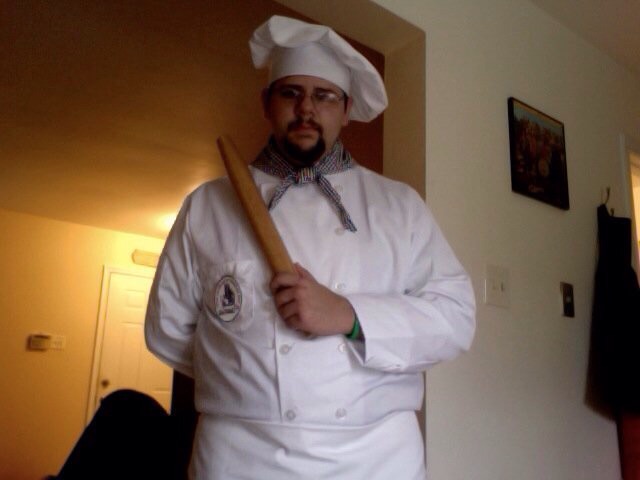
I was inducted into the Chaine de Rotisseur, and was addressed as “chef”- unironically- for the first time at Roberta’s, where I helped in preparing my first Chaine dinner alongside Chef Joe MuldoonI also catered my first wedding, and prepared desserts for my first Restaurant Gala. 
I redid the Black Hat Bakery website, reimagined this blog and what it should contain, and added a host of new desserts and treats to my repertoire.

At the same time, 2014 brought me work at the casino.
While working at the casino has brought me money and security, it is not my ideal work or work environment. I find so much of my energy is consumed by the casino that I have difficulty finding time to focus and work on the things that I want to do, and mean the most to me. While my coworkers and some members of my management are good people, I still feel constrained and tethered to work that I can no longer find meaning in.
In this year, I have had to accept several facts about my employment:
1. My loyalty to the casino is misplaced, and certainly not reciprocated.
2. My career and advancement trajectory in the casino is nil.
and 3. The job is not likely to ever bring me closer to my goals. All it provides anymore is a paycheck.

I don’t really do New Years resolutions- they are too much like aspirational statements and dreams than real goals. Instead, I am setting several goals, and I am determined to make them real within the coming year.

If I cannot find a new job closer to my ideals by May 1rst, I will quit the casino job and instead devote my time and energy to the Black Hat Bakery. Either way, come December 31rst, 2015, I will NOT be working at the casino, or any casino.

The Black Hat Bakery is the closest thing to my dream that I have, and I refuse to let neuroticism, fear, and doubt prevent me from making it the best it can be anymore. I have plans in the works to make this bakeworks in to something truly excellent.

As my grandfather used to say, “They may love it, or they may hate it- but they won’t be able to ignore it.”

2015 is promising to be very interesting. Keep your eyes open.

In the meantime-

Stay Classy,

A Skinny Chef’s Point Of View

Good evening, friends and neighbors! Hope everyone’s holiday season is underway with lots of food, festivity, and fun stuff!

I’ve hestitated to talk about tonight’s topic for a while. Initially because I was uncertain what qualified me to speak on body stereotyping and shaming. I didn’t want to write another vapid, rambling, whiny post like so many on this topic- lots of words, lots of pain and questions, but no real answers.

Then I just decided to change how was going to write it. Less as a complaint, and more as  a testimonial.
Less questioning, more examining.

First of all, let me share something with all of you- I was not always lean. Those of you out there who have known me personally for years are well aware of how I used to look, but for the rest of you:

This was me just as I was starting culinary school, in the fall of 2010. I was working as an EMT. I had bad knees and a back that would cripple me nightly after work. At my heaviest, I weighed 270 lbs (122.5 kg.)

In May 0f 2012, I made the decision to lose weight and get fit once and for all.

I knew exactly what was stacked against me:
– the habits of a lifetime: stress eating, inactivity, poor diet.
– genetics: my family has a predisposition to obesity, diabetes, heart disease, and more.
– time constraints: I was then working at a hospital as well as going to school and starting up the Black Hat Bakery. My time was at a premium.

But I also knew what I had going for me:
– willpower
– genetic predisposition to a strong metabolism.
– cheap access to a gym.
– the support of a friends
– the knowledge that nothing good lay ahead if I stayed as I was.

With the support of friends and family, I set myself on a fitness regimen. I used a couple of free apps on my phone, MyFitnessPal and Fitocracy, to help me keep track of my eating and exercise and to motivate me along.

This is me, May of this year:

When this photo was taken, I weighed 163 lbs. (just shy of 74 kg)

There is a common joke maxim: “Never trust a skinny chef.” The joke is that the guy obviously doesn’t eat his own food.
Joke this may be, I have met several people that hold it to be true. I regularly hear that I’m “too skinny” or “too fit” to be a pastry chef, followed by the question “How do you DO it?! Surrounded by all that sweet stuff, I’d turn into a blimp!” The general conception is that I either A. don’t actually eat what I make, or B. I’m on some crazy diet/ diet pill.

How do I do it? Simple.
1. Yes, I try everything I make. A chef that isn’t CONSTANTLY tasting what’s around them or what they are working on is like a typist working with one hand, or a driver with an eyepatch. What these inquistive people don’t seem to get, however, is that you know when to STOP. If you are a baker and you have done your job well, you don’t need to eat a dozen cupcakes to know how ONE tastes.

2. Being a professional baker is a VERY physical job. You are constantly bending, lifting, and moving. You are on your feet at LEAST 8 hours a day, and most bakeshops won’t hire someone who isn’t capable of physically lifting at least 75 lbs. The exercise is exhaustive and nigh- constant. You are NOT just standing in place and cramming icing down your throat- you do not have the time.

3. Incredible as it sounds, you lose your desire for sweet stuff VERY quickly. After spending a day surrounded by the smell of sugar, butter, and flour, the smell nauseates me. All I want when I get home is meat and vegetables.

4. I exercise intensively, and regularly. Not just to burn calories, but stress. I wake up at 4:30 every morning so I can exercise for at least an hour before I go to work. Exercise relieves stress and tension, boosts energy and metabolism, and triggers endorphins which improve your mood. All of which can make the difference between a happy baker and one that holes up in the walk-in fridge with a bottle of whiskey and a rolling pin.

5. My diet is very simple- I DON’T. I can eat whatever I like, and I do- but I am very picky about WHAT I choose to eat. This is where MyFitnessPal comes in handy. I know what a serving looks like, and I know when to stop. I know how many calories I can consume in a day, and I can look at that last piece of chocolate cake and say “Am I going to enjoy that enough that I won’t mind just having a salad instead of a hearty stew tonight?” Nine times out of ten, the answer is no. As a result, my tastes have developed and my palate refined. If I am going to blow calories on something sweet, it is going to be WORTH IT.

All of this came about with a lot of hard work, self-control, and willpower. Implying that I got to where I am because of a miracle diet or pill- or worse, that I’m a poor chef that doesn’t try his own work- ignorantly cheapens and denies all of that.

I am a pastry chef, and a damn good one if I say so myself.
I also now weigh 170 lbs, now that I have lost the weight and am looking to build muscle.
I exercise at least 6 days a week.
My knees and back no longer bother me.
I regularly deadlift 250 lbs kettles in the kitchen.
And just last Saturday, I ran my first 5K. I completed the track in a shade under 22 minutes, at a pace of 8:14 minutes per mile.

Trust me.

Stay Classy,

Let Your Tastebuds Wander

     Good evening, friends and neighbors! Hope your Thanksgivings were full of friends, fun, and tryptophan!
This week….
 
Picture

Image from Wikipedia

“Travel is fatal to prejudice, bigotry, and narrow-mindedness, and many of our people need it sorely on these accounts. Broad, wholesome, charitable views of men and things cannot be acquired by vegetating in one little corner of the earth all one’s lifetime.” – Mark Twain, “The Innocents Abroad”

     Several times before, I have mentioned my personal love of traveling and the desire to do more. I have also mentioned the Reading Terminal Market in Philadelphia and how such places are absolute windows to the world. 
     
       James Beard, one of the fathers of American gastronomy, famously said “Food is our common ground- a universal experience.” Placing this bit of wisdom alongside Mark Twains, one can reach a simple conclusion- food is the gateway to cultures around the world. It is the single greatest commonality we have, and perhaps the greatest way to start exploring distant lands. 

      Very recently, I attended an event at my old school, the Academy of Culinary Arts at Atlantic Cape Community College, Mays Landing, NJ. The event was a yearly celebration of the Beaujolais Nouveau (the first release from France of that year’s wines), and has been happening in connection with the Chaine de Rotisseurs for the last several years. Ticket prices go to funding scholarships for the school, and the students of the school put their very best work on parade- delicacies, sweets, cold foods, hot foods, all made by the students help wash down the wines. 

     This was my first time attending a Beaujolais Nouveau- the last one I had been to, I was a student serving foie gras-stuffed ravioli. It was a wonderful time meeting up with my old teachers and friends again, and trying to choke down the amusement and awkwardness when a student not much younger than myself called me, “sir.” 

     Towards the end of the night, the dessert kitchen opened (to much fanfare and excitement in the crowd.) As a pastry chef, I can’t help but be excited and intrigued to see what the students of the school have been doing since I left. That night, however, proved to be extra special. 
 
     The chef in charge of the desserts (and a former teacher of mine,) Chef McCann, revealed that the nights desserts were all the products of the first International Desserts class to run at the school. In slightly under a month, the students had to master desserts from 18 different countries- Italy, France, Canada, India, China, Morocco, and more. 

     The products were, of course, sensational- merengue-wrapped ice cream from Italy, butter tarts from Canada, Polish babka, Indian sweet carrots, and more- all masterfully done and deliciously decadent. More than the satisfaction of an overfull belly, however, I felt a satisfaction in my soul. 

     Here was a class of young men and women who now knew more about the cultures of 18 nations than many of their peers ever will, and they learned it through the medium they love- food. 
 
     A culture’s food doesn’t develop in a vacuum- the geography, the climate, the average lifestyle, the religion and spirituality of the people, and their history all play a part in forging what goes on the dinner table. 
How many staples of Eastern European cuisines came from the need to travel quickly and keep food fresh? 
How many dishes in the Middle East were born from the merging of native cuisine and that of one-time conquerors? 
How many of our comfort foods were born from moments in a country’s history when the people were poor and had to find some way to eat? 
What can you eat when you are a stranger in a strange land, and cornerstones of the native cuisine are utterly forbidden by your faith? 

      These students now know how to answer these questions. This class is a force for good in this world. It is a step in the right direction toward destroying the evils of nationalism, ethnocentrism, jingoism, and appropriation. Evil happens in this world when people stop seeing others AS people. This class reminds us that not only are we all people, but the people sitting across the dinner table from each other, with stories and histories to share with every bite.

     We open our country’s eyes and minds by first opening their mouths. 

     Bon appetit, and bon voyage. 

 Stay Classy,

In Hoc Crustulo Vinces, Part 2- Pie of the Tiger

Good morning, friends and neighbors! Sorry about the non-post last week, but my newly-acquired lack of appendix is healing up well, so last night I actually got to get into my kitchen and make some pie! My friend Becky thoughtfully came by to help take pictures of the prep (no doubt lured by the promise of pie and beer,) so I can finally show you not only the method of preparing pie dough, but how to manage it, use it, and decorate with it.

That said, let us begin!

Pie Dough Prep

In my previous pie entry, I gave you the recipe for my favorite pie dough. This is a good, all-around pie dough that can be made sweet or savory, and doctored up with a variety of flavors. Seeing as how we are now full-throttle into autumn, I decided to make apple pie. 

Of course, this was not too be just ANY apple pie. I wanted this to be CRAZY apple pie- a bite should taste like eating fall itself, and the smell should be like being hit in the face with an apple orchard and a sack of cinnamon.

This was to be Über Apple Pie, and every part of it had to say so.

Therefore, the crust was made with brown sugar rather than white, and a potent melange of cinnamon, cardamom, nutmeg, allspice, and clove. 

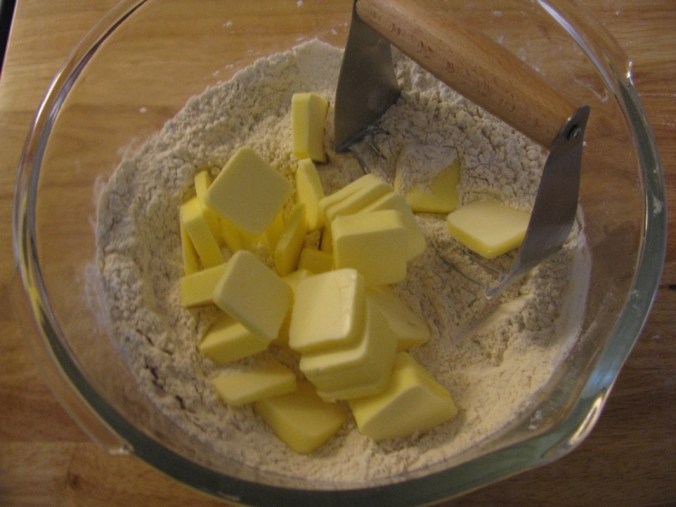
I started by throwing all the dry ingredients together in a mixing bowl. You’ll notice the weird tool on the bottom right, next to the rolling pin- that is the pastry blender I had mentioned in the previous post. As simple a tool as can be imagined, that turns your fist into four butter knives. 
The butter you see on the table is fresh out of the fridge, and is VERY cold- that is to say, perfect for making pie dough.
If you tend to have hot hands, or don’t want to go through the time and trouble of manual labor, this pie dough can very easily be made in a food processor- it’ll just be harder to get the flaky texture you want without some experimenting.

Picture

Blender at work!

Picture

In goes the butter! To save time (and energy!) you should cut the butter up into chunks, rather than just throwing the whole sticks in. Cutting into nice little pats should do well.

Working in the butter by hand DOES take some time, but you’ll see in the difference in the finished crust, I promise you. In general, you want to work the butter in until the mix looks like coarse corn meal, and any visible chunks of butter look like small peas- for a mealier crust (for single crust pies, quiches, tarts, etc), work the butter in until you can’t see any big chunks at all.
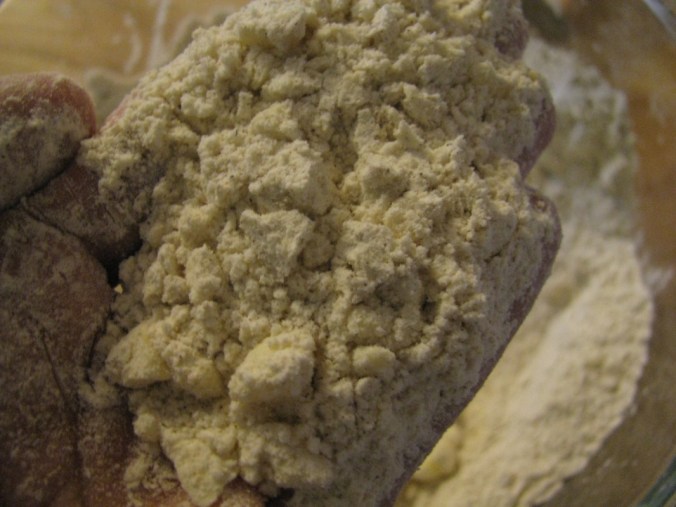
Picture

“Coarse corn meal”

Picture

“Small peas”


Next comes the liquid! In the previous entry, I’d mentioned how you can use ice cold water, or almost any kind of chilled liquid in this step. Since I was going for Über Apple, though, there was only one solution…
Ooooh yes… I only needed 2 oz. for the crust. The rest was delicious. One more reason why it’s awesome to be a baker.

Work in the liquid briefly with your pastry blender- then, get your hands dirty.
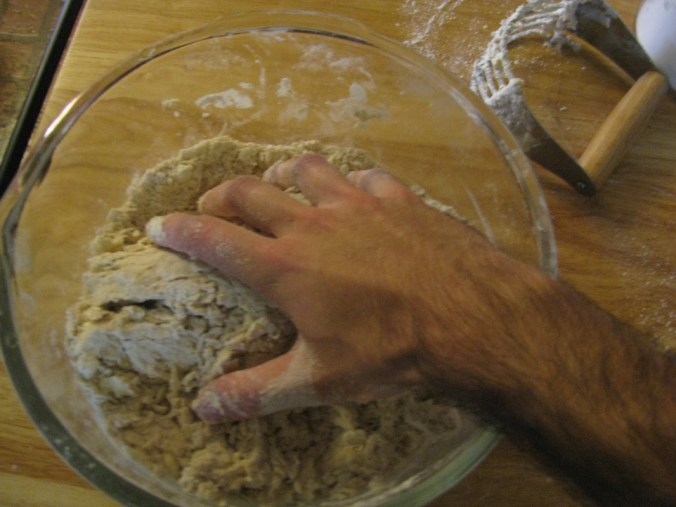
Picture

Grargh! Meatpaw want pastry!

Get right in there with your hands and start kneading. You’re trying to get the liquid and flour together so they form a dough, so this will be a combination of working squeezing and mixing. It will be dry and crumbly at first, but just keep working it together. If it’s REALLY not coming together, add a little more liquid (if you haven’t drunken it already…) Keep it going until…
You have two equal sized smooth balls. Pat them into patties, wrap in plastic, and toss them in the fridge for the time being. If you’re not making the pie today, throw them in the freezer- frozen pie dough can keep for a couple months.

Pie Assembly

The time has come! Your crust is made. Your filling is prepared. Time to put it all in a pan and bake it!

First, you will need your pie pan, and your workspace ready!

If your filling wasn’t ready yet, at this moment you might put the lined tin in the fridge for a little bit to relax the dough. I made the filling for this pie ahead of time, so the crust only spent a few minutes in the fridge- just enough to relax it, but not so much it would crack and be difficult to work with later. DON’T trim off the hanging dough! You’ll need it shortly.

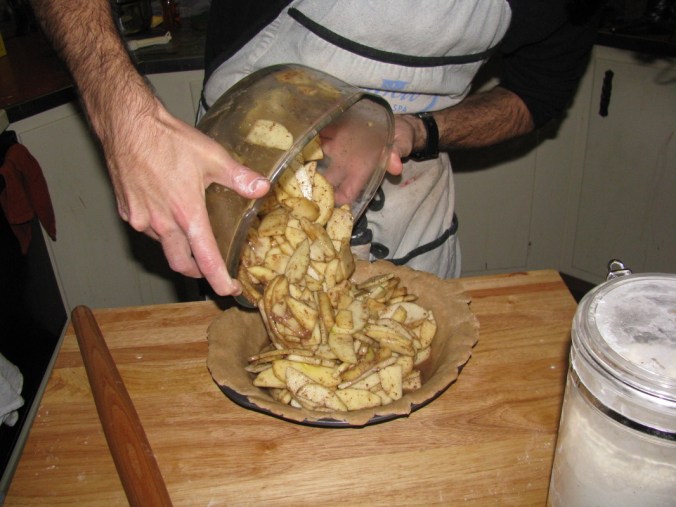
Once the crust is ready… in goes the filling!

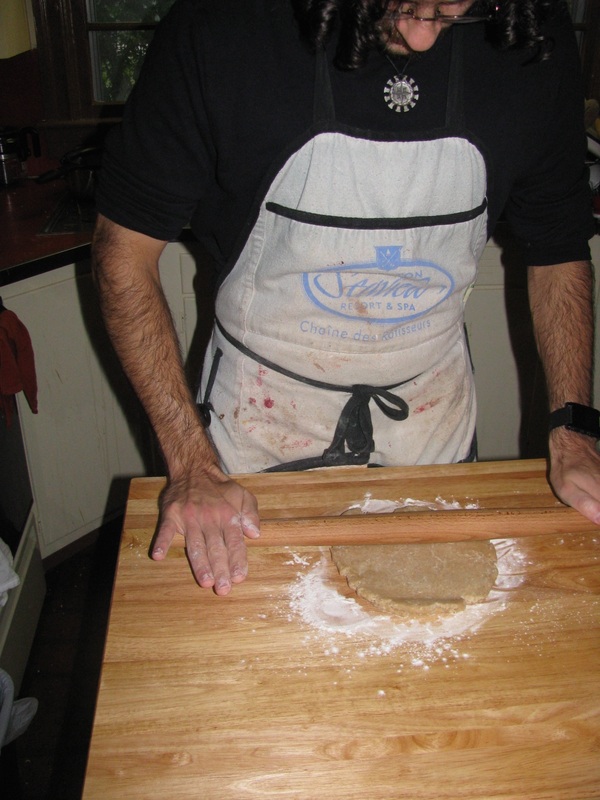
You’ll notice the very small amount of flour on the table to keep the dough from sticking- this is called “bench flour” and you want to use as LITTLE AS POSSIBLE. As you work with the dough, some of this flour WILL get absorbed into it, and you don’t want to dry out your crust. A little on the table, on your rolling pin, and on your hands- NO MORE.

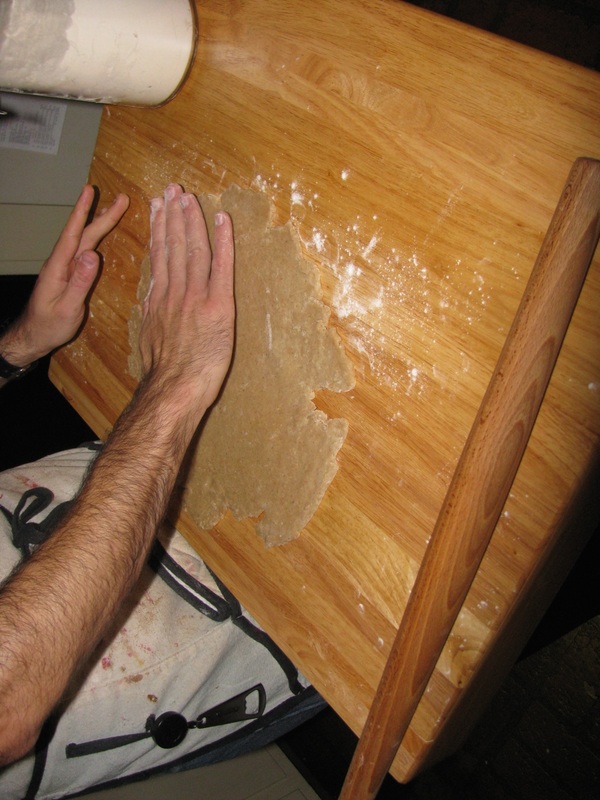
When rolling dough, you want it to keep as smooth and regular a shape as possible. At first, this will be difficult- your dough will be chilled, and it will want to crack rather than stretch or flex. You don’t want to overwork your dough, but just keep pushing together tears as they form.

Another way to keep your dough even (and from sticking to the table) is to rotate it with every pass. When using a rolling pin, you will naturally press harder with your dominant hand- by rotating the dough, you negate this and make a nice, smooth piece of pastry..

Picture

So roll…

Picture

…and turn…

Picture

..and roll again.

Picture

Fix tears…

Picture

And roll out as regular a shape as possible.


Next comes the transfer to the pie tin- for most pies, you do not need to grease the pie tin, just make sure it’s clean.
Picture

Flip the edge of your dough over your pin…

Picture

And roll it right up. This keep the dough from being stretched by gravity too much- just make sure the pin is floured.

Picture

Start at the edge of your pie pan…

Picture

And unroll.

Picture

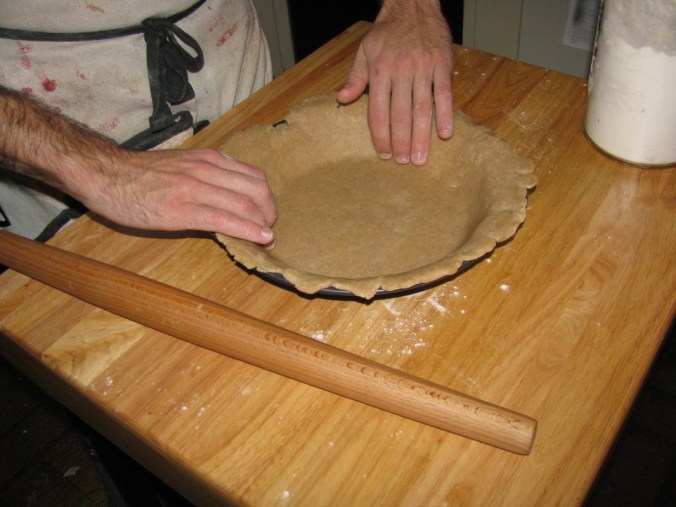
Use your fingers to press and stretch the dough as needed to make sure it drapes over the edges and fills every corner of the pan.

For my Über Apple pie, I used a combination of apples- Winesap (for tartness and body), Honeycrisp (for sweetness), Fuji (for sweetness), and Granny Smith (for additional tartness and body). The spice mixture was the same as the crust, with a little something extra dropped in- a tablespoon or so of apple brandy, and some homemade vanilla extract.

…It’s good to be a baker.
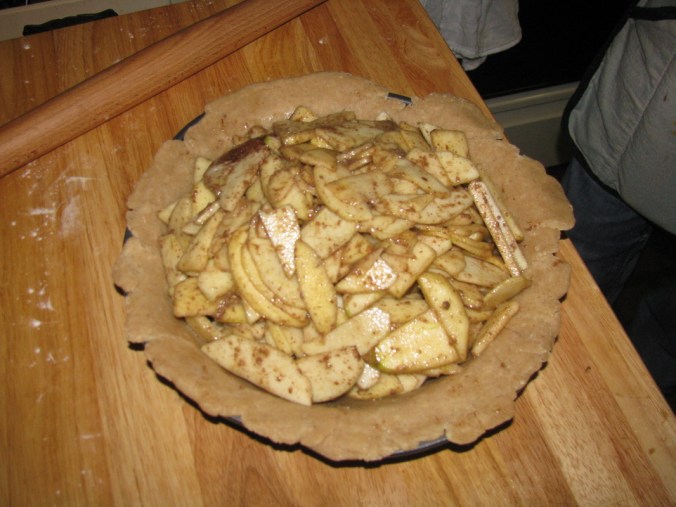
Picture

Awww yeah…


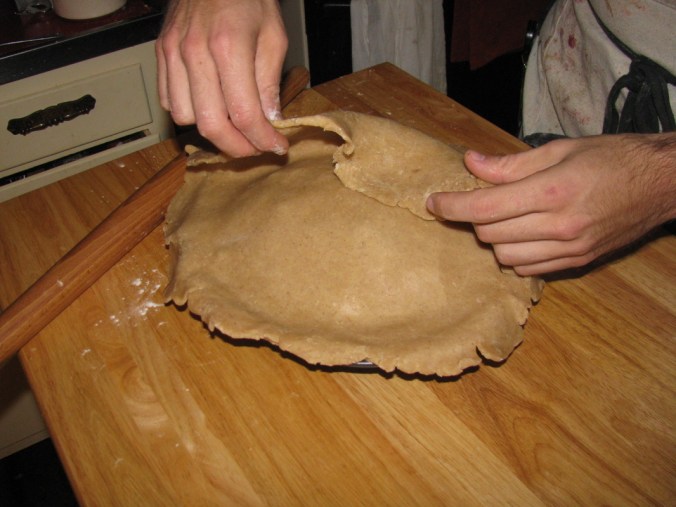
Now, the top crust! Wet the edges of your pie with a pastry brush dipped in water or a wet finger, and the roll out and transfer your top crust exactly as before.

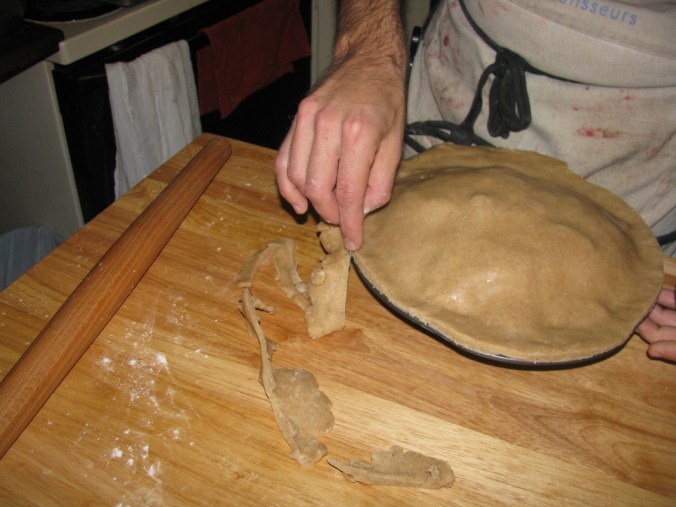
Press your top crust down on the moistened edge of the bottom crust to make a preliminary seal.

Here’s where you can get creative- depending on the pie pan you are using and the edge you want, you may choose to either trim the edges or leave them on and use them in the crimping later on.

If you decide to trim them use a VERY sharp knife or a razor blade to cut the dough- you don’t want to use sawing, cutting motion as much as just push the blade against the dough and have it fall away.

Picture

Just push in…

Picture

and turn the pie to cut the dough.

Picture

This will keep from pulling and stretching the dough, and creating a ragged edge. If your knife isn’t cutting this easily, get a sharper knife or use a razor blade. I’m using a razor in these pictures.


Don’t throw away the scrap dough! You can use it to make little cookies, smaller pies (if you have enough), or something else that I will show you shortly…

Here is where you can apply a “wash” to your pie- a coating that will make things stick to it and affect it’s appearance. The two most popular washes are an egg wash and a milk wash. The egg wash makes your shiny and golden, while the milk wash will make your pie look duller and more rustic. For this pie, I went with the egg wash- which was just a scrambled egg mixed with a little water. A milk wash is simply a bit of milk in a bowl. Both are applied with a pastry or basting brush, like so…

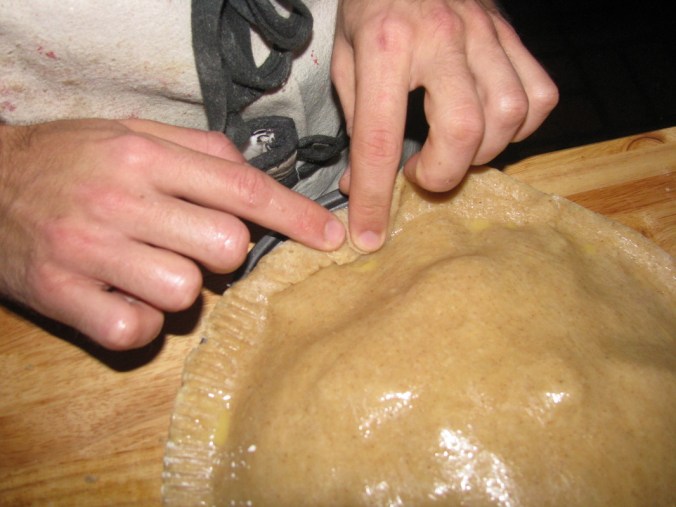
Now it’s time to crimp your edges! This is how you seal in the filling. There are lots of ways of crimping your pie, all very effective- the choice is all up to the way your want your pie to look. The most popular way is using a fork dipped in flour, and pressing the tines to  the crust. My personal favorite is a sort of dog-earred, scallop like crimping. For your education and delight, I did both here.

Picture

Flour, press, repeat…

Picture

Fold and press…

Picture

Continue…

Picture

Completed crimping!

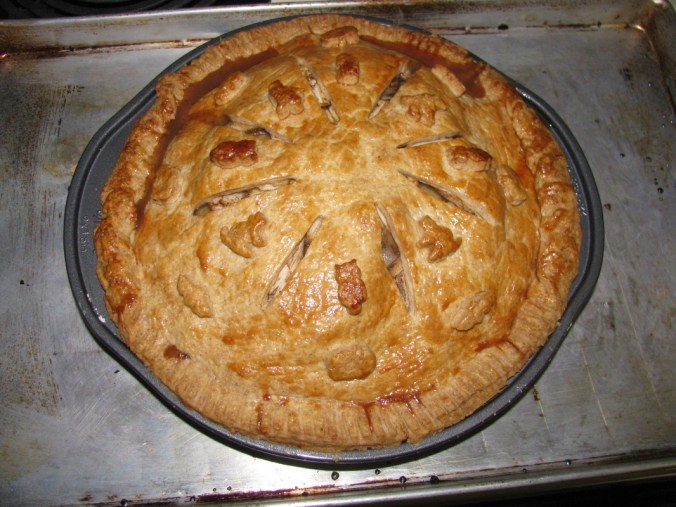
Now, remember when I told you to save the scrap dough after trimming? Here’s where that comes back in. Rummaging through my tools, I found tiny Halloween themed pastry cutters! Since Halloween is coming up, I rolled out the scraps, and cut little pumpkins, bats, cats, and ghosts to decorate the pie with!
After egg washing the shapes as well, the only thing left to do was cut vents in the crust. Since you have now sealed up the edges, the steam of cooking filling is going to build up in there. If you don’t want it exploding out the sides, you need to cut vents into the top. This is another chance for creativity- but first, it’s a good idea to put your pie back in the fridge for a good 5 or 10 minutes. This will firm up the wash and relax the dough so that when you cut your vents, they’ll spread cleanly and clear- VERY important if you are going to try and cut a shape! As an alternative, you can use the pastry cutters to cut shapes out of the top crust before you put it on the pie- have fun and experiment!

Normally I vent my pies with my signature top hat, but for this pie, 8 little cuts (once again, with a sharp knife or razor!) did just fine.

And then, after about 90 minutes in the oven…

The Über Apple pie is completed!

Experiment every way you can to make your own pies exactly how you like them!

Thanks to Becky for the great pics, and as always-

Stay classy,