Stammtisch- German for “regular’s table.” An information meeting of friends that happens regularly.
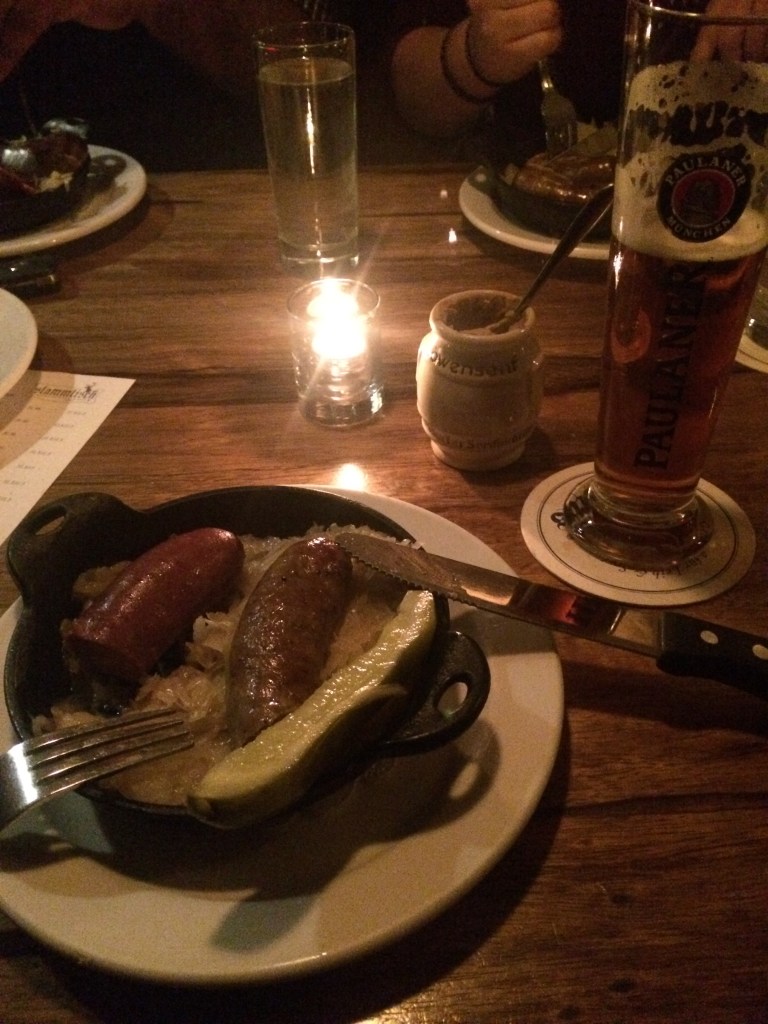
It’s been a while since I sat down at Stammtisch. Even before the pandemic, it didn’t seem like the kind of place that you ate or drank at by yourself. Having friends with you seemed as important to the German restaurant on 28th Ave. as large beers, pork, and spicy mustard. As it happened, I was usually alone when I worked in that neighborhood and would pass it by in favor of a quiet barstool elsewhere. Somewhere where I sit by myself, read, write, and let the afternoon slip away in solitude.
When I would go to Stammtisch with friends, the beer just tasted that much colder, the sausages that much juicier, and good things were that much more likely to happen. Case in point- the last time I remember sitting at their great slab of a bar, I had just run the Tabor Challenge 5K earlier that morning, and I was getting some dinner with my wife. We pounded delicious and decidedly non-local beers and split a warm pretzel (VERY local, having come from Fressen down the street) dipped in addictive bierkase and brown mustard. Then, after a quick trip to the john, I came back to the barstool and decided I was going to write a book.
That book will be published later this year. Stammtisch- as the name implies- is best enjoyed with friends and loved ones, and that is why I wanted to be there on my post-pandemic birthday last weekend.
I am definitely not a “neat freak.” Cleaning up my desk and bedside area today were proof enough of that.
A garbage bag was filled with old mail, flyers, documents I thought were too important to throw out (until I realized that I didn’t need three year old insurance mailers,) and probably every time slip and receipt I’ve gotten in the last two years. Some actually important stuff was moved elsewhere, and my desk now faces a wall rather than out into the room. The floor got vacuumed, the surfaces wiped down, and reorganized.
Yes, I am writing this from a corner table at Belmont Station with a short beer at my side (I did promise myself, after all, and rewards are important) but much like a kitchen, cleaning up your workspace (and keeping it that way!) may do more for your productivity and motivation than all the little quote calendars filling your waste bin.
I apologize for the lack of a blog post this past week, but last Sunday I left the French bakery behind and started a new job at a pie company. Despite the fact that pie is, some would say, very much my wheelhouse, that’s not the part that will make this job uniquely interesting or what consumed so much of my time and energy. What will make this particular gig a real challenge started right at the interview. As I sat down with the owner, she flipped through my resume and said,
“Listen, I’m hiring a baker, but you’ve got training experience, right? You can train, schedule, and lead a team? Good- because I am stretched way too thin. Here’s the plan: I hire you, make you my kitchen manager, and turn the production, scheduling, and menu of our sweet pies over to you. That will free me up to run the rest of business. Deal?”
For the first time in my career, I’m scheduling production, training up the team, and choosing the menu. In other words, actually functioning as a chef (at least as it’s popularly defined in America.)
For the first week while I learned methods, recipes, and the rhythm of the kitchen, I stuck to some classics on the menu… but next week I’ll really have to come up with some ideas and prove that I can hack it. Not so much to my co-workers or boss- they have an almost unbelievable faith in my ability to deliver and perform.
No, I’ve got to prove it to me that I haven’t bitten off more than I can chew.
It was a habit I’d gotten used to every Thursday morning. Thursday is Scone Day.
Every Thursday for the last year, I’d start my day in the bakery by double-checking our inventory and getting started mixing giant batches of scone dough. Sometimes three flavors, but lately just the two best ones. Giant masses of sour-sweet short dough, weighed into mounds, then pressed into discs. No real thinking about it, unless something went wrong- the mix too dry, too wet, not the right yield, or whatever. Otherwise, it was automatic- just like most aspects of the position I’ve worked in for the last two years.
Today I made my last batch of scone dough. Next week, I’ll be moving on to a new job. The staff says it won’t be the same and that they’ll miss me, and I know they’re being kind. I’ve trained the people I’m leaving behind well- they almost function better without me hanging around looking for something to do.
“Looking for something to do.” Once upon a time, the position was grueling. I sweated my bones trying to make production lists, meet the needs of a frantic bakeshop, and train a parade of faces and names to bake. Now, the job is almost… easy. It’s scheduled. Practiced. Thoughtless.
I helped make it that way, and now I’m too tired and stressed to enjoy the easy part anymore.
It should have been a commonplace part of the day. Everything should have gone according to plan (one could say about anything.) Yet, someone goofed up.
Part of my job on prep involves readying the next mornings bake in the proofer and setting it on a timer. Lately, I’ve been able to pull all the necessary pastries and keep them in the fridge. The proofer gets used until near the end of my shift, and there’s no real point in me sticking around just to load it. The afternoon team knows where I keep the trayed goods- I point them to the rack, I go home, and they load the proofer when they’re done.
Yesterday, someone forgot. There was mayhem in the morning, and my manager called to ask why the proofer wasn’t loaded.
Yes, I was told to leave early. Yes, other people loading the proofer is common. Yes, there were four other pairs of eyes that should have noticed something was left undone.
It’s my job though. It’s my team- and I am responsible.
The Buck Stops Here
Servant leadership means that, instead of being a “boss” and just telling people what to do, the leader says “Here’s what I need you to do- what can I do to help make that possible?” A leader doesn’t just hand out tasks- the leader controls the timeline, provides the resources, streamlines work, fosters communication, and makes the hard decisions and final calls.
This doesn’t mean every screw-up needs to be handled with chest beating and a refrain of mea culpa. As a leader, part of the job is keeping everyone honest and responsible for their actions and coaching when needed. Regardless, a problem with your team is always your problem. Even if it’s something that came from above, that’s a discussion for the leader and their superiors- the leader is still responsible to their team.
Responsibility Goes Three Directions
I am purposefully ignoring a certain famous Spider-Man quote regarding power and responsibility. I’m pretty sure that even in-universe, Peter Parker is sick to the teeth with how cliche it’s become.
Regarding responsibility, however, there is always a direction involved- Person A is responsible to Person B for task/condition/team/whatever C. You might note that that does not indicate that responsibility only goes “up” the ladder:
Someone in a leadership position is responsible to their superiors for making sure the mission of their team gets donecorrectly, on time,with a minimum of fuss and complication, and in accordance with the organization. They are responsible for essentially making sure the higher-ups will be done, that their team gets the job done right, and in a way that brings credit to the organization.
An unfortunate aphorism is that “Shit runs downhill.” Credit goes up, blame goes down… a good leader knows how to subvert this “wisdom.”
They are also responsible to their team to manage competently and to the best of their ability. They are responsible for providing the resources needed to get the job, the “big picture” of their goal as a team, and a strategy to help the team succeed. They are responsible for advocating for their team to the higher-ups- whether it’s for needed resources and support, better working conditions, or being the intermediary when discipline is called for.
The aphorism here is that “A chef is a cook that leads other cooks.” As a leader/authority, they are the face of their team to the higher-ups and vice versa.
Finally, a leader is responsible to themselves. They need to meet their expectations for themselves while keeping those expectations reasonable. They need to execute their job to the best of their ability without martyring themselves. They need to give their full effort to their team while still looking after themselves- or else they won’t be in a condition to take care of anyone. They need to answer to their superiors, but without going against their own moral compass in the name of convenience or expediency.
Summing It Up
When you become a leader or take a leadership role, authority comes with responsibility. You are answerable to everyone, and everything is- in some way- your problem. You need to be able to enforce your superiors will, speak up for your subordinates, and look after yourself according to your own values all at the same time. Even when it’s not your fault, it’s your responsibility.
It’s a hard road to walk- we can all tell stories about “leaders” who slipped up one way or another. If it was easy, though, it wouldn’t be worth doing.





 The Black Hat Baker