Off (and On) The Rails

Good afternoon, friends and neighbors! Sorry about missing last Thursday- my Halloween baking sort of pre-occupied my mind. Hope everyone had a fun, safe, delightful, and spooky Halloween!

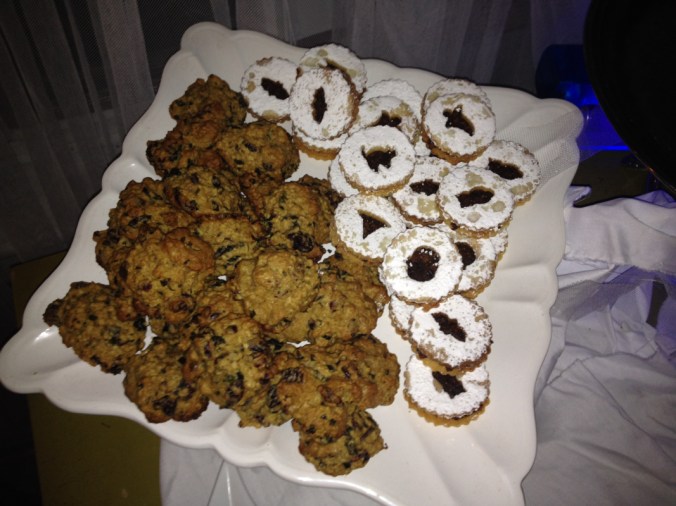
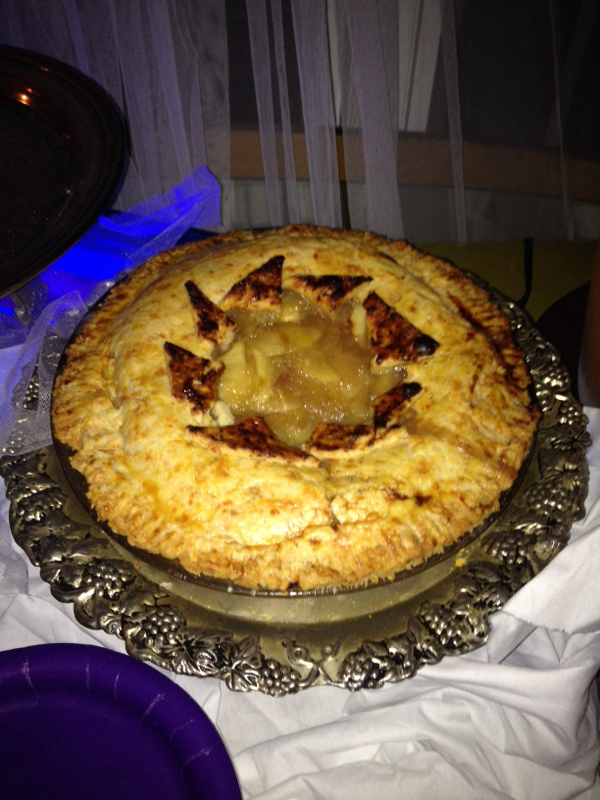
Usually for Halloween, I try to make my spookier-themed pastries for parties, such as my Jack the Ripper and Elizabeth Bathory cupcakes. This year, I decided to try a couple new recipes- Fig and Bacon Linzer cookies, and a Chedder Cheese and Cider Apple Pie I had had my eye on for a while.

The pie crust was a little difficult to work with, and this is an excellent demonstration of the importance of having the proper tools for a recipe. The crust involved shredded cheddar cheese, and was meant to be made in a food processor. Since I don’t have one of adequate size, I went at it as I told you two weeks ago- with a handheld pastry blender.
Unfortunately, my little hand blender could cut up the cheese nearly as  small as a food processor could, making the dough very crumbly and difficult to work with. Fortunately, the pie came out splendidly all the same.

The second little adventure came in trying to make the filling for the linzers. The cookies themselves were no problem (and I was thrilled for the excuse to finally use my little Linzer cutters!), but the filling was problematic. This year was abysmal for figs, and there were no fresh figs to be found- leaving me with just dried figs to mess around with. I rehydrated some in water for a few hours, and put them through my mini-chopper for with four fried-up strips of thick cut bacon, some dark chocolate balsamic vinegar, a little salt and pepper, and some of the bacon fat to add a creamy texture. The texture was sublime, but the fig was very prevalent- I had wanted the bacon to be a bit more forward. Fortunately, I achieved some success by chilling the mixture and allowing a day for the flavors to meld. I think next time I might use a bit more bacon.

There- all caught up on my doings.

Right now, I’m cutting across New Jersey on a train bound for New York City. It is rather telling when you arrange travel (and particularly layovers) so you can get to a favorite spot that you ordinarily might not have a reason to visit. This spot, for me, is the Bridgewater Pub at 30th St.Station in Philadelphia. I got tickets for certain trains so that A. I would be at that station around lunchtime, and B. I would have a solid hour to eat. The food is usually fantastic, and the beer menu equally so.
My meal today was a fantastic beef brisket sandwich on brioche roll with a herby and peppery chimichurri, and a pint of Flying Dog’s Mint Chocolate Stout. I highly recommend both the place AND beer if you find yourself in the vicinity of either.

The notion of “destination” food is an amusing one to think about- the idea that some food or restaurant is SO good, SO desirable, it is worth traveling an incredible distance, altering travel plans, and often expending more money than you might believe, just for the experience of having it. A Chicago deep-dish pizza in Chicago, a Cubano sandwich FROM Little Havana in Miami… the kind of romantic, glassy-eyed gastronomic eroticism you’d expect from a foodie.

Absolutely ridiculous, yet completely reasonable at the same time.

Over and over, I’ve written about the way food holds the psyche- linking tastes and smells to memories and experiences. Sometimes destination food can hold a feeling of nostalgia. Other times it can fulfill a fantasy for the person, or re-enact a story for them from their family history.

Increasingly, I find my choices in “destination” food to be a combination of all of these- tastes of childhood to bring me back to a safe place from the madness of adult life, fantasies read about in books and travelogues or related to personal heroes, and sometimes just looking up places my parents told me about from before I was born, to see if they are real and as good as they said.

What’s destination food for you? Let me know in the comments! I have a long train ride, and full, happy belly to read them on.

Stay classy,

-BHB

A Pause in Transmission

Good morning, friends and neighbors!

This week, I KNOW I promised a continuation on the promised pie theme. I KNOW I promised pics and how-to’s for decorating pies.

Unfortunately, my appendix had other plans, and I’ve been laid up for most of the last week. 

In the meantime…. 

MEMES!

Legitimate blog entry next week, I swear!

Stay classy,

How To Order A Cake

Good evening, friends and neighbors! Due to (yet another) busy week at the 9 to 5, today’s intended pie-related post is being postponed until either Saturday or next week. Since I’ll be discussing some very visual elements, I wanted the opportunity to whip something up and provide pictures for you.

Instead, tonight I offer you a quick and hopefully helpful little how-to that I’ve had rolling around in my mind for a few months, and was finally requested- in detail- by my sister.

My older sister is getting married in the fall of next year. Of course, she asked me if I could provide the wedding cake (having a baker for a brother has significant perks!) I began asking her the typical questions- flavor, color, themes, servings, etc. All my sister had decided on, thus far, was just the look, and provided a picture. A picture alone does not a cake make. Confused and exasperated, she threw her hands to heaven and said “It’s too much- you should write a questionnaire or something!”

So I thought- “Why not? I’ve had nightmare experiences with people ordering cakes before. Why not just tell them what they should keep in mind when placing an order?”

Hence, this post.

Pulling on my own experience as a professional baker and the experiences of other professionals, I have comprised the following list based around the question: “What do you wish your customers would do when they place orders?” This applies for specialty cakes- that is birthday cakes, wedding cakes, or any kind of cake you want specially made for your event.

WHAT TO KEEP IN MIND WHEN ORDERING A SPECIALTY CAKE

1. Be decisive about flavor.
“I want chocolate!… no wait, Carrot!… no, Red Velvet…” When ordering a cake, bear in mind that different cakes are… well, different. Ingredients, time, characteristics, etcetera are all different. Know what cake you WANT to have when you show up.

2. Be honest about servings.
No one wants to admit that their family are heavy eaters. No one wants to admit that they might need a 40-serving cake for 20 people, and many think it’s low-class to say that they want leftover cake around afterward. Whatever ever the reason is, your baker will likely not care. What they DO need to know is how many servings the cake should make. It will affect the cake itself- obviously- and the invoice at the end.

3. Be as specific as possible.
A baker’s job is to make you the cake that you want. That said, you need to KNOW what you want. Have a clear picture in your head (or in hand, if you have one.) Colors, decoration, text, font, theme should all be at least pictured in your head, and you should let the baker know in as much detail as possible

4. Give a solid “yes” or “no” about alcohol in the cake.
Alcohol can do wonderful things in a baked good- Less so if one of your attendees is a recovering alcoholic, has liver damage, or is a minor. If you are concerned about the contents of a cake, or have reason to be, let your baker know. If you are getting multiple desserts, you can ask to make sure which, if any, have alcohol in them so you can provide necessary warning to those who are sensitive.

5. Be conscious of allergens.
This goes hand-in-hand with #4. Let the baker know well ahead of time if you have any allergy concerns- wheat, milk, eggs, nuts, etc. Know something about the cake you want to order- for example, do not order a German Chocolate cake if you have a guest that is allergic to coconuts.

6. State your price range and DO NOT HAGGLE.
Many people seem to think that, particularly when dealing with a small bakery or an individual baker, it is acceptable to haggle over prices. This is absolutely NOT the case. If you have an ideal price range, state that outright. Your baker will let you know what can be done. Trying to whittle down the price on a specialty cake is rude, ignorant, and frankly insulting. Bakers set the price of their cakes based on the ingredients, time necessary, their own labor, and many other costs. Telling a baker that they should charge a lower price (that likely means cheating themselves on time and labor) because you can “go down to the supermarket and get an cake for half that price” will likely only get you directions to the nearest supermarket and shown the door. If you want quality, be prepared to pay for it.

7. Do not expect free samples from a small baker
Larger, established bakeries or baking services tend to have extra cake lying around that they can give out as samples, or they do enough business where they can make small cakes or cupcakes and store them just for that reason. An individual baker, in all likelihood, does not. Recipes do not make a single cupcake- if you ask for a sample, the baker has to make either a full-size cake or a dozen cupcakes, and eat that cost- which rarely returns. Many small bakers simply will not provide samples, or if they do, will ask a token amount of a money for each to offset time, labor, and ingredients.

8. Be receptive to the baker’s judgement.
Your baker will (hopefully) have enough experience in the field to know what combinations and ideas work in different situations, and which ones don’t. As brilliant and wonderful as your idea may be, it may not be practical- or indeed possible. If the end, as always, the decision is yours- but if your baker is making suggestions about the practicalities of your idea, they are not being lazy, critical, or judgmental. They have simply “been there, done that, cleaned up the mess” and can spare you from paying for a disappointment.

9. Have logistics worked out ahead of time.
Once a cake is baked, it generally needs to travel to the event, and then be stored. Ask your baker if they can deliver the cake if you need it delivered. Make sure you have a place to put it once it arrives.

10. Have a realistic timeline- be aware good cake takes time. 
Cakes do not poof out of thin air. Nor do bakeries have 5-tier wedding cakes just lying around waiting to be decorated. Would you even want to EAT a cake that had been sitting in a freezer for 6 months, waiting to be bought? Good cakes take time- have a realistic timeline, and order WELL in advance. For small birthday cakes, I generally prefer a minimum three days notice. Larger cakes, multiple items, or event- obviously much longer. Do not be angry or surprised when you call and ask for an elaborate cake by the end of the day and get a “no.”

11. DO NOT TELL US TO DO “WHATEVER WE WANT.”
This is perhaps the cardinal rule of ordering cakes- do NOT tell the baker to “do whatever they think is best,” “make it look pretty,” or otherwise your decisions in their hands. The event is yours, and the cake is yours- all the baker has to do is make it happen. No baker wants to work hard on a cake, decorate in the way “they think is best” and deliver it only to have it refused because it “doesn’t look the way the customer thought it would.” You are paying for it- that means that you decide everything that happens. The baker may offer suggestions about style and will remind you of what is practical and possible, but it is not THEIR cake- it is YOURS. 

H
opefully this helps any of you who are looking to buy cakes in the future!

Stay Classy,

In Hoc Crustulo Vinces, Part 1- The Season Is Upon Us!

 Good evening, friends and neighbors! Still trying to get back on schedule with weekly updates, I’m afraid. New and interesting topics are getting harder to devise. What might alleviate the situation? Leave comments about what you want to see here! Recipes? Philosophical ramblings? How-tos? Puppy memes? Drop a comment either here, on the Facebook page (http://www.facebook.com/blackhatbakery) or even shoot them off to me on Twitter (@blackhatbakery.) I want to write what you want to read!
That said, moving on to tonight’s topic!

With fall having already *officially* started, the air feeling noticeably cool in the mornings, hoodies and light jackets starting to find themselves more in use, and Halloween costumes and decorations appearing in shop windows, those of us who know and love autumn find ourselves eagerly anticipating the true harbinger of the season.

No, not pumpkin spice (insert item here.)

…Nope, not piles of crunchy leaves.

Nope, not even the Great Pumpkin.

My friends, we eagerly await PIE SEASON.

I have always considered myself more of a pie fan than anything, and it took some time and navel-gazing to determine why. If you can think of a better product of introspection, I invite you to go after it and write your own blog.
The reason I love pies so much is because they are my food philosophy in a pure, recognizable, and delicious form. There are few things that recall memories of home, happiness, and simpler, warmer times more readily than a fresh-baked pie (Sweeney Todd and Miss Lovett notwithstanding.)

At the same time as they are quickly reminiscent of simple joys, perfectly crafted pies are works of diligence, care, grace, and finesse. The texture of the crust, the color and appearance, the seemingly effortless affectations of vents and fluting- all under the bakers control, with the precision and premeditation of a sculptor.

Simplicity with elegance, made physical.

It is not without reason that the old idiom goes “easy as pie.” Pies are, from their very origins, meant to be simple, efficient, and entirely self-contained. Savory meat pies can be an entire balanced meal sealed into a crust, all baked together at once.

When I discuss piemaking, the following issues are usually raised:

1. Don’t know how to make pie crust/ any good recipes.
2. Requires a special pan.
3. Takes too long/ they have no time.
4. Why not just buy it?
5. They don’t like pie.

#2 is a non-issue. A pie is, by definition, a filling baked in a pastry crust. You can use a reusable metal or glass one, a disposable foil pan, or make hand pies, crimped and baked by the sheet.

#3 and #4 tend to go together, and involve a critical misunderstanding about pie. Fillings can be made days ahead of time, dough (if frozen) can be months. Few pies take more than an hour to bake, and as was stated before- a well-made pie can be an entire meal in one plate.

Those who claim #5 are a lost people- let us not speak of them again.

Therefore, this entry will mainly deal with #1, which is entirely reasonable and easily remedied.
———————

Pie dough is what is called a “short” dough- yes, akin to shortbread cookies. The reason it is called short dough is because the amount of fat in it (whether butter, lard, shortening, or oil) inhibits gluten bonds from forming as long as they might in other doughs (bread dough, for instance). Consequently, short dough has a crumbly, flaky texture. The amount of fat also makes it an ideal sealant- perfect for keeping the juices/gravies of your filling from running out.

The absolute basic short dough can be made using a simple formula:
3 parts flour
2 parts fat
1 part liquid

Those of you who read my series on kitchen math will have seen notation like this before- baker’s formulas are represented as ratios rather than recipes to allow for easy scaling (making different sized batches.)

This will create an extremely simple, all purpose short dough. Add sugar, it becomes sweet. Add herbs, it becomes savory. Switch the liquid from water to iced tea to juice to whatever you like. It will work. Towards the end, I will give you my personal favorite recipe.

Pie dough is also an excellent example for how the HANDLING of ingredients can make a difference in the final product- particularly the fat, in this case. If you’ve ever drooled the perfect flaky pie dough, or the melt-in-your-mouth crumbliness of shortbread, the difference is entirely in how the fat is worked into the dough.

As you will see in the recipe below, the butter is “cut” into the dry ingredients- meaning, it is worked in to the flour by cutting it down into smaller and smaller chunks. You can use your fingers, a pair for butter knives (if you are exceedingly patient), or a special device called a pastry blender (if you feel like getting one and pretending to be Wolverine.)

When working the butter in, if you leave relatively large solid lumps of butter intact, these lumps will form paper-thin layers within the dough, leading to the flaky perfection you seek in a pies top crust. If you work the butter into smaller and smaller pieces, the butter will melt more readily in the oven and absorb into dough, leaving a mealy texture- ideal for bottom crusts and shortbread cookies.

Here is my personal favorite pie dough recipe- with minimal tweaking, this makes an ideal crust for savory or sweet pies. It will make enough for one double-crust 9 inch pie, or two single crust pies.

Pie Dough

Ingredients
2 1/2 cups (350 grams) all-purpose flour
1 teaspoon salt
2 tablespoon (30 grams) granulated white sugar (leave out if you want it savory)
1 cup (226 grams) unsalted butter, chilled, and cut into 1 inch (2.5 cm) pieces
1/4 to 1/2 cup (60 – 120 ml) ice water or other chilled liquid (experiment with different liquids to get interesting flavors!)

Herbs or Spices as you see fit

Mix all the dry ingredients together, and cut the butter in until it resembles coarse corn meal (or some pellets of butter the size of peas.) Add the liquid and continue to work until the dough forms. Dump out onto a lightly floured surface and work into two even-sized balls. Flatten the balls slightly and wrap in plastic. The dough can now be refrigerated or frozen until ready for use.

When rolling, roll the dough out on a lightly-floured surface and rotate 45 degrees with each pass. This will keep the dough from sticking as readily, and it will also even out your rolling (as you will instinctively press harder with your dominant hand.)

Tips and Tricks for Pie Dough
———————————
– The butter (and dough itself) should be kept as cold as possible while you work with it. If the butter is allowed to get too warm, it can melt into the dough too quickly leavve you with greasy, gritty crust. You can keep things cool by working quickly and lightly, and by picking a cold, dry surface to work on. Marble slabs are ideal, but expensive- a good quality wood tabletop will do fine. 

– Keep an eye on your dough. You do not want to overwork it- despite the fact that it is short dough, gluten bonds HAVE formed. If you notice your dough shrinking back after you roll it, it is being overworked. Relax the dough by letting it sit covered in plastic for a few minutes.

– You will want to flour virtually every surface your dough comes in contact with while you work with it- your hands, the tabletop, and your rolling pin. You do NOT want to overflour, however- in the course of work, the dough will absorb the flour and get drier. Therefore, use the bare minimum flour you need to keep things from getting sticky.

– The best rolling pin to us
e is… the one you like. Pins come in all shapes and sizes- the best one for you will feel balanced in your grip, comfortable in your hand, and will be made from material that is easy to clean and doesn’t warp. Wooden pins should NOT be washed with soap and water- instead, they should be rubbed down vigorously with a clean cloth or paper towel.

That’s all for tonight! Next week, I’ll discuss a couple of my favorite recipes, as well as some aesthetic touches that will really make your pie yours.

Stay Classy,

-BHB

Where To Keep Your Pride

Good evening, friends and neighbors! 

     I apologize for the long silence- it’s been a manic few weeks, and Thursday nights have found me mentally/ physically drained to the point that I couldn’t think straight, let alone type. 

     Tonight, however, finds me in- you guessed it- another taphouse. This one is Vagabond in Atlantic City, just off of Albany Ave./ the Black Horse Pike. It definitely has a sports bar vibe, but somewhat more homey. The rotating selection of interesting craft beers doesn’t hurt either- right now, a Cape May Brewery Honey Porter is keeping the rain’s chill at bay. 

     Part of what has kept me so frantically busy for the last two weeks was catering my friend Lauren’s wedding- my first wedding gig, and an interesting one at that. Lauren and her (now) husband Keith are Revolutionary War reenactors as a hobby, and they wanted their wedding to be period 18th Century- from their attire, to the location, to (of course) the food. 

     No, I did NOT squeeze myself into a pair of stockings and a waistcoat. No one needs to see that. Besides, 18th Century professional bakers- given the conditions of their bakeshops, in front of open roaring fires- tended to work in their underwear or naked.
 
     NO ONE needed to see that. 


     What it meant instead was that all of the desserts I made (with the exception of French macarons and the cake itself- the bride requested Red Velvet) would be from recipes from the 1700s. A fascinating and interesting challenge to say the least.
 
   The website for Colonial Williamsburg in Virginia was incredibly useful- their kitchens acquire recipes from 18th Century cookbooks and their measurements and instructions in modern equivalents, offering both the original text and the 21rst Century ingredients and instructions they’ve hit upon- I highly recommend it for anyone interested in food or culinary art history!

But now, a brief break for… PICTURES!


The wedding was a great time, and everyone loved the food.

Perhaps you are wondering by now, though, what the title of this entry means. It is a lesson that I have had a hard time learning, and got a full-on education in at the wedding and the day after.

In my discussions with the bride and groom, I was told that instead of a traditional tiered wedding cake, they wanted a tree of red velvet cupcakes and a small 6 inch cake on top for them to cut. Later on, the bride informed me that the groom’s mother had insisted on making a cake for the wedding as well, and that it would be a “groom’s cake.” Traditionally, groom’s cakes are not as large as the wedding cake, are gifts from the bride to her groom, and usually are made to represent the grooms personality and interests. I had no problem with this, seeing it as insurance that there would be plenty of food for all.

On my arrival at the wedding venue, however, I discovered that the groom’s mother had not simply made a groom’s cake, but a full-blown 4 tiered wedding cake, and had placed it on the front table, where it was reasonably assumed to be *the* cake. The cupcake tree and 6″ cake I had made were subsequently relegated to the dessert table with the rest.

At first, I felt rather annoyed and irritated- in my view, I had worked hard on a wedding cake, and it was no longer to be *the* cake because someone else showed up first. To add insult to injury (in my mind,) I was then asked if I could slice and serve the wedding cake, since no one else present knew how. I felt put-upon, cheated, and betrayed that my friends wouldn’t speak up and say that I was already making the cake.

A day or so later, once I had time to calm down, I put it in perspective. I realized that, in all truth, I was being egotistic, selfish, and generally stupid.

It may have been awkwardly arranged, but it was entirely reasonable that the groom’s mother would want to have SOMETHING to do with her son’s wedding, and that keeping her happy would be higher up in their priorities than the ego of a friend.

I was being selfish in that I had made the entire affair all about me and my wounded pride, where the entire point of the day had nothing to do with me at all- it was my friend’s wedding.

Lastly, what I learned was that, in the end, my pride had nothing to do with ANY of it. I could absolutely take pride in the quality of my work (and I do), but in the end, it was THEIR cake and cupcakes to arrange or prioritize as they wished. A friend of theirs I may be, but it was also business- I was there delivering and setting up food. I had no right to expect any kind of ego stroking for what, in truth, was just the filling of a contract.

It’s perfectly right and acceptable to take pride in your work. In fact, if you don’t, you have other far more serious issues at hand. When you are selling your work, however- your pride doesn’t matter at all. All your hard work is to help make your CUSTOMERS event happen , your CUSTOMERS day a good one, and your CUSTOMERS guests and family happy.

Keep your pride in your work… and leave it there. 

“No, I don’t like work. I had rather laze about and think of all the fine things that can be done. I don’t like work – no man does – but I like what is in the work – the chance to find yourself. Your own reality – for yourself, not for others – what no other man can ever know. They can only see the mere show, and never can tell what it really means.” – Joseph Conrad, “Heart of Darkness”

Stay humble.
Stay content,
and of course,

Stay Classy,