Let Your Tastebuds Wander

     Good evening, friends and neighbors! Hope your Thanksgivings were full of friends, fun, and tryptophan!
This week….
 
Picture

Image from Wikipedia

“Travel is fatal to prejudice, bigotry, and narrow-mindedness, and many of our people need it sorely on these accounts. Broad, wholesome, charitable views of men and things cannot be acquired by vegetating in one little corner of the earth all one’s lifetime.” – Mark Twain, “The Innocents Abroad”

     Several times before, I have mentioned my personal love of traveling and the desire to do more. I have also mentioned the Reading Terminal Market in Philadelphia and how such places are absolute windows to the world. 
     
       James Beard, one of the fathers of American gastronomy, famously said “Food is our common ground- a universal experience.” Placing this bit of wisdom alongside Mark Twains, one can reach a simple conclusion- food is the gateway to cultures around the world. It is the single greatest commonality we have, and perhaps the greatest way to start exploring distant lands. 

      Very recently, I attended an event at my old school, the Academy of Culinary Arts at Atlantic Cape Community College, Mays Landing, NJ. The event was a yearly celebration of the Beaujolais Nouveau (the first release from France of that year’s wines), and has been happening in connection with the Chaine de Rotisseurs for the last several years. Ticket prices go to funding scholarships for the school, and the students of the school put their very best work on parade- delicacies, sweets, cold foods, hot foods, all made by the students help wash down the wines. 

     This was my first time attending a Beaujolais Nouveau- the last one I had been to, I was a student serving foie gras-stuffed ravioli. It was a wonderful time meeting up with my old teachers and friends again, and trying to choke down the amusement and awkwardness when a student not much younger than myself called me, “sir.” 

     Towards the end of the night, the dessert kitchen opened (to much fanfare and excitement in the crowd.) As a pastry chef, I can’t help but be excited and intrigued to see what the students of the school have been doing since I left. That night, however, proved to be extra special. 
 
     The chef in charge of the desserts (and a former teacher of mine,) Chef McCann, revealed that the nights desserts were all the products of the first International Desserts class to run at the school. In slightly under a month, the students had to master desserts from 18 different countries- Italy, France, Canada, India, China, Morocco, and more. 

     The products were, of course, sensational- merengue-wrapped ice cream from Italy, butter tarts from Canada, Polish babka, Indian sweet carrots, and more- all masterfully done and deliciously decadent. More than the satisfaction of an overfull belly, however, I felt a satisfaction in my soul. 

     Here was a class of young men and women who now knew more about the cultures of 18 nations than many of their peers ever will, and they learned it through the medium they love- food. 
 
     A culture’s food doesn’t develop in a vacuum- the geography, the climate, the average lifestyle, the religion and spirituality of the people, and their history all play a part in forging what goes on the dinner table. 
How many staples of Eastern European cuisines came from the need to travel quickly and keep food fresh? 
How many dishes in the Middle East were born from the merging of native cuisine and that of one-time conquerors? 
How many of our comfort foods were born from moments in a country’s history when the people were poor and had to find some way to eat? 
What can you eat when you are a stranger in a strange land, and cornerstones of the native cuisine are utterly forbidden by your faith? 

      These students now know how to answer these questions. This class is a force for good in this world. It is a step in the right direction toward destroying the evils of nationalism, ethnocentrism, jingoism, and appropriation. Evil happens in this world when people stop seeing others AS people. This class reminds us that not only are we all people, but the people sitting across the dinner table from each other, with stories and histories to share with every bite.

     We open our country’s eyes and minds by first opening their mouths. 

     Bon appetit, and bon voyage. 

 Stay Classy,
In Hoc Crustulo Vinces, Part 2- Pie of the Tiger

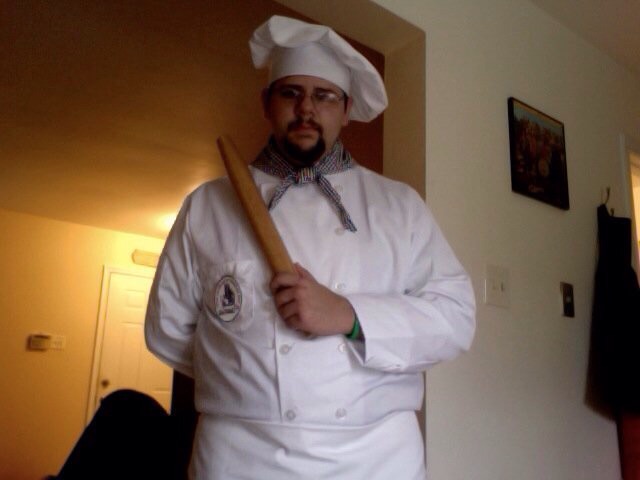
Good morning, friends and neighbors! Sorry about the non-post last week, but my newly-acquired lack of appendix is healing up well, so last night I actually got to get into my kitchen and make some pie! My friend Becky thoughtfully came by to help take pictures of the prep (no doubt lured by the promise of pie and beer,) so I can finally show you not only the method of preparing pie dough, but how to manage it, use it, and decorate with it.

That said, let us begin!

Pie Dough Prep

In my previous pie entry, I gave you the recipe for my favorite pie dough. This is a good, all-around pie dough that can be made sweet or savory, and doctored up with a variety of flavors. Seeing as how we are now full-throttle into autumn, I decided to make apple pie. 

Of course, this was not too be just ANY apple pie. I wanted this to be CRAZY apple pie- a bite should taste like eating fall itself, and the smell should be like being hit in the face with an apple orchard and a sack of cinnamon.

This was to be Über Apple Pie, and every part of it had to say so.

Therefore, the crust was made with brown sugar rather than white, and a potent melange of cinnamon, cardamom, nutmeg, allspice, and clove. 

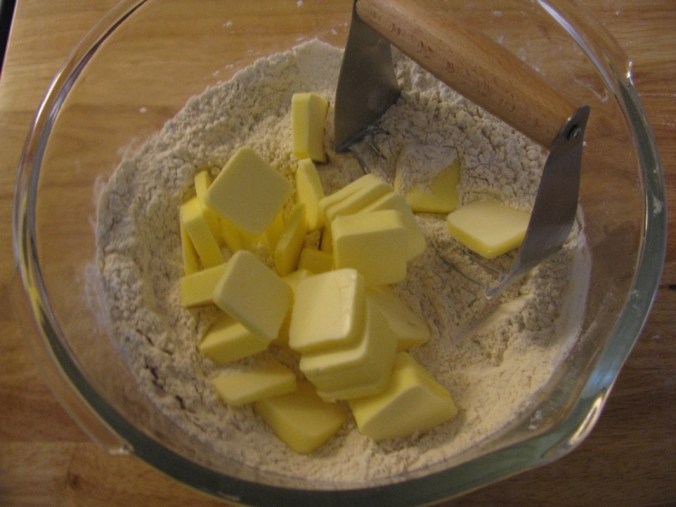
I started by throwing all the dry ingredients together in a mixing bowl. You’ll notice the weird tool on the bottom right, next to the rolling pin- that is the pastry blender I had mentioned in the previous post. As simple a tool as can be imagined, that turns your fist into four butter knives. 
The butter you see on the table is fresh out of the fridge, and is VERY cold- that is to say, perfect for making pie dough.
If you tend to have hot hands, or don’t want to go through the time and trouble of manual labor, this pie dough can very easily be made in a food processor- it’ll just be harder to get the flaky texture you want without some experimenting.

Picture

Blender at work!

Picture

In goes the butter! To save time (and energy!) you should cut the butter up into chunks, rather than just throwing the whole sticks in. Cutting into nice little pats should do well.

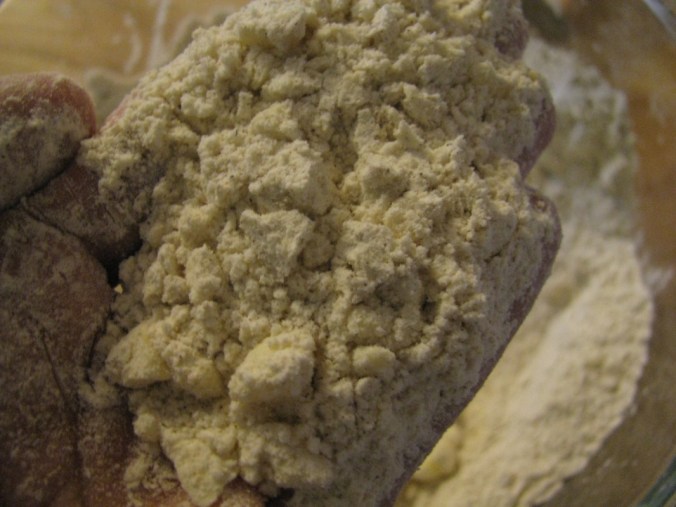
Working in the butter by hand DOES take some time, but you’ll see in the difference in the finished crust, I promise you. In general, you want to work the butter in until the mix looks like coarse corn meal, and any visible chunks of butter look like small peas- for a mealier crust (for single crust pies, quiches, tarts, etc), work the butter in until you can’t see any big chunks at all.
Picture

“Coarse corn meal”

Picture

“Small peas”


Next comes the liquid! In the previous entry, I’d mentioned how you can use ice cold water, or almost any kind of chilled liquid in this step. Since I was going for Über Apple, though, there was only one solution…
Ooooh yes… I only needed 2 oz. for the crust. The rest was delicious. One more reason why it’s awesome to be a baker.

Work in the liquid briefly with your pastry blender- then, get your hands dirty.

Picture

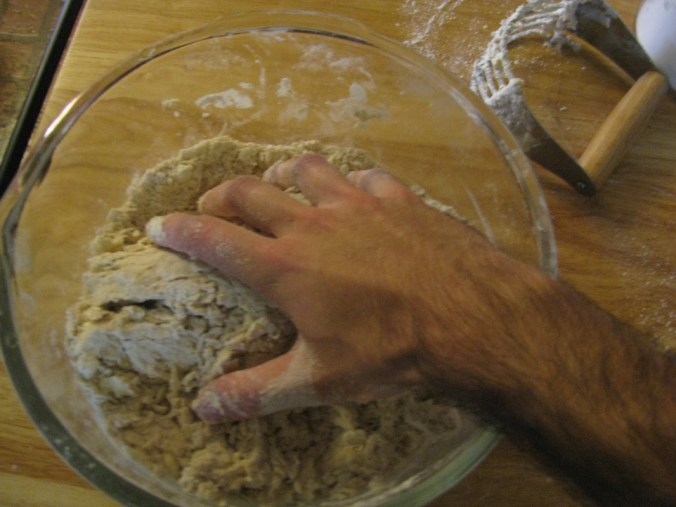
Grargh! Meatpaw want pastry!

Get right in there with your hands and start kneading. You’re trying to get the liquid and flour together so they form a dough, so this will be a combination of working squeezing and mixing. It will be dry and crumbly at first, but just keep working it together. If it’s REALLY not coming together, add a little more liquid (if you haven’t drunken it already…) Keep it going until…
You have two equal sized smooth balls. Pat them into patties, wrap in plastic, and toss them in the fridge for the time being. If you’re not making the pie today, throw them in the freezer- frozen pie dough can keep for a couple months.

Pie Assembly

The time has come! Your crust is made. Your filling is prepared. Time to put it all in a pan and bake it!

First, you will need your pie pan, and your workspace ready!

If your filling wasn’t ready yet, at this moment you might put the lined tin in the fridge for a little bit to relax the dough. I made the filling for this pie ahead of time, so the crust only spent a few minutes in the fridge- just enough to relax it, but not so much it would crack and be difficult to work with later. DON’T trim off the hanging dough! You’ll need it shortly.

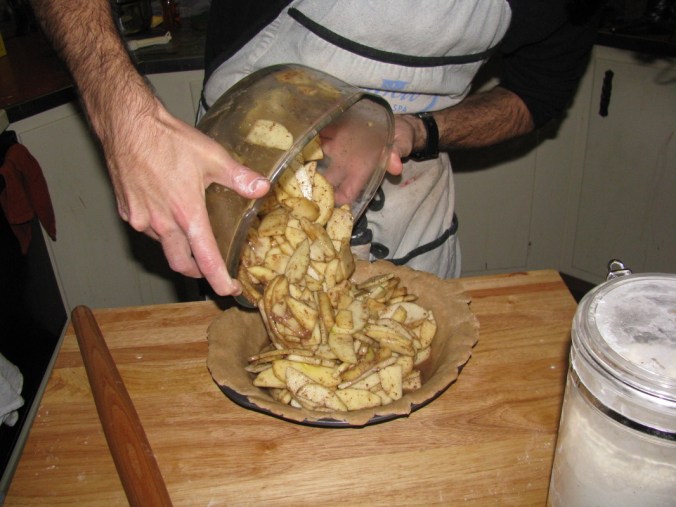
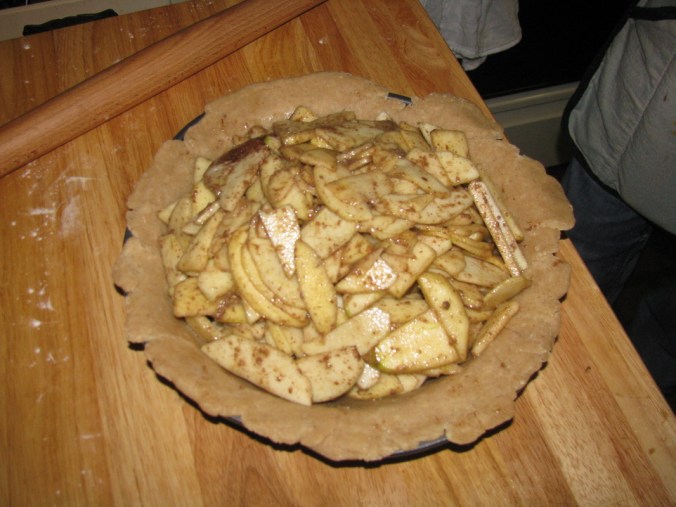
Once the crust is ready… in goes the filling!

You’ll notice the very small amount of flour on the table to keep the dough from sticking- this is called “bench flour” and you want to use as LITTLE AS POSSIBLE. As you work with the dough, some of this flour WILL get absorbed into it, and you don’t want to dry out your crust. A little on the table, on your rolling pin, and on your hands- NO MORE.

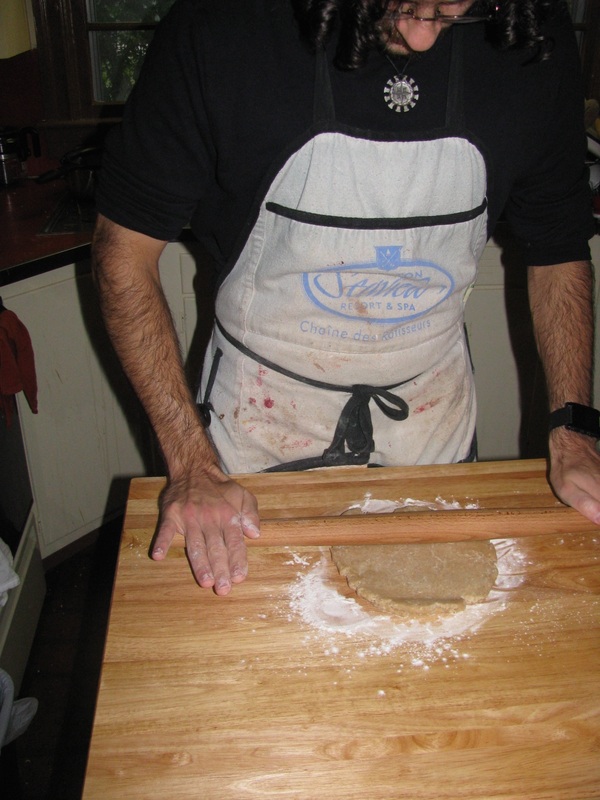
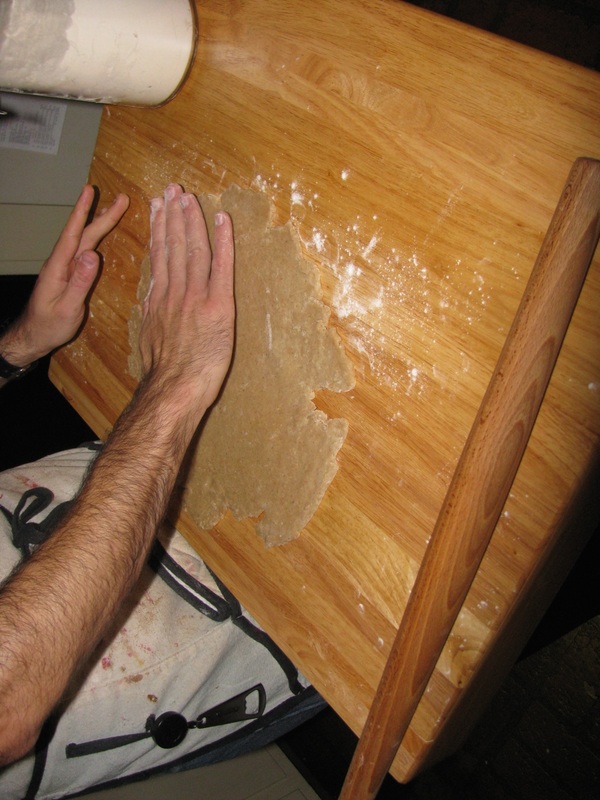
When rolling dough, you want it to keep as smooth and regular a shape as possible. At first, this will be difficult- your dough will be chilled, and it will want to crack rather than stretch or flex. You don’t want to overwork your dough, but just keep pushing together tears as they form.

Another way to keep your dough even (and from sticking to the table) is to rotate it with every pass. When using a rolling pin, you will naturally press harder with your dominant hand- by rotating the dough, you negate this and make a nice, smooth piece of pastry..

Picture

So roll…

Picture

…and turn…

Picture

..and roll again.

Picture

Fix tears…

Picture

And roll out as regular a shape as possible.


Next comes the transfer to the pie tin- for most pies, you do not need to grease the pie tin, just make sure it’s clean.
Picture

Flip the edge of your dough over your pin…

Picture

And roll it right up. This keep the dough from being stretched by gravity too much- just make sure the pin is floured.

Picture

Start at the edge of your pie pan…

Picture

And unroll.

Picture

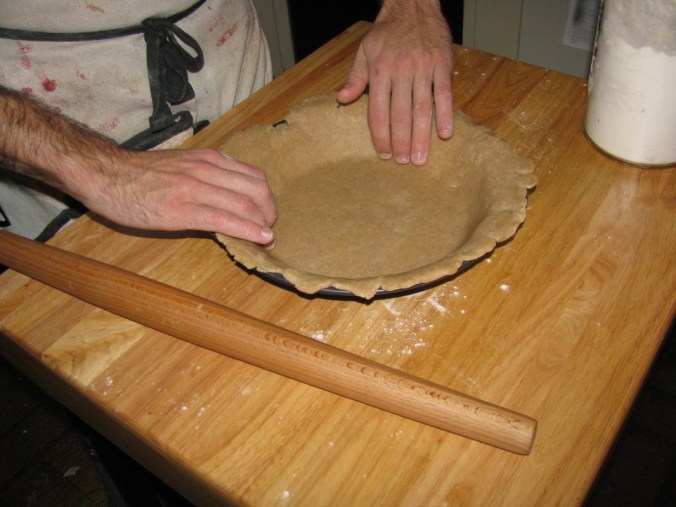
Use your fingers to press and stretch the dough as needed to make sure it drapes over the edges and fills every corner of the pan.

For my Über Apple pie, I used a combination of apples- Winesap (for tartness and body), Honeycrisp (for sweetness), Fuji (for sweetness), and Granny Smith (for additional tartness and body). The spice mixture was the same as the crust, with a little something extra dropped in- a tablespoon or so of apple brandy, and some homemade vanilla extract.

…It’s good to be a baker.

Picture

Awww yeah…


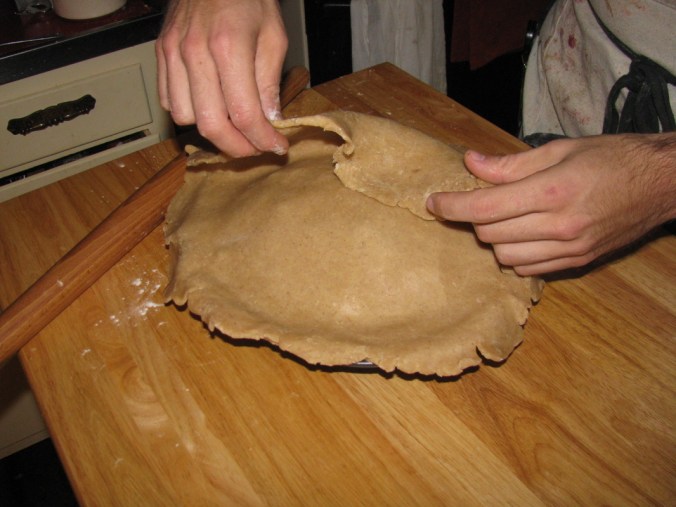
Now, the top crust! Wet the edges of your pie with a pastry brush dipped in water or a wet finger, and the roll out and transfer your top crust exactly as before.

Press your top crust down on the moistened edge of the bottom crust to make a preliminary seal.

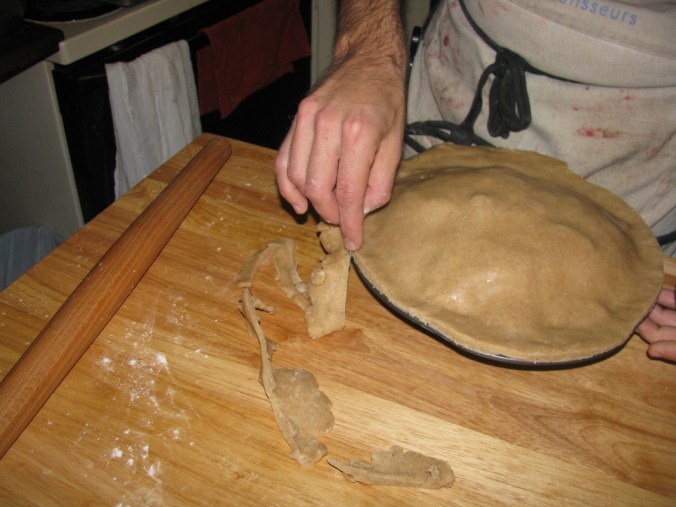
Here’s where you can get creative- depending on the pie pan you are using and the edge you want, you may choose to either trim the edges or leave them on and use them in the crimping later on.

If you decide to trim them use a VERY sharp knife or a razor blade to cut the dough- you don’t want to use sawing, cutting motion as much as just push the blade against the dough and have it fall away.

Picture

Just push in…

Picture

and turn the pie to cut the dough.

Picture

This will keep from pulling and stretching the dough, and creating a ragged edge. If your knife isn’t cutting this easily, get a sharper knife or use a razor blade. I’m using a razor in these pictures.


Don’t throw away the scrap dough! You can use it to make little cookies, smaller pies (if you have enough), or something else that I will show you shortly…

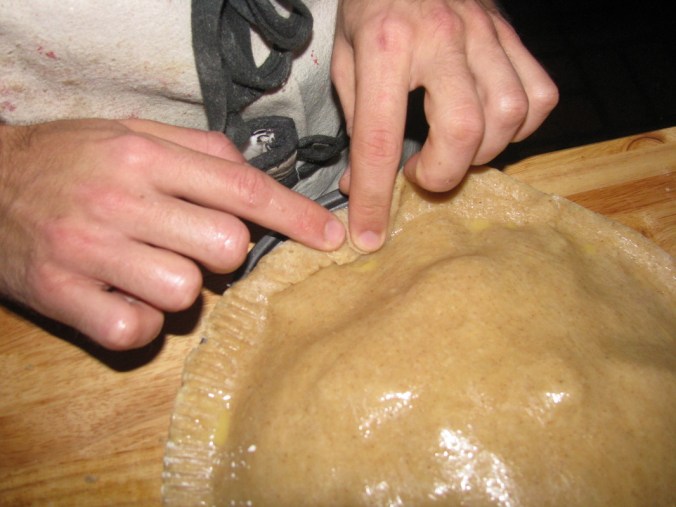
Here is where you can apply a “wash” to your pie- a coating that will make things stick to it and affect it’s appearance. The two most popular washes are an egg wash and a milk wash. The egg wash makes your shiny and golden, while the milk wash will make your pie look duller and more rustic. For this pie, I went with the egg wash- which was just a scrambled egg mixed with a little water. A milk wash is simply a bit of milk in a bowl. Both are applied with a pastry or basting brush, like so…

Now it’s time to crimp your edges! This is how you seal in the filling. There are lots of ways of crimping your pie, all very effective- the choice is all up to the way your want your pie to look. The most popular way is using a fork dipped in flour, and pressing the tines to  the crust. My personal favorite is a sort of dog-earred, scallop like crimping. For your education and delight, I did both here.

Picture

Flour, press, repeat…

Picture

Fold and press…

Picture

Continue…

Picture

Completed crimping!

Now, remember when I told you to save the scrap dough after trimming? Here’s where that comes back in. Rummaging through my tools, I found tiny Halloween themed pastry cutters! Since Halloween is coming up, I rolled out the scraps, and cut little pumpkins, bats, cats, and ghosts to decorate the pie with!
After egg washing the shapes as well, the only thing left to do was cut vents in the crust. Since you have now sealed up the edges, the steam of cooking filling is going to build up in there. If you don’t want it exploding out the sides, you need to cut vents into the top. This is another chance for creativity- but first, it’s a good idea to put your pie back in the fridge for a good 5 or 10 minutes. This will firm up the wash and relax the dough so that when you cut your vents, they’ll spread cleanly and clear- VERY important if you are going to try and cut a shape! As an alternative, you can use the pastry cutters to cut shapes out of the top crust before you put it on the pie- have fun and experiment!

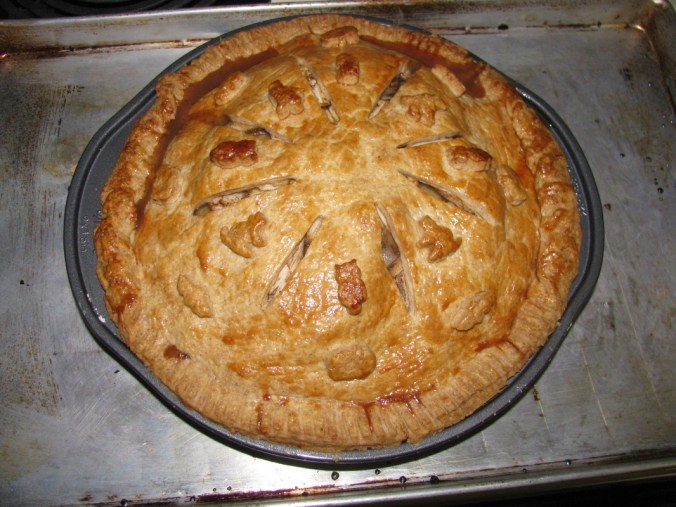
Normally I vent my pies with my signature top hat, but for this pie, 8 little cuts (once again, with a sharp knife or razor!) did just fine.

And then, after about 90 minutes in the oven…

The Über Apple pie is completed!

Experiment every way you can to make your own pies exactly how you like them!

Thanks to Becky for the great pics, and as always-

Stay classy,

15 Minutes May Be Too Long…

Good evening, friends and neighbors!

“So what do you do?”
“I’m a baker.”
“Really?”
“Yep. Cakes, pies, cookies, that kind of thing.”
“So you want to be like Cake Boss / Ace of Cakes or something?”
                                         -conversation I have on a weekly basis

     More than once, I’ve spoken about the mixed blessing of food television. It enlightens people to the vast and wonderful landscape of cultures through the medium of food and expands their dietary horizons. Chefs can play more and let their customers in on more of the good stuff because they are seeing it on TV and ASKING for it.

    On the other hand, notoriety in the culinary world is a double edged sword. Television is entertainment, which means the public wants to be entertained- and not always by good stuff. Take it from Chris Cosentino.

Chris Cosentino is a California-based chef, deeply devoted to introducing people to the joy of offal- the organs and seemingly less desirable bits of a given animal rather than just its muscles, which is what we usually eat. In a recent speech, Chris (occasionally tearfully) documents his rise to chef stardom- and the spiky place he found himself in when he got there.

In a recent newspaper article, I was asked what culinary school does for its students to prepare them to work in the culinary world (“the Industry” as it was ominously called) and I said, “It gets the Norman Rockwell vision out of your head.”

It’s true. The picturesque, smiling baker handing over a fresh-baked pie to a smiling woman and her cheerful children out doing their shopping rarely, if ever, happens. More often, the baker is long since asleep when the customer comes by- he started at 3 in the morning. When he is awake, he may not be smiling either- it’s very stressful, lonely, exacting work he does.

After the above conversation, I’ve been asked “What DO you want then?”
Here’s the answer:

I want to travel the world, and eventually find a small town to settle in.
I want to open my bakery, and run it myself.
I want to make everything from scratch, to the best of my ability, and as best I can.
I want to put down roots in the community and be Matt the Baker, at the Black Hat Bakery.
Eventually, if they are so inclined, I’d like to leave the business to my kids.

Norman Rockwell-ish, yeah. It’s good to have a goal in mind, though.

Stay on top of it.
Stay clear.
And of course-

Stay Classy,

Picture

Beer Today, Bread Also Today

Good evening, friends and neighbors!

     Anyone who knows me (or has read at least half the entries in this blog) knows that one of my favorite things to work with in the bake shop is alcohol- beer, wine, liquor, liqueurs, and so on.

Why? Simple- Alcohol (liquor and beer in particular) have so many deviations, flavor profiles, and attributes to choose from- all based upon the fermentation of sugars, and how it’s done with what materials. Sugars, fermentation, and flavor? Sounds like baking to me!

While I have no problem dropping some rum into a vanilla sponge cake, or whiskey into devil’s food, far and away my favorite type of alcohol to bake with is beer. The flavors of the grain, the bitterness of the hops, and signature aroma of the fermentation from the brewers yeast are- for obvious reasons- delightfully similar to the flavors and smells of baked goods, especially breads and quickbreads (muffins, scones and the like.)

With the astounding variations in beer itself- from the bright and bitter India Pale Ale to the dark, heavy depths of porters and stouts- and the variations of flavor possible within those, one can devote a lifetime to finding all the wonderful ways beer and baking combine. 

One of my favorite recipes is for a simple beerbread. This is a quickbread- meaning that it is leavened (raised) with baking powder, and therefore tends to go stale much more quickly than yeast-leavened breads. This simple recipe allows you an extremely forgiving blank canvas where you can experiment with different kinds of beers and their various flavors.
———————
Beerbread
Yield- 1 loaf

3 c. all purpose flour
1 tbs. salt
1 tbs. baking powder
1/2 c. sugar
12 oz. bottle beer
2 tbs melted butter
Herbs/spices/ additions you like (as long as they do not weigh down the bread)

Preheat oven to 375 F. Grease an ordinary 9 x 5 loaf pan.
Mix dry ingredients together in a large bowl, and pour in bottle of beer. Herbs and spices should go into the dry ingredients, additions (berries, nuts, etc) get mixed in here. Mix well until no dry ingredients remain. The dough should be sticky.

Pour dough in the loaf pan, garnish top as desired (seeds, berries, sanding sugar, etc) and bake for 55 minutes. At the last three minutes of baking, brush the top of the loaf with the melted butter, and then continue baking for the remaining three minutes.

Remove from oven and allow to cool completely before removing the loaf from the pan.

—————-

 I have found that darker, heartier beers (porters and stouts) tend to make the bread rich and molasses-flavored, while pale ales and more bitter beers will impart a sourness similar to sourdough. 

One of my favorite things to do is get two bottles of a given beer. One will go to making the bread, the other I’ll drink and try to describe the flavors present. From that, one can pair flavors together and make additions to the bread that will bring those flavors out. For example, Blue Moon is an excellent unfiltered wheat beer that pairs well with citrus, so the addition of candied orange peel might be a good idea in the bread.

Be creative, and have fun!

Stay classy,