Ever since I was old enough to actually appreciate hot “adult” beverages, I preferred tea to coffee. In fact, there’s only one coffee drink I really like. It’s a cappuccino with cinnamon and honey that I was introduced to at my favorite West Side writing cafe as a cafe con miel, but I’ve since understood is easier to explain to baristas just as “cappuccino with honey and cinnamon at the bottom.”
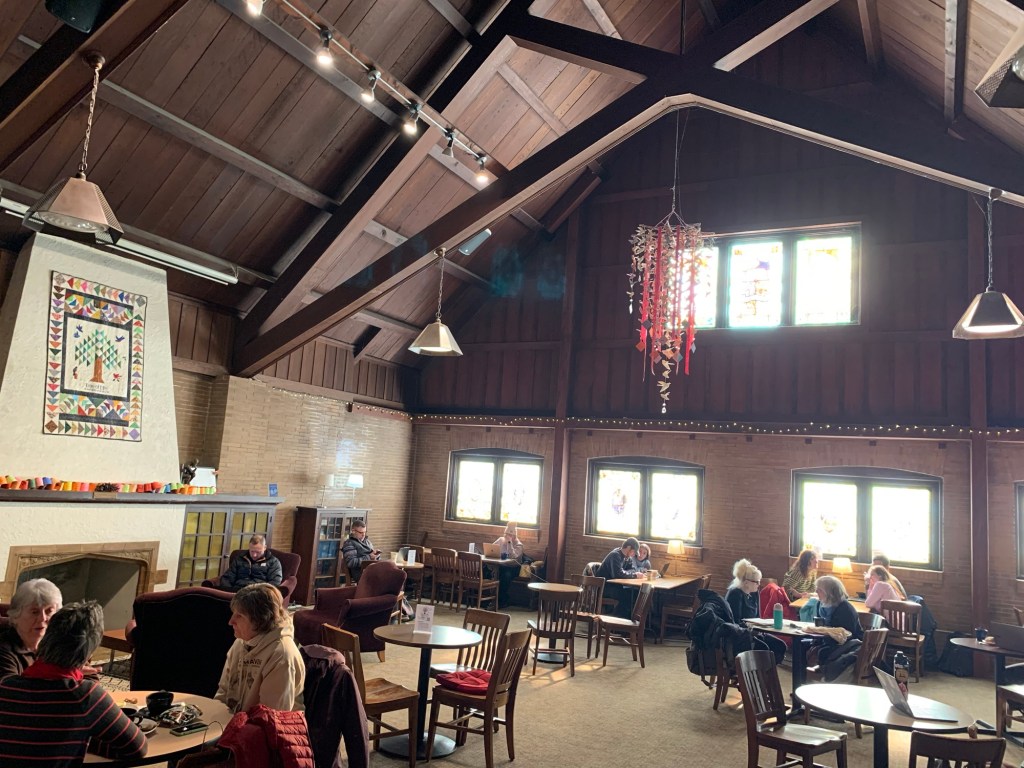
I’m drinking that coffee drink right now at Taborspace- the cozy social hall of a church on Mount Tabor where the base of the bell tower was rented out to a series of cafe and fast-eats ventures. Most recently, and popularly, it became the third satellite location of the cafe I worked at nearly a decade ago. I talked briefly with the new faces about the old faces (and recipes, and wall notes, and procedures most likely) still around the main kitchen that used to be my world. Then I took my scone and Only Coffee Drink I Actually Like into the sunny, raftered, cozy hall with Christian-themed stained glass windows that only adds to the vibes.
The ups-and-downs of the hospitality industry are no joke. Bosses and owners use words like “feast or famine” to describe the activity between the “busy seasons” and “slow seasons.”
I came from a beach town, where “slow season” meant quiet time. It meant half the local, non-chain ice cream stands and places on the boardwalk simply shuttered from Labor Day to Easter. Kids who wanted/needed summer jobs near their parents summer homes knew they needed to have their applications and resumes in shortly after Valentines Day if they wanted an apron waiting for them by the time Mom and Dad aired out the “life’s a beach” and “Island state of mind” decor.
The winery’s busy season starts around Easter- our “dress rehearsal” for Mother’s Day Brunch- and lasts the entirety of Wedding Season (May- September) with possibly a small lull before the Holiday Party. After New Years Day, however, business goes off a cliff. Hours get cut, and employees cash out reserved PTO to fluff up their checks and pay bills. They find gig work, pursue side hustles, or even pick up per diem jobs at places with skeleton crews and sick time policies.
“Lovers and madmen have such seething brains, Such shaping fantasies, that apprehend More than cool reason ever comprehends. The lunatic, the lover and the poet Are of imagination all compact: One sees more devils than vast hell can hold, That is, the madman: the lover, all as frantic, Sees Helen’s beauty in a brow of Egypt: The poet’s eye, in fine frenzy rolling, Doth glance from heaven to earth, from earth to heaven; And as imagination bodies forth The forms of things unknown, the poet’s pen Turns them to shapes and gives to airy nothing A local habitation and a name.”
– A Midsummer Night’s Dream, Act V Scene I
At the end of his own weird and raunchy comedy A Midsummer Night’s Dream, Shakespeare lets us in on his own thoughts regarding passion and madness. Passion, Creativity, and Insanity are the coin of the realm in culinary arts. The work of food writers, celebrity cooks, and media like The Bear parade our damage for the public and make us heroes, horror stories, characters, and even martyrs when we die.
I don’t think for a second it’s somehow undeserved. That’s the part of our lives that kitchen veterans miss and swap stories about. What some people think needs to be done about- or with- that passion, however, has me wondering. How to do you temper, train, guide, and coordinate that kind of raw passion and madness? History would tell us we need to be like the military. Owners and executives who spend more time owning and eating in restaurants than actually making them work tell us we need to lead and manage like a business or a factory- possibly one that turns Dirt into Diabetes.
Personally, I think that the answer to leading and managing cooks is to stop seeking “employees” as much as finding acolytes.
When you work in a restaurant, experiencing growth in your skills or knowledge is often a humbling but pretty neat experience.
Imagine for a minute you are a capable chef. You’ve been at it for awhile and a couple cooks reporting to you. You’re not in charge of the restaurant, but the executive chef trusts you to work their will and keep the team performing. You’ve got techniques in your hands and recipes/formulas you trust to get the job done.
One day, one of your cooks- younger or maybe just newer- looks at a method and recipe you just handed them and says, “Hey, why do we do it this way?”
In a moment, a wave of responses flash through your mind: “That’s my method. Who does this little shit think they are? Kids these days are so fucking lazy…that’s the way we’ve always done it…”
You might feel enraged, exasperated, or at the very least annoyed… but there’s something else behind it all. We don’t wanna look at it. We can’t always afford to honor or accept it, so we spend a lot of time pushing it down or numbing it.
Doubt.Doubt and Questions.
It can seriously suck to feel Doubt when you are so used to the meritocracy of the kitchen. Doubt is the mind killer. Doubt is the little death that brings total clusterfuckery. You can’t afford the time or space to doubt.
But, in a moment, you realize “I never asked that question… I just did as I was told.” You look at the cook and finally say “That’s the way we do it here… why? Do you know another way?”
Maybe that cook suggests a method you know (from your knowledge and experience) won’t get the result you need. “We roast the squash rather than steaming because we don’t want the added moisture in the recipe.” “We coddle the eggs so they won’t be so cold the butter seizes when we add them to the batter.”
Maybe they don’t and it’s an honest question. It seems like a wasted step. It seems redundant. In all your knowledge and experience, you can’t explain why that method is so important. “It’s the way we’ve always done it…” it made sense to someone some time ago and no one’s ever been bothered to check their work.
That’s where the growth happens. You either figure out the reason, or you figure out it HAS no reason and it’s a waste. In a meritocracy, you are judged by what you accomplish and are capable of- not what you were, who you know, or how long something as been done your way.
By choosing Curiosity and Humility over Hubris, the answer is found. Dispassionate and clear as a failed sauce or a botched bake. It’s either “this is why’ or “this is a waste.”
Curiosity weaponizes Doubt against itself.Curiosity is powered by Humility. We can’t know everything, or everyone’s experiences.
For me, Curiosity and Humilty are crucial to leading well. If my staff are watching me and hoping to see their future in the field, I need to show them that asking questions and having doubts are good.
They need to see that even the pastry chef, with knowledge and experience, still has a lot to learn and can even learn from them. It’s been a tenet of mine for a long time that if one of my apprentices comes up with a new way to do something that renders a better product, does a job more efficiently, or both, that’s how we do itnow.My ego takes a backseat, and if it turns out there’s a problem with that new method, we all learn why.
Imagine what you will learn when you admit you don’t know everything.
I spent a good chunk of today looking for a candle.
It wasn’t just for a candle though. I went shopping for some clothes today, and I intended to pick up a scented candle for my new desk because I have apparently become a guy who likes having a nice candle burning near me when I write. I don’t really know or care if its aromatherapy, meditative, or vibes- it feels Nice and Good and Right for the Desk, so when my little lavender-scented candle burned out, I said “Time to get another.”
I grabbed the clothes from Target (if you catch me in a fancy brand of clothes, assume I got lucky at a thrift shop) and realized I wasn’t going to find the candle I wanted. All the candles that smelled good at all were way too big or pungent than I needed. I wanted it to be low-profile and not to distract me while I was working. Since Emily had come with me and was doing her own shopping, I resolved to just wander around and look for a little something extra for myself. New pins for my collection and little bags of gummy candy are my usual weaknesses and “treats” when I’m out shopping.
After walking through store after store in Clackamas Mall, I came out empty-handed and okay with it, which was an interesting moment in and of itself. Somehow, I’ve gotten to the point where I like looking at “Stuff” and thinking about it, but not getting it.
The things I want, need, and that stick with me I will get, and I will happily eat the cost. After losing my white summer hat, I had very few qualms about dropping $112 for a new, authentic Panama hat. I don’t mind shelling out for a bottle of whiskey that calls to me or that I think I’ll enjoy. Good things cost money.
Somehow, though, the kid who used to collect stuffed animals, Transformers toys, mint containers, tea, and eventually teapots has gotten past the need to have things just to have them.





 The Black Hat Baker