Curiosity and Humility- The Not-So-Secret Weapons of Leadership

When you work in a restaurant, experiencing growth in your skills or knowledge is often a humbling but pretty neat experience.

Imagine for a minute you are a capable chef. You’ve been at it for awhile and a couple cooks reporting to you. You’re not in charge of the restaurant, but the executive chef trusts you to work their will and keep the team performing. You’ve got techniques in your hands and recipes/formulas you trust to get the job done.

One day, one of your cooks- younger or maybe just newer- looks at a method and recipe you just handed them and says, “Hey, why do we do it this way?”

In a moment, a wave of responses flash through your mind: “That’s my method. Who does this little shit think they are? Kids these days are so fucking lazy… that’s the way we’ve always done it…”

You might feel enraged, exasperated, or at the very least annoyed… but there’s something else behind it all. We don’t wanna look at it. We can’t always afford to honor or accept it, so we spend a lot of time pushing it down or numbing it.

Doubt. Doubt and Questions.

It can seriously suck to feel Doubt when you are so used to the meritocracy of the kitchen. Doubt is the mind killer. Doubt is the little death that brings total clusterfuckery. You can’t afford the time or space to doubt.

But, in a moment, you realize “I never asked that question… I just did as I was told.” You look at the cook and finally say “That’s the way we do it here… why? Do you know another way?”

Maybe that cook suggests a method you know (from your knowledge and experience) won’t get the result you need. “We roast the squash rather than steaming because we don’t want the added moisture in the recipe.”We coddle the eggs so they won’t be so cold the butter seizes when we add them to the batter.”

Maybe they don’t and it’s an honest question. It seems like a wasted step. It seems redundant. In all your knowledge and experience, you can’t explain why that method is so important. “It’s the way we’ve always done it…” it made sense to someone some time ago and no one’s ever been bothered to check their work.

That’s where the growth happens. You either figure out the reason, or you figure out it HAS no reason and it’s a waste. In a meritocracy, you are judged by what you accomplish and are capable of- not what you were, who you know, or how long something as been done your way.

By choosing Curiosity and Humility over Hubris, the answer is found. Dispassionate and clear as a failed sauce or a botched bake. It’s either “this is why’ or “this is a waste.”

Curiosity weaponizes Doubt against itself. Curiosity is powered by Humility. We can’t know everything, or everyone’s experiences.

For me, Curiosity and Humilty are crucial to leading well. If my staff are watching me and hoping to see their future in the field, I need to show them that asking questions and having doubts are good.

They need to see that even the pastry chef, with knowledge and experience, still has a lot to learn and can even learn from them. It’s been a tenet of mine for a long time that if one of my apprentices comes up with a new way to do something that renders a better product, does a job more efficiently, or both, that’s how we do it now. My ego takes a backseat, and if it turns out there’s a problem with that new method, we all learn why.

Imagine what you will learn when you admit you don’t know everything.

Stay Classy,

The BHB's Top Hat Signature Logo

Context Is Key- Giving Meaning to Tedium and Avoiding Orthodoxy

No one likes wasting their time, or feeling like their time is being wasted. If you can’t explain the impact of a task, why does the task need to be done by anyone?

I’ve been silent on here for the last few weeks. Between a very compressed event schedule at the winery, Yom Kippur, and the anniversary of October 7th, I haven’t had the energy or the will to do much at all. With the arrival of a slow period, though, I finally have time to rest, think clearly, and put something on this blog worth reading.

I also have time to take on some of the more… “long-form” projects that come through the kitchen. One of these was a process I’ve come to call “Quinceageddon.” It began last year when my chef bought about 40 lbs of locally-grown quince, dropped it in our walk-in fridge, and told me to do something with it.

Photo by Meruyert Gonullu on Pexels.com

For those who don’t know, a quince is the tsundere version of a pear. Historically called the “fragrant pear,” a quince looks like a giant lumpy pear that has a positively wonderful fragrance- floral, sweet, and sharp all at the same time- but is utterly inedible by itself. The fruit is so rich in pectin and tannin that it’s like biting into a rock-hard raw potato, but painfully bitter in addition to being actually painful.

The single most popular- and arguably the best- thing to do with quince is to make quince paste, or membrillo. The striking red color and tart/sweet flavor makes it a staple pastry filling in Latin America and Spain, as well as a classy addition to cheese boards. Membrillo can be bought from specialty stores, but it tends to be expensive because making it takes hours of work. First comes peeling, coring, and chopping the rock hard fruit. Then braising the fruit with water and citrus to soften it. Then milling, blending, mixing and cooking it slowly for hours until the puree turns crimson red, and finally blending and cooling… but if you (or the pastry chef you hired) have a bit of a blank day to spend, it’s easy enough to make it yourself.

The other project I found myself working on this week was seeing to the end of our tomato supply. All summer, we had an excellent supply of local tomatoes that we worked into sauces, salads, jams, platters, platings, and the like. With autumn in full swing and tomatoes leaving the markets, it was time to similarly see them off our menu.

That meant we had about 20 pounds of beautiful (if somewhat wrinkly) multicolored cherry tomatoes that would soon be attracting more fruit flies than customers if we didn’t deal with them soon, turning them into jam that could be reliably frozen for a future time… which meant they were handed over to me and my team.

Overhead shot of a tray of multi-colored cherry tomatoes being stemmed and placed in a clear plastic bucket

Slowly, individually plucking the green stems and leaves off the tomatoes as I dropped them into a bucket on a scale, I realized, would probably make a cook fresh out of school (or a younger me, for that matter) go mad and question their life choices… if I just told them to do it.

While I was plucking through these tomatoes, my assistant Marisah was taking another crack at piping the gouger cheese puffs we use for events. As I plucked stems, I called back advice over my shoulder as she mixed the sticky pate au choux batter until I realized what I was doing and said “Augh, sorry… you’ve literally made this before, I’m preaching to the choir here.” To which Marisah graciously laughed and said “It’s alright, I enjoy the teaching.”

That’s when I looked back down at my tomatoes and realized a mistake that too many chef make and that I do my very best not to make- they don’t give the context for a task.

For too many “old school” chefs and cooks, when you are given an instruction, the correct answer is “Yes, chef” and then you do it. Maybe the almighty Chef will give you a reason or some instruction, but the key in that task is obedience. When the boss says “jump,” you ask “how high” on the way down. That was what made a good cook. “Kids these days with their questions and their ideas and their entitlement…”

Karen fixed that for me relatively quickly in my career over a batch of pastry cream.

“Your custard always gels too hard, Matt. What are you… wait, are you done mixing it already?”
“Um, yeah Karen- that’s what I was taught, mix it until the butter melts…”
“Matt, if you just put the butter in there, it’ll melt and then you’ll have brick. You move it until the butter melts and it’s cool. If you want a custard pie filling, that’s fine, but if you want it smooth and pipeable, you need to mix it longer.”
“Always ask questions, Matt.”

A young man has his hand to his ear and seems to be listening.
Photo by Andrea Piacquadio on Pexels.com

If I told Marisah or anyone else “peel and chop 40 pounds of quince” or “individually pull the green bits off 16 pounds of cherry tomatoes” without any other information, or if I answered questions with “because I said so,” why wouldn’t I expect shitty results? That’s stupid, capricious, annoying, and a massive waste of goddamned time.

If, on the other hand, I was honest and said “Peel, core and chop these quince. We’re making a shit-ton of quince paste for the year, and peels and seeds will make the milling more difficult” and “We’re throwing all these into jam and we don’t want the green bits,” suddenly there’s a reason to do a good job of it beyond “I have authority and you don’t.”

What’s more, being open to questions can help, change, or eliminate the task altogether. I think of it as “keeping me honest’ in the face of culinary orthodoxy, because if someone else says “why can’t we just food mill or process the tomatoes as they are” suddenly I, as a teacher and leader, have to think the task through.

In the case of the tomatoes, I need to be able to say “The food processor will chop up the green bits, and we don’t want them at all. The food mill will strain out the seeds which we do want.” The same logic applies for why we don’t process the parsley.

Occasionally, however, it gives me pause to say “Hey, why DON’T we do the task that way?” If I can’t find a reason, we experiment. If it works, voila- a useless task as been eliminated because I was able to say “Huh… let’s try it!” Instead of getting butt-hurt over my orders being questioned, an apprentice feels validated, labor has been reduced, and efficiency increased.

Put your ego aside, get your head out of your ass, and invest the tiny amount of time it takes to feed your employees curiosity. Create enjoyable teaching moments, and reap the benefits of ideas beyond your own.

Stay Classy,

The BHB's Top Hat Signature Logo

One Deep Breath

You can absolutely love what you do and still be fucking tired.

Compared to a lot of folks, I’m lucky. I have a wonderful wife. I live in a decent town, and between the two of us we manage to make enough to live comfortably working in fields we love and trained for.

I’m going to go ahead and toot my own horn a bit here (my therapist said I need to improve my self-talk) and share that I am objectively very good at my job. The work of being a pastry chef, running and training a small team, and developing recipes is not an unmanageable burden for me. My team and I deliver excellent work for our employers and our customers.

Just because someone carries a burden well doesn’t mean it isn’t heavy, and even people who perform well at work they enjoy feel the need to put down their tools, scream into the void for a bit, and then take a nap.

Continue reading

A Moment In Time

The internal editor is both a writer’s best friend and worst nemesis because its voice sounds like all of our heroes, influences, instincts, talent, and tastes. The problem is that those voices are both encouraging us and criticizing us, simultaneously and constantly. I think writing only really comes out when you can shut all those voices off- even just for moments at a time. Between news of the world, work, and my own preoccupation with getting back in shape, there are precious few times when I can actually feel “still” enough to hear my own voice.

In the Hagakure by Yamamoto Tsunetomo, the samurai-turned-Buddhist monk writes “Lord Sanenori said, ‘In the midst of a single breath, where perversity cannot be held, is the Way.’”

Think about that for a moment. You’re breathing right now, right? I hope so, anyway. Don’t do anything to change your breath, but just kind of notice it. When people meditate, the reason we get told to “count our breaths” or “focus on our breath” so much is that it’s impossible to breathe anywhere but in the present moment.

So here you are, breathing, and just being aware of air going in and out of your body. Without changing your breath, though, try to notice the spots between the breaths. The point just before you inhale or exhale when the previous motion has just finished. Nothing in, nothing out, you’re not actively holding your breath… it’s just stillness.

Paying this kind of attention to something as ubiquitous as breathing- really just being still and present long enough to notice- can feel really freaking weird. It’s like suddenly noticing how your clothing feels on your skin, or realizing you can feel the structure of your teeth in your mouth.

Okay, that last one WAS seriously weird. Sorry about that, but when was the last time you stopped long enough to notice something like that, though? Before I started meditating regularly, that kind of sensation only happened when I was injured or something felt off/wrong. We’re not encouraged to stop or think or be present- there’s so much to do and see and consume and needs doing and we’ll be left behind otherwise, and therefore less-than therefore shamed therefore unfuckable therefore therefore therefore… It’s not a good way to live, but we’re used to it. We’re so used to it that stopping to think, feel, and be present in our bodies feels really goddamned weird.

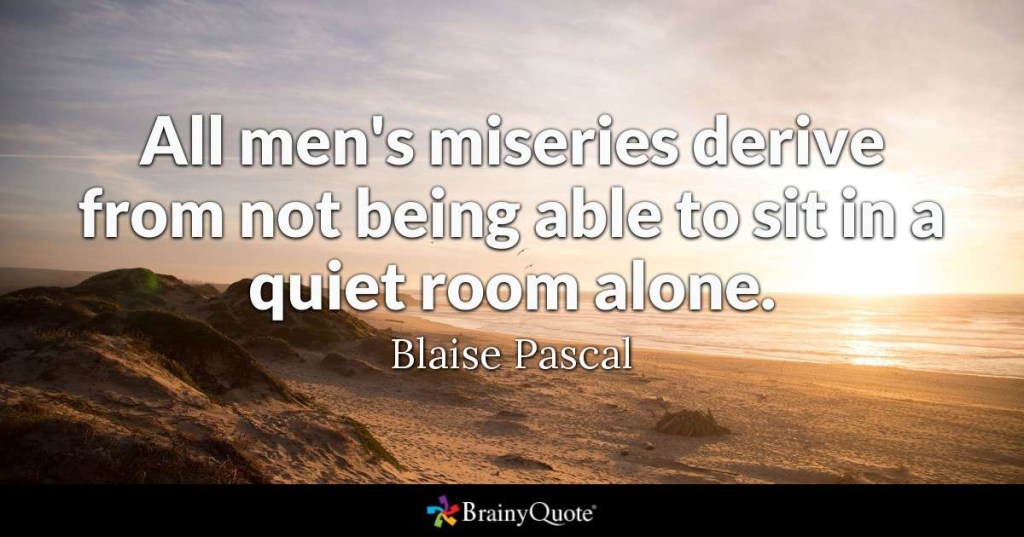
A quote meme reading in white text over a landscape "All men's miseries derive from not being able to sit in a quiet room alone. Blaise Pascal"

I still don’t always feel as still or serene as I want to, or when I want to, but I have started to notice moments that make feeling present easier.

I’m a chef, so of course focusing on a taste or flavor is important. Whether it’s shutting my eyes to focus on what a new batch of nectarine jam needs at work or sitting up on my porch, determined to experience everything a dram of whiskey has to offer, those are moments of quiet focus, stillness, and presence that I need in my life.

When I run, that feeling of presence and stillness is called “the Zone” or “the Void.” The mind goes blank and there’s nothing but the slap of shoes on asphalt and wind on skin. Even physical pain is ignorable and thus endurable.

It’s a bit different when I’m sitting down at my writing desk because ironically it’s here that sensory presence can be a distraction. The candle I’ve made a habit of lighting when I write does less to inspire presence than encourage contemplation. Above my desk is a large print of Rene Magritte’s “Personal Values.” I chose it because it’s surreal, serene, and just odd enough to let you stare at it for a moment and think about other things, like watching fish in a tank.

The painting "Personal Values" by Rene Magritte. Looking at the painting, it's unclear if the room is small or the occupants are large. A mirrored wardrobe and a neatly made bed are in a room painted to look like clouds on a white sky. The floor is wood planks with oriental rugs. Occupying the room are enormous turtle-shell comb leaning against the wall on the bed, a massive match stick, a blue glass water goblet, and a pink bar of soap the size of a trunk. On top of the dresser is an equally massive shaving brush.
“Personal Values, 1952”- Rene Magritte

Even as I sit here writing, there is that internal editor again. “Where are you going with this, Matt? Does this have anything to do with food? The culinary industry? Are you a food writer or aren’t you?”

Yeah, I am- and I could easily spin this whole article to be something about finding stillness in the creative life, maintaining mindfulness in the kitchen, or meditations over a medium-well-roasted tofu block. I’m not going to, though. Even in your creative life and the pursuit of a craft, you need to take the equivalent of a breath and find the stillness before it.

Stay Classy,

The BHB's Top Hat Signature Logo

How To Live Forever

If you would not be forgotten, as soon as you are dead and rotten, either write things worth reading, or do things worth writing.’

– Ben Franklin

You don’t get to decide whether or not you are a mentor. Your apprentices decide that when they determine whether or not they can learn from you- and the absolute greatest feeling on Earth is when your apprentices succeed.

Continue reading