Master of the House

Good evening, friends and neighbors!​

You likely don’t know who Jean-Anthelme Brillat-Savarin is. You MAY know of a creamy spreading cheese named after him, or possibly the rich, spherical dessert.
If you’re like me, however, and you loved watching Iron Chef Japan, you know the quote that started each episode before Chairman Kaga’s monologue:

     Amazingly, the man who offered us this maxim was never a chef, a baker, or even a cook. He was a lawyer, a judge, a politician, and a violinist. He fled to America in order to save his head from the guillotine. He was a writer, a thinker, an amateur physician, and a singer- and he wrote the bible on how to be a host and a gourmand.
     When “La Physiologie du gout” (“The Physiology of Taste”) was published in 1825, a scant few months before Brillat-Savarin’s death, his words were treated like gold. His book was the latest on the science, development, society, and abject of food and the culinary arts. Memories of his parties- both recalled by attendees and recorded as anecdotes in the book- made him the final word in what it was to be a good host. How to throw a dinner party worth attending, how everything should be arranged and chosen to befit visiting nobility- all of it laid out with a physicians intellect, a gentleman’s decorum, and a party animal’s joie de vive.

     In 2016, however, we have Martha Stewart and Ina Garten on our TVs, and Alice Waters on our book shelves, offering an invitation to a different dinner party- one that most of us can only attend in our dreams, lacking the time or resources to make the TV show fantasies come true.

     If these pastel dreams are rare in the real world, then the classic dinner parties are all but dead. They’ve been left in the keeping of certain gourmet organizations that refuse to put them aside, or relegated to Masterpiece Theater.
     ​In this day and age, do the 190-year-old words of the legendary host still shine, or does their luster belong to a world long since past?

     Well, I read them- and I have thoughts on this.

Who Is Brillat- Savarin?
     Born in 1755 in the small town of Belley, France, Brillat-Savarin was a gourmand- a lover of fine food and wine- and was a magistrate to pay the bills. He eventually was elected mayor of Belley. However, when the French Revolution broke out, the heads of administrators (and a number of gourmands, for that matter) started to roll. Brilliant-Savarin would have been in line for the guillotine himself, had it not been for a chance encounter at a dinner party with a revolutionary’s wife. A shared love of music convinced the woman that “when a man cultivates the arts as you do, he does not betray his country,” and she persuaded her husband of the same. Even with this promise safety, Brillat-Savarin still feared for his life and fled first throughout Europe, then to America. ​

     Returning to a calmer, less-deadly France in 1796, he became a judge in the French Supreme Court- the perfect thing to keep Brillat-Savarin’s finances happy while he pursued his love of entertaining. At the same time, Brillat-Savarin wrote prolifically of his opinions and meditations on food, dining, and everything to do with them. Every now and then, Brillat-Savarin would read some snippets at his dinner parties, much to the amusement of his guests (after all, a good host should never be without a few stories and jokes to tell!)
After much cajoling and goading from his friends, Brillat-Savarin published his writings as “La Physiologie du gout”, to almost immediate widespread acclaim- only to die a few months later of pneumonia in 1826.

Basic Gourmandism
First off, if you decide to pick up a copy of the book, this is absolutely a product of its times- with all the heteronormative, cisgendered, white ethnocentric thinking that time involves. While Brillat- Savarin (calling himself “the Professor”) fills most of the book with anecdotes about his life and doings, the first part of the book is given over to his understanding of physiology, gastronomy, and psychology. There’s a number of things you’ll likely be able to pick up as patently outdated and since disproved. Among them is Brillat-Savarin’s references to psychomorphology, the idea that certain body types and physical characteristics affect one’s personality and vice versa, such as “fat people tend to be jollier,” and “a smaller nose indicates greater intelligence.” 
While reading these chapters is certainly a fascinating look into the scientific understanding of the time, it should be regarded as just that- and since this blog post is aimed at his views of hospitality and food rather than the human body, I’m going to skip over those bits.
Picture

Relax, you’re fine.
     That being said, Brillat-Savarin thoughtfully starts off with a list of 20 aphorisms he has coined, forming the nuts-and-bolts of his philosophy. Some of my favorites include:

“Animals feed: man eats: only the man of intellect knows how to eat.”
“The pleasures of the table belong to all times and all ages, to every country and every day; they go hand in hand with all our other pleasures, outlast them, and remain to console us for their loss.”
“The discovery of a new dish does more for the happiness of mankind than the discovery of a star.” ​

Thoughts on that one, Dr. Tyson?
     Perhaps most pointedly for this blog are these two additions-
“The man who invites his friends to his table, and fails to give his personal attention to the meal they are going to eat, is unworthy to have any friends.”​

“To entertain a guest is to make yourself responsible for his happiness so long as he is beneath your roof.”

    These lines form the basis of what it is to be a gourmand- that food and wine should be loved, studied, admired, and enjoyed in the same manner as a symphony or a novel. It is the recognition that food is an art form, and should be treated as such.
Brillat-Savarin, in his chapter on gourmandism, laments the fact that the word and concept are so misunderstood:

“I have consulted all the dictionaries about the word ‘gourmandism’ and am far from satisfied with what I have found. There is endless confusion between gourmandism, properly so called, and gluttony​ or voracity…”
“Gourmandism is an impassioned, reasoned, and habitual preference for everything which gratifies the organ of taste. Gourmandism is the enemy of excess; indigestion and drunkeness are offenses which render the offender liable to be struck off the rolls.”


-The Phsyiology Of Taste, trans. by Anne Drayton

Today, most of us may confuse the word “gourmand” with its hipper, more modern cousin “foodie.” While there is certainly nothing wrong with considering oneself one or the other, one writer for the Orange County Register suggests that while both foodies and gourmands love food, “They are beyond foodies. Foodies dabble. These are gourmets.” Indeed, Nancy Luna charges groups like the Chaine des Rôtisseurs with keeping and protecting the traditions and decorum that Brillat-Savarin loved and espoused.
​
Thus Spake Savarin…
Throughout the book, Brillat-Savarin offers anecdote after anecdote to illustrate his points (often amusingly- the man really DID have a great memory for stories.) Thankfully, however, in his chapter “On the Pleasures of the Table”, Brillat-Savarin lays down his requirements for the perfect enjoyment of a dinner, or to invoke “…the pleasures of the table in the highest degree.”

First, the guest list:
“Let the number of guests be not more than twelve so that the conversation may be constantly general;
Let them be chosen with different occupations but similar tastes, and with such points of contact that the odious formalities of introduction can be dispensed with;…
Let the men be witty without being too pretentious, and the woman charming without being too coquettish.”

The atmosphere:
“Let the dining-room be well lighted, the cloth impeccably white, and the atmosphere maintained at a temperature of sixty to seventy degrees;…”
“Let the drawing room be  large enough to allow for a game at cards to be arranged for those who cannot do without, yet still leave space for postprandial conversations;

The schedule of the evening:
“Let the progress of the meal be slow, for dinner is the last business of the day, and let the guests conduct themselves like travelers due to reach their destination together;…
Let the guests be detained by the charms of the company, and sustained by the hope that the evening will not pass without some further pleasure;…
Let retirement begin not earlier than 11 o’clock, but by midnight let everyone be in bed.”

And obviously, the food:
“Let the dishes be few in number, but  exquisitely choice, and the wines of the first quality, each in its class; 
Let the service of the former [the food] proceed from the most substantial to the lightest, and of the latter [the wines,] from the mildest to the most perfumed;…
Let the coffee be piping hot, and the liquers chosen by a connoisseur;…
Let the tea be not too strong, the toast artistically buttered, and the punch mixed feelings with proper care.” 

According to “the Professor,” this was how you throw a dinner party for the ages.

Sorry, Doc… times have changed.

​According to “the Professor,” this was how you throw a dinner party for the ages.

Sorry, Doc… times have changed.

Entertainment Today
     Today, if people throw a dinner party, it is likely not based on the words of gourmands or society gurus- rather the size of their budget, and what they have at their disposal.
     The last “dinner party” Emily and I held was Thanksgiving dinner. It was our first in Oregon, and we invited three friends from her work. It was in our small, one bed/one bath apartment, gathered around a folding table in the living room.
     The tablecloth was green and folded awkwardly to fit the tiny table, as we had just picked it up (along with many of our plates) from Goodwill. It was placed in our living room as that was the only place besides the bedroom and kitchen to put it.
     No order was given to the wines, as our friend Nick had brought them and I supplemented with some choice beers and homemade mead. The order of the dinner was not arranged “light to heavy” for the sake of proper enjoyment- the turkey simply needed more time in the oven, and everything else was ready to go first.
     Afterwards, coffee and tea were offered, but generally refused- there was still plenty of wine, and the desserts I had made of Jewish Apple Cake and Pumpkin Pie were on the table.
     We talked, played guitar, and watched YouTube videos for a while- and then everyone left around 9 to get home. They didn’t have work in the morning, but I did. ​
Picture

We don’t do “holidays.”
This is likely better-than-average for a modern dinner party. Even compared to the suggestions of Martha Stewart and Ina Garten, it was notably tacky and lack-luster.

Yet, I have a feeling that Brillat-Savarin himself would have had a good time and found no reason to complain. The reason, I feel, is very simple, and goes back to those two aphorisms of his-

“The man who invites his friends to his table, and fails to give his personal attention to the meal they are going to eat, is unworthy to have any friends.”

“To entertain a guest is to make yourself responsible for his happiness so long as he is beneath your roof.”

Not to toot my own horn, but Emily and I put our all into that tacky little dinner. Emily spent the day cooking and prepping. I was up early baking the pie and cake- all just to make sure that our three friends could have one night of good food and good times. We shared stories, drank and laughed, and enjoyed the products of our labor.

THAT is what makes a good party, and while the decorum that Brillat-Savarin espouses is certainly grand and wonderful, it’s the effort and attention of the hosts that truly makes a gathering memorable. 

Times and food change, but good hospitality does not- and there will always be people like Jean-Anthelme Brillat-Savarin who love and study entertaining not just for its own sake, but to show the rest of the world something wonderful.

Cheers, Professor- Vous avez bien parlé, et un monde affamé est reconnaissant.

Rester chic,

​Rester chic,
Culinary Drivers

Good evening, friends and neighbors!

As I said last entry, I try to keep things on here apolitical. I really hate bringing up social policy, economics, and other junk on here that would encourage any of my readers to assign me to a specific camp- or assign themselves to one. Instead, I like covering things everyone loves and can agree or disagree on good-naturedly: food and drink, and how to enjoy it.

Picture

I’ll drink to that!

Continue reading →

“L’CHAIM!”- The BHB’s Forays Into Homebrewing, Part 2

Good evening, friends and neighbors!
Picture

on On The Bench… some dude screamed the whole time with his arms up or something.
Actually, I told you how to how to get started brewing a simple mead at home. Here’s what you do for when the 10 days- 2 week fermentation time is up!
Ok, not to curb your enthusiasm or anything, but just a quick note- this is only the PRIMARY fermentation. Today, we’ll be getting your delicious mead off the dead cells, sediments and whatnot that might mess up the flavor if you let it sit there. Your mead will KEEP fermenting until either it runs out of sugar (which can take years) or you choose to kill it by boiling and filtering it.
​
Mead is interesting in that, in most cases, after it is bottled it can be cellared INDEFINITELY. You can drink this stuff in 5 years and see where the reaction and aging has taken it. If you just want a sweet, quick little drink, go ahead and enjoy now. Otherwise, hold off for a while- this is only a BABY mead at this point.
Picture

Unless you’re REALLY into drinking babies for some reason…

What To Do When Your Mead is Done

First of all, you might want to get some equipment from your local homebrew supply store:
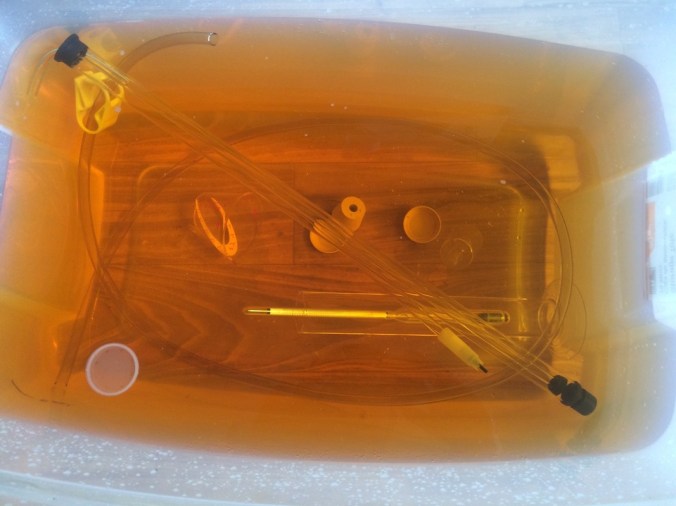
A large tub for sanitzing everything (remember what I said about cleanliness?). This is a storage tub I got from Home Depot, filled up with about 10 gal. of water.
This is my preferred sanitizing agent, BTF Iodophor- an iodine-based cleaner. It’s food-safe, doesn’t require rinsing afterwards (even though I do anyway,) and doesn’t leave a funky flavor on the stuff it cleans. Whatever you decide to get, pick something that won’t leave weird flavors, and DEFINITELY won’t mess with your equipment.
Just dump the appropriate amount in (following the sanitizer’s instructions) and mix.

You’ll also want a couple of tools to make this process a little easier for you. None of these things will break the bank, and in fact some homebrewing stores may include them in a “starter” kit.

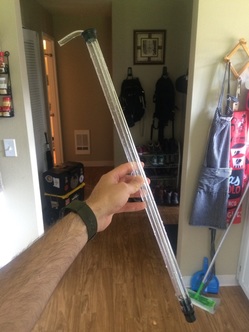
This is an auto-siphon, an open-ended pump that’ll make it super easy to get your mead from your big fermenting jug to smaller bottles. This one even has a special cap on the bottom to keep it from sucking up TOO much of the sediment.
You’ll also need a length of food-safe tubing. I picked up a clamp for mine just to keep things neat.
This is a bottle filler, and it will prevent a LOT of cleanup later, trust me. The valve on the bottom only opens when pressed, so with your siphon and hose connected to this bad boy, your mead will go where you want it- as opposed to the floor.
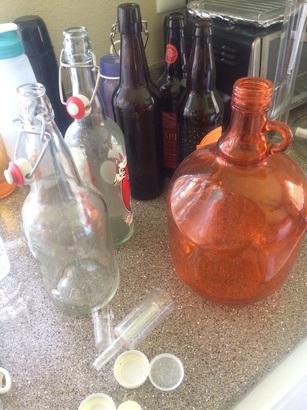
Bottles. Duh.

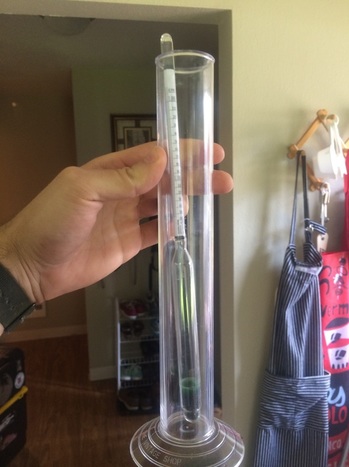
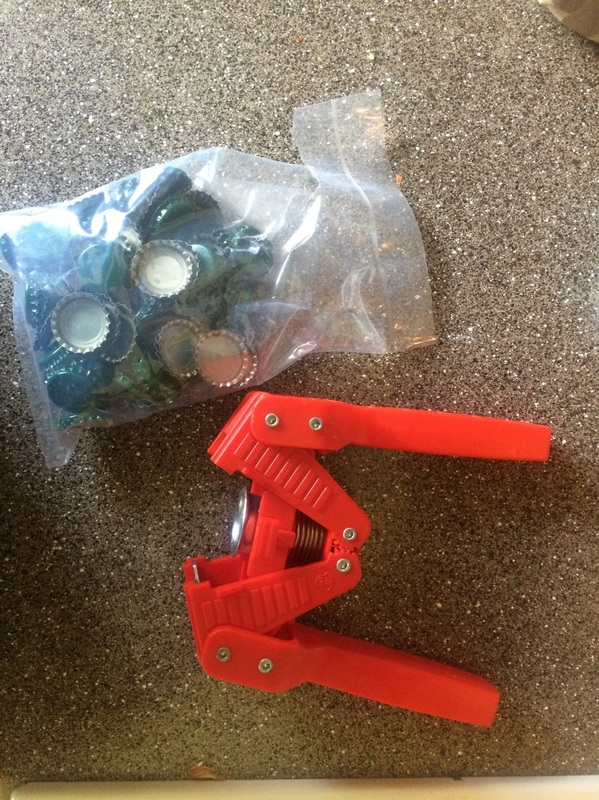
Those are the basics. I also have a hydrometer, testing flask, capper and caps.

These are for if you are a super-nerd like me and really want to figure out the proof (alcohol content) of your mead. The capper and caps are only a must if you want to store it in bottles that don’t have a swing or screw top, and it’s cheaper than a corking machine.

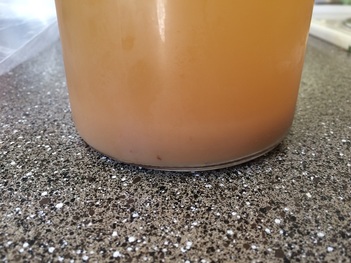
At this point, you will want to chill your mead down as best you can. This will slow down the fermentation and it will gather most of your sediments to the bottom in a process called “clarifying.”

This whole process is called “racking.” In winemaking, this would be when the wine is pumped from steel fermentation containers to barrels so that it can sit and age. In my case, my big 3 gal. fermenter can’t fit in my fridge, so I split it up between several smaller containers so I can clarify it more quickly and fully rack it later.

​CLEAN EVERYTHING!!!

Picture

FIll all your bottles with sanitizing solution, let sit about 4 minutes, then dump them out…
Picture

…drain them well, and let them air/sun dry.
Picture

Everything else goes in the tub for about 5 minutes, immersed COMPLETELY, inside and out.
EVERYTHING that interacts with your mead must be cleaned, sanitized, drained, and air-dried. EVERYTHING.

Once you have your cleaning out of the way, it’s time to set up your siphon and get things going!

Simply take your hose and connect your auto-siphon to one end, and your bottle filler to the other. Drop the business end of your siphon slowly into your mead so that it sits JUST ABOVE the sediment on the bottom. Yes, you will lose some mead to that. Sorry. :C
If you’ve ever filled up a fuel can or cleaned a pool, you know how a siphon works. Put simply, it’s when water goes down a tube in such a way that it pulls more water with it. The pump on your auto-siphon will get your mead “up the hill” enough that it can fall and create the siphoning action. Since the end of your hose has your bottle filler on it, you might need someone to press that down into your first bottle while you pump. That’ll get everything going.

From there… just fill up your bottles!

Cap them in whatever way pleases you. I love swing-top bottles just for this purpose.

Voila! You have bottled your first mead! Now label it, date it, and either drink it or store it!

​Just remember, before you put all your equipment away…

Yeah, you weren’t getting away from that one. Brewing is mostly cleaning.

At least you get booze out of it!

​Stay Classy,

“L’CHAIM!”-The BHB’s Forays into Homebrewing, Part 1

Good evening, friends and neighbors!

Like many good, honest souls across this great land of ours, indeed this whole wonderful world… I like my booze.

Wide and varied is the world of fermented portables, and I am very keen to try as many as I can from as far abroad as I can. Call it my humble task in bringing understanding and goodwill the world over… or I just want to get pickled in the tastiest ways possible. Whichever way is tax-deductible
Picture

Obviously, company is welcome in my quest… provided you cover your own tab time to time.
That said, sometimes my financial situation is not exactly conductive to my altruistic bringing-peace-through-boozing desires. Being a bit of a do-it-yourselfer, though, makes that MUCH less of an obstacle.

With the recent rush toward everything being local, seasonal, homemade, small-batch, etcetera, the long-loved tradition of homebrewing in America has emboldened the “microbrewing” surge, and let humble beer and wine-lovers like myself not only embrace a new set of skills, but make the jump into entrepreneurship- bringing the taste of home and local flavor to the masses.

While most of these ambitious drinkers embrace the complexities of beer or austerity and mystery of wine, I have chosen a more simple, ancient, and no less wonderful beverage to bend my thirsty energies against.

MEAD.

The legendary drink of Vikings, and potentially the oldest fermented drink in history. Thick and sweet or light and refreshing, easy to make, and usually gluten-free.

Mead is little more than a fermentation of honey and water, sometimes with the addition of fruit, juices, spices, herbs, or any other conceivable flavoring. While beer and wine aficionados will argue to the end of time, throwing archaeological proof at each other over whether man fermented grain or grapes first, I make the humble assertion that only honey NATURALLY occurs in a fermentable state. Grapes must be crushed, and grain must be milled and steeped to make mash for beer or whiskey- raw honey only needs water and time. With Paleolithic evidence available for the gathering of honey from wild hives, I maintain that mead has a VERY strong case.

I started brewing my own mead about a year or so ago, after Emily’s family gave me a copy of “The Art of Fermentation” for Chanukah. The book is a veritable encyclopedia for anyone who wishes to understand and control the forces of fermentation, pickling, canning, and pleasurable decomposition. Since then, I have made several brews ranging from the acrid to the pleasurable to the competition-worthy (one of which I have just recently entered into the Oregon Homebrewing Festival.)
Picture

“Scarlet O’Hara”- a mead I made with raw meadowfoam honey, dried hibiscus, and vanilla bean. Tasting is on the 7th- wish me luck!

Obviously, if homebrewing is something you wind up REALLY getting into, there are WAY more sources for you than my little blog, and a lot more details you can play around with. Online, you can get a lot of leads from the American Homebrewers Association. The books on homebrewing are numberless, but recently my go-to guide for how-tos and ideas is Ken Schramm’s “The Compleat Meadmaker.” If you have a homebrew supply store nearby, you can absolutely ask there or even see if they offer classes.

For the purposes of this blog, though, I’m just going to give you a quick how-to on an absolutely basic level spiced mead.

How to Get Hopped Up On Honey

YOU WILL NEED:

  • ​1 lbs. raw honey (available at most health food stores and crunchy supermarkets. If they have a bunch of varietals, pick the one that most appeals!)
  • 4 lbs. water (about 2 quarts. This 4:1 ratio will give you a “standard” strength mead. For a thicker, sweeter, “sack” strength mead, go for a 2:1 ratio.)
  • A combination of your favorite herbs and spices (don’t go overboard here- you want the BEST tasting spices, but not so many that your mead becomes undrinkable. This ESPECIALLY goes for strong ones like whole cloves.)

Equipment:
(All of this should be SANITIZED- you can use whatever means you like- steam, chemical, whatever. Just make sure they are really REALLY clean.)

  • 2 strong glass containers, about 1 gallon each. Fermentation creates carbon dioxide (CO2), and a LOT of it. Exploding containers are no fun, so make sure they are up to the task.
  • Measuring cup
  • Funnel
  • Strainer/sieve
  • Strong-fitting caps for the containers. If you are using an airlock (a device that lets CO2 escape without letting in outside air), you might use a cork with a bored center. Otherwise, a screw-top for your jug will work best. 

At homebrew stores, there’s a lot of other equipment you can get that can give you metrics on your mead- hydrometers, acid testers, flasks, and such. That stuff you might want to forego until you decide that homebrewing is something you are really into. Other stuff will make these steps a little easier, but aren’t strictly necessary for what we are doing here- siphons, filters, and such. 

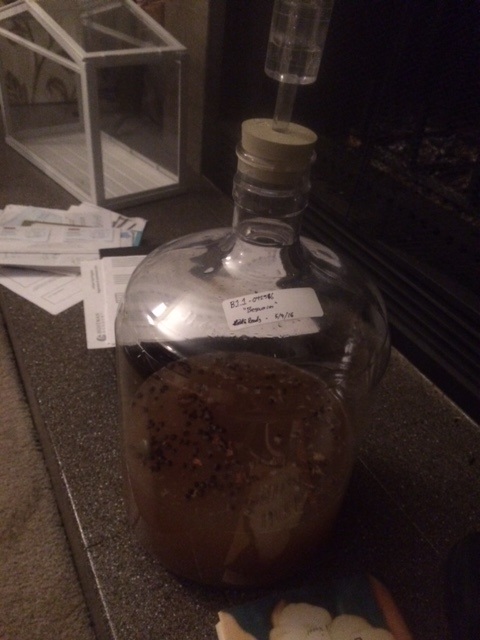
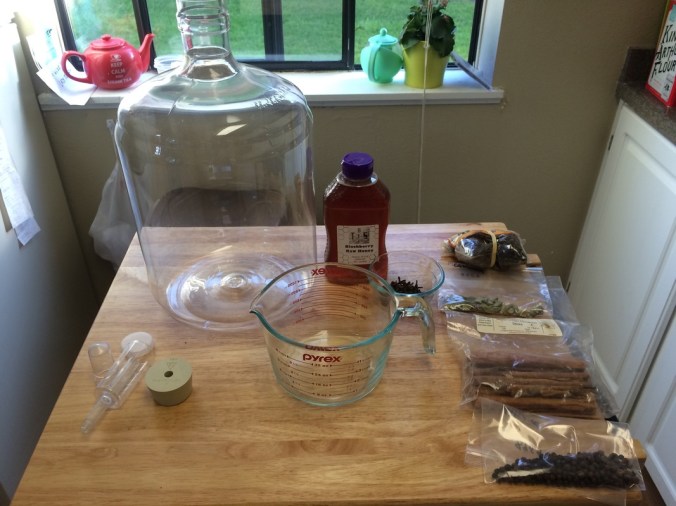
    Here’s my set up for my next mead that I’m calling “Besamim,” after the aromatic spices used to end the Jewish observance of Shabbat.
    In case you’re wondering, that thing down at the lower left corner is my preferred airlock, with a cork for the container. My container is a 3 gallon PET carboy, since I’m making a larger batch here.

    Now, how do you get everything started?
    ​

    1. Pour the honey into your container.
    2. Pour the water in. You want to use cool to room temperature water here.
    3. Use a bit of hot water to swirl in the honey jar to make sure you get everything in there.
    4. Add your spices, cap the container, and shake vigourously to make sure the honey is dissolved.
    5. Wait.

    ​Yup. That’s really it.

    “What happens now?”
    Well, now your job is over for the time being. Inside that container, you’ve just diluted the honey enough that the live cultures trapped inside can get busy fermenting! Fermenting is when microorganisms (usually yeast) eating sugar, and excreting alcohol and CO2- and you just threw them into a Scrooge McDuck-style vault of their favorite food.
    All you have to do, for at least the next 10 days or so, is put your mead (well, technically, “must” at this point. It’s not mead yet) in a cool spot in your house, give it a little shake about twice a day, and let those little guys have fun. If you decided not to use a cork and airlock like I have here, you’ll need to vent it about twice a day to let the CO2 out but just SLIGHTLY untwisting or opening the top and resealing it quickly- remember, you REALLY don’t want outside air in there, with all the nasty stuff it carries.
    That’s all for the time being- stay tuned for Part 2 in a few days, for what to do when your mead is ready!

    Stay Classy,